Fort St. Anthony of Simbor
Fort St. Anthony of Simbor (Portuguese: Forte de Santo António de Simbor, also known as Forte Simbor, Fortim-do-Mar or Forte Pani Cola) is a small ruined fortification situated on a rocky islet at the mouth of the Sahil River, known to the Portuguese as the Vançoso River, in the bay of Simbor on the western coast of India. Located about 25 kilometers east of the historic town of Diu, this fort was constructed in 1722 during the post-Renaissance period as part of the Portuguese colonial efforts to secure their maritime possessions and suppress piracy along the Arabian Sea coast.
The fort's strategic position on the islet allowed it to control access to the river and the surrounding bay, which was a known haunt for pirates preying on Portuguese shipping routes. Despite its modest size, Fort St. Anthony of Simbor played a crucial role in the defense network of the Portuguese Estado da Índia, acting as an outpost subordinate to the larger and more fortified city of Diu.
Historical context and Portuguese presence in the region
The fort was part of a tiny Portuguese exclave known as Simbor, which encompassed the islet and two small plots of land on either side of the Vançoso River. This exclave covered roughly one square kilometer and was governed from Diu, a major Portuguese stronghold on the western coast of India. The Portuguese presence in this region dates back to the early 16th century, when they established a network of forts and trading posts to control maritime trade routes and protect their commercial interests.
By the early 18th century, piracy had become a significant threat to Portuguese shipping and coastal settlements. The construction of Fort St. Anthony of Simbor was a direct response to these challenges, aiming to curb pirate activities and secure the maritime approaches to Diu and the surrounding areas. The fort's location on a small rocky islet made it difficult for pirates to approach undetected and provided a vantage point for Portuguese forces to monitor the sea lanes.
Architectural features and fortifications
The design of Fort St. Anthony of Simbor reflects the functional military architecture of the 18th century Portuguese colonial forts, characterized by modest size and simple defensive features adapted to its coastal setting. The fort was built primarily of local stone and mortar, with thick walls to withstand cannon fire and attacks from small vessels.
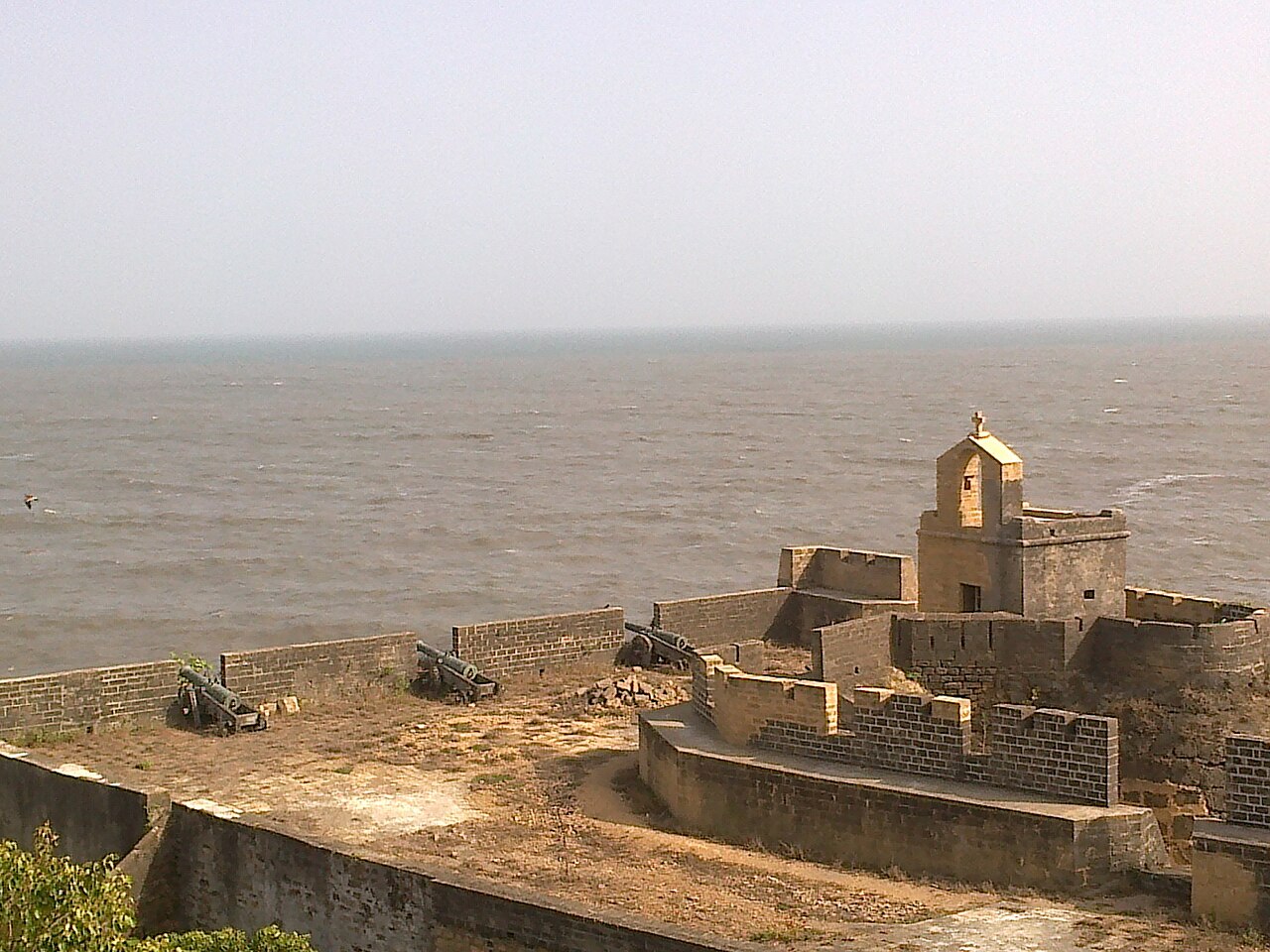
Although now in ruins, the fort originally included a small bastion or battery facing the sea, designed to mount artillery pieces for defense against pirate ships. The walls enclosed a compact courtyard and likely contained barracks or storage rooms for ammunition and provisions. The fort's position on the islet meant it was surrounded by water on all sides, enhancing its defensive capabilities but also limiting its size and facilities.
The fort is often confused with another similarly named structure, Fortim do Mar in Diu, but the two are distinct, with Fort St. Anthony of Simbor uniquely positioned on the islet at the river mouth.
Decline and current condition
With the decline of Portuguese power in India and the eventual integration of Portuguese territories into the Indian Union in December 1961, the fort lost its strategic importance. The tiny exclave of Simbor, including the fort, was absorbed by India during the annexation of Portuguese India, ending centuries of Portuguese colonial rule.
Since then, Fort St. Anthony of Simbor has fallen into a state of ruin. The fort's walls and structures have deteriorated due to exposure to the harsh marine environment and lack of maintenance. Despite its ruined state, the fort remains a site of historical significance, representing the maritime heritage of Portuguese India and their defensive architecture.
Preservation efforts and tourism potential
Recognizing its cultural and historical value, the authorities of Daman and Diu have earmarked Fort St. Anthony of Simbor for restoration. Efforts aim to stabilize the ruins and preserve what remains of the fort's structure to prevent further decay. Restoration plans also consider the fort's potential as a tourist attraction, highlighting its unique location and role in the maritime history of the region.
Visitors to the fort can explore the remains on the islet, appreciating the rugged coastal landscape and imagining the fort's past role in maritime defense. The site is accessible by boat from nearby Diu, providing an opportunity to combine historical exploration with scenic views of the Arabian Sea.
Access and visitor information
While the fort is not currently equipped with extensive visitor facilities due to its remote location and ruined condition, it attracts history enthusiasts and those interested in colonial architecture and maritime history. The best time to visit is during the cooler months, avoiding the monsoon season when sea conditions can be rough.
Significance in Portuguese India’s maritime defense
Fort St. Anthony of Simbor exemplifies the smaller coastal fortifications that were integral to the Portuguese strategy of controlling trade routes and protecting their enclaves in India. Its construction reflects the challenges faced by colonial powers in maintaining security against piracy and regional threats during the 18th century.
Though overshadowed by larger forts like Diu Fort, Simbor's fort remains a testament to the layered defensive network that the Portuguese established along the western coast of India, contributing to their maritime dominance in the Indian Ocean for over four centuries.
Frequently asked questions (FAQ)
- How do I get to Fort St. Anthony of Simbor?
- Fort St. Anthony of Simbor is located in Simbor, India, and can be accessed by road from nearby cities. The nearest major city is Mumbai, which is approximately 150 kilometers away. Local transport options include buses and taxis that can take you directly to the fort.
- What is the historical significance of Fort St. Anthony of Simbor?
- Fort St. Anthony of Simbor was built in the 17th century by the Portuguese as a strategic military outpost. It played a crucial role in maritime defense and trade routes along the western coast of India. The fort's architecture and history reflect the colonial influences in the region.
- When was Fort St. Anthony of Simbor constructed?
- The construction of Fort St. Anthony of Simbor began in 1661 and was completed in the late 17th century. It was built to protect the Portuguese interests in the area during a time of intense competition for trade dominance. The fort has since become a symbol of the region's rich historical legacy.
- Can I visit Fort St. Anthony of Simbor year-round?
- Yes, Fort St. Anthony of Simbor is open to visitors throughout the year. However, it is advisable to check local weather conditions, as the monsoon season from June to September may affect accessibility. Visitors during the dry season typically enjoy better weather and clearer views.
- Why is the architecture of Fort St. Anthony significant?
- The architecture of Fort St. Anthony showcases a blend of Portuguese and Indian styles, characterized by thick walls, bastions, and a strategic layout. This unique design reflects the military needs of the time and the cultural fusion that occurred during colonial rule. It offers visitors a glimpse into the past and the engineering techniques of the era.
- Is it possible to explore the interior of Fort St. Anthony?
- Yes, visitors can explore the interior of Fort St. Anthony, including its ramparts and various structures within the fort. Guided tours are often available to provide insights into the fort's history and architecture. Be sure to wear comfortable shoes, as some areas may require climbing.
- What are the opening hours for Fort St. Anthony of Simbor?
- Fort St. Anthony of Simbor is typically open from 9 AM to 6 PM, allowing ample time for exploration. It is recommended to check for any seasonal changes in hours or special events that may affect access. Arriving early can enhance your experience by avoiding crowds.
- What are the ticket prices for visiting Fort St. Anthony?
- The ticket prices for Fort St. Anthony of Simbor are quite affordable, typically ranging from ₹20 to ₹50 for adults. Children and students may receive discounted rates or free entry on certain days. It's advisable to carry cash, as card facilities may not always be available.
- What nearby attractions should I visit while in Simbor?
- While visiting Fort St. Anthony, you can also explore nearby attractions such as the beautiful beaches of Simbor, local markets, and other historical sites. The scenic coastal area offers opportunities for relaxation, photography, and cultural experiences. Plan a full day to enjoy all that Simbor has to offer.
Photo gallery

Photo by Unknown (uploaded on Wikimapia (open-content project) by xcoisas in 2010)•Public domain
Information
Current owner
Government of India
Loading map...
Visitor reviews
No reviews yet. Been here? Write the first review and help other travelers!
Write the first reviewVisited this castle? Share your experience
Your review helps other travelers and adds first-hand knowledge to our encyclopedia.