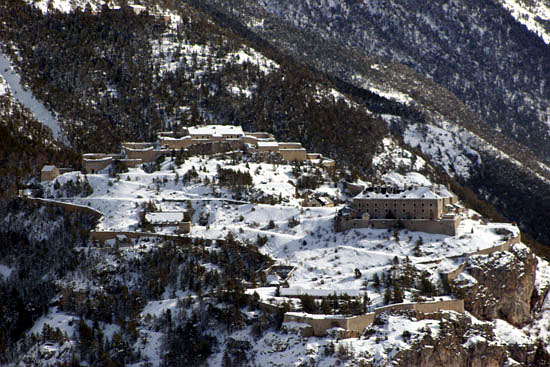
Fort Queyras
Fort Queyras is a remarkable 13th-century fortress located in the commune of Château-Ville-Vieille within the Hautes-Alpes department of France. Perched atop a rocky glacial peak, the fort commands a strategic position overlooking the Guil valley, near the border between France and Italy. Its location, approximately 50 km from Briançon and 80 km from Gap, made it a vital defensive stronghold for the Upper Dauphiné region against incursions from the House of Savoy and Provençal forces. Fort Queyras also played a key role in protecting the Escarton du Queyras, an autonomous alpine territory since 1343, alongside the neighboring Briançonnais region.
Medieval origins and strategic importance
The fortress was first annexed to the Dauphiné in 1265, with historical records from 1301 referring to it as the castrum Cadrassi. Its initial construction capitalized on the natural defensive advantages of the rocky outcrop, forming a classic hill castle that controlled the narrow mountain passage. Throughout the high medieval period, Fort Queyras served as a bulwark against regional conflicts and territorial disputes. Its position allowed it to monitor and regulate movement through the valley, ensuring the security of the Dauphiné frontier.
Role during the wars of religion
In the turbulent 16th century, Fort Queyras was embroiled in the French Wars of Religion. The castle changed hands amid the conflict and was used as a prison, notably detaining accused "witches" awaiting execution by burning. This dark chapter highlights the fortress's role not only as a military installation but also as a center of judicial authority during a period marked by religious strife and social upheaval.
Vauban's transformative fortifications
The castle's defensive capabilities were significantly enhanced following the 1695 siege by Savoyard troops. Although the fortress itself resisted capture, the adjacent village suffered partial destruction. This event prompted the renowned military engineer Sébastien Le Prestre de Vauban to inspect the site and propose extensive fortification upgrades. Vauban's plans, implemented starting in 1695, included a new northeast enclosure featuring an escarpment, ditch, counterscarp, and a distinctive crescent-shaped bastion. Around 1700, the fort was further expanded with a large western enclosure, enhancing its capacity to withstand artillery assaults and sieges.
19th-century modernization
In the mid-19th century, Fort Queyras underwent additional modernization with the installation of casemate batteries. These reinforced artillery positions reflected evolving military technology and the continued strategic importance of the fortress in controlling alpine passes. Despite these upgrades, the fort's military role diminished in the 20th century, culminating in its disarmament during World War II between 1940 and 1944.
Post-military use and preservation
After its decommissioning, Fort Queyras transitioned to civilian use in 1967. Recognized for its historical and architectural significance, it was listed in the inventory of historic monuments in 1948. The fortress remains privately owned and is accessible to visitors, offering a tangible connection to centuries of alpine military history. In 2021, the property was sold at public auction by the Judicial Court of Gap for €661,000, reflecting ongoing interest in preserving this cultural landmark.
Architectural features and layout
Fort Queyras exemplifies a hill castle adapted to alpine terrain, with layered fortifications that blend natural rock formations and man-made defenses. The original medieval structures include thick stone walls and a central keep, while Vauban's additions introduced advanced bastioned elements designed to counter artillery fire. The fort's enclosures, ditches, and bastions create a complex defensive system that illustrates the evolution of military architecture from the high medieval to the early modern period.
Cultural significance and tourism
Today, Fort Queyras stands as a symbol of the region's rich history and resilience. Its preservation allows visitors to explore centuries of military strategy and alpine heritage. The site offers panoramic views of the surrounding mountains and valleys, enhancing its appeal as a cultural and historical destination. Guided tours and educational programs help contextualize the fortress's role in regional defense and its architectural innovations.
Frequently asked questions (FAQ)
- What is the historical significance of Fort Queyras?
- Fort Queyras, built in the 17th century, played a crucial role in the defense of the region against invasions. It is a prime example of military architecture of its time, showcasing the strategic importance of the Queyras Valley. Today, it stands as a testament to the area's rich history and is a popular site for visitors interested in medieval warfare.
- When was Fort Queyras built?
- Construction of Fort Queyras began in 1681 and was completed in 1685 under the direction of the military engineer Vauban. The fort was designed to protect the southern borders of France during a time of conflict, specifically the Franco-Savoyard wars. Its impressive structure has been well-preserved, allowing visitors to explore its historical features.
- Can I visit Fort Queyras year-round?
- Yes, Fort Queyras is open to visitors throughout the year, but the best time to visit is during the summer months when guided tours and events are more frequent. Winter visits can be beautiful, but access may be limited due to snow. It’s advisable to check the official website for specific opening hours and any seasonal events.
- What are the opening hours for Fort Queyras?
- The opening hours for Fort Queyras vary by season. Typically, the fort is open from 10 AM to 6 PM during the summer months, while winter hours may be reduced. Visitors should verify current hours before their visit to ensure they can explore the site fully.
- Is it possible to access Fort Queyras with limited mobility?
- While Fort Queyras is an impressive historical site, some areas may be challenging for visitors with limited mobility due to its steep paths and uneven terrain. However, efforts have been made to improve accessibility, and staff can provide assistance where needed. It is recommended to contact the site in advance to discuss specific accessibility options.
- What are the ticket prices for visiting Fort Queyras?
- The ticket prices for Fort Queyras are quite reasonable, with discounts available for students, seniors, and children. As of the latest updates, adult tickets are priced at around €6, while children under 12 can enter for free. Check the official website for any special promotions or family packages available during your visit.
- What nearby attractions should I consider visiting?
- In addition to Fort Queyras, visitors can explore the stunning natural beauty of the Queyras Regional Natural Park. Other nearby attractions include the charming village of Château-Ville-Vieille and the historic church of Saint-Michel. Outdoor activities such as hiking, skiing, and mountain biking are also popular in the surrounding area.
- When is the best time to visit Fort Queyras?
- The best time to visit Fort Queyras is during the summer months, from June to September, when the weather is warm and many guided tours are offered. This season allows visitors to fully enjoy the beautiful landscapes and engage in outdoor activities. However, autumn can also be a lovely time to visit for those who appreciate fall colors and fewer crowds.
- How do I get to Fort Queyras?
- Fort Queyras is accessible by car, and there is parking available near the site. Public transportation options may be limited, so it is often best to drive or join a tour group. Detailed directions can be found on the official website, which can help ensure a smooth journey to the fort.
Information
Loading map...
Visitor reviews
No reviews yet. Been here? Write the first review and help other travelers!
Write the first reviewVisited this castle? Share your experience
Your review helps other travelers and adds first-hand knowledge to our encyclopedia.