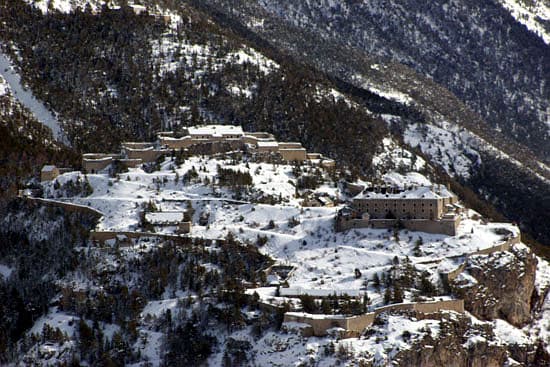
Fort du Randouillet
The Fort du Randouillet is a significant 18th-century bastioned fortress located near the town of Briançon in the historic Dauphiné region of southeastern France. This fortification forms a crucial part of the extensive defensive system designed by the renowned military engineer Sébastien Le Prestre de Vauban, whose influence shaped much of France's military architecture during the post-Renaissance period. The fort was constructed between 1724 and 1734 as part of Vauban's master plan to fortify Briançon, which was surveyed by Vauban in 1692 and subsequently developed into one of the most heavily fortified towns in France over the following decades.
Strategic importance and location
Situated on a commanding position overlooking the town and surrounding valleys, the Fort du Randouillet was specifically built to protect the lower Fort des Têtes from potential attacks coming from higher ground. Its location on elevated terrain allowed it to control key approaches and provide overlapping fields of fire with adjacent fortifications, enhancing the overall defensive network around Briançon. The fort's role was integral to the defense of the region, particularly during periods of conflict such as the War of the Austrian Succession and later military engagements up to 1940.
Architectural features and design
Bastioned fortress layout
The fort exemplifies the bastioned fortress style characteristic of Vauban's designs, incorporating angular bastions that allow defenders to cover all approaches with cannon and musket fire, eliminating blind spots. This polygonal layout was a significant advancement over medieval fortifications, emphasizing geometry and the use of artillery in defense. The fortification includes a prominent citadel or donjon located at the highest point of the site, serving as the last line of defense and command center.
Supporting structures
Below the citadel lies the caserne, a barracks area situated on a lower shelf of the rocky terrain, providing accommodation and operational facilities for the garrison. The fort is connected to the Fort des Têtes by an enclosed, fortified gallery known as "Communication Y", allowing safe passage between the two strongholds even under siege conditions.
Logistics and access
Logistical support was facilitated by a military aerial tramway linking the fort to the town of Briançon, enabling efficient movement of troops, supplies, and artillery. This tramway extended further to connect with the Fort de l'Infernet, illustrating the integrated nature of the defensive system in this mountainous region.
Historical context and military use
Following its construction in the early 18th century, the Fort du Randouillet served as a key military installation for the French Army. Its strategic importance was maintained through various conflicts, including the turbulent periods of the 18th and 19th centuries. The fort remained operational into the 20th century and was actively used in the defense of Briançon during the early stages of World War II. It formed part of the Fortified Sector of the Dauphiné, a component of the larger Maginot Line defensive system designed to protect France's southeastern borders.
Vauban's legacy and UNESCO recognition
The fort is a testament to Vauban's innovative military engineering, showcasing his principles of fortification that combined natural terrain with carefully calculated geometric designs. In recognition of its historical and architectural significance, the Fort du Randouillet, together with the Fort des Têtes and other military works around Briançon, was designated a UNESCO World Heritage Site in 2008. This designation honors Vauban's profound influence on military architecture and the preservation of these fortifications as cultural heritage landmarks.
Current condition and visitor information
Today, the Fort du Randouillet is well preserved and stands as an important cultural and historical monument. Its robust bastioned walls, citadel, and connecting galleries remain largely intact, offering visitors insight into 18th-century military architecture and the strategic defense of border regions. The fort's elevated position also provides panoramic views of Briançon and the surrounding Alpine landscape, making it a notable destination for history enthusiasts and tourists alike.
Frequently asked questions (FAQ)
- How do I visit Fort du Randouillet?
- Fort du Randouillet is accessible to the public with guided tours available during the warmer months. Visitors can reach the fort via hiking trails from Briançon or by using the military aerial tramway that connects the fort to the town. It is recommended to check seasonal opening times before planning your visit.
- What is the historical significance of Fort du Randouillet?
- The fort is a key part of the Vauban fortifications around Briançon, representing 18th-century military engineering designed to protect France's southeastern borders. It played a role in various military conflicts up to World War II and is part of a UNESCO World Heritage Site recognizing Vauban's influence.
- Can I explore the interior of the fort?
- Visitors can explore many parts of the fort, including the citadel, barracks, and fortified galleries. Some areas may be restricted for safety or preservation reasons, but guided tours provide access to the main defensive structures and explain their historical context.
- Is the fort wheelchair accessible?
- Due to its mountainous location and historic construction, Fort du Randouillet has limited wheelchair accessibility. The terrain includes steep paths and stairs, so visitors with mobility challenges should inquire in advance about available accommodations.
- When is the best time to visit Fort du Randouillet?
- The best time to visit is during late spring to early autumn when the weather is favorable for hiking and outdoor exploration. Winter months can be harsh and limit access due to snow and cold temperatures.
Photo gallery

Information
Current owner
French Army
Loading map...
Visitor reviews
No reviews yet. Been here? Write the first review and help other travelers!
Write the first reviewVisited this castle? Share your experience
Your review helps other travelers and adds first-hand knowledge to our encyclopedia.



