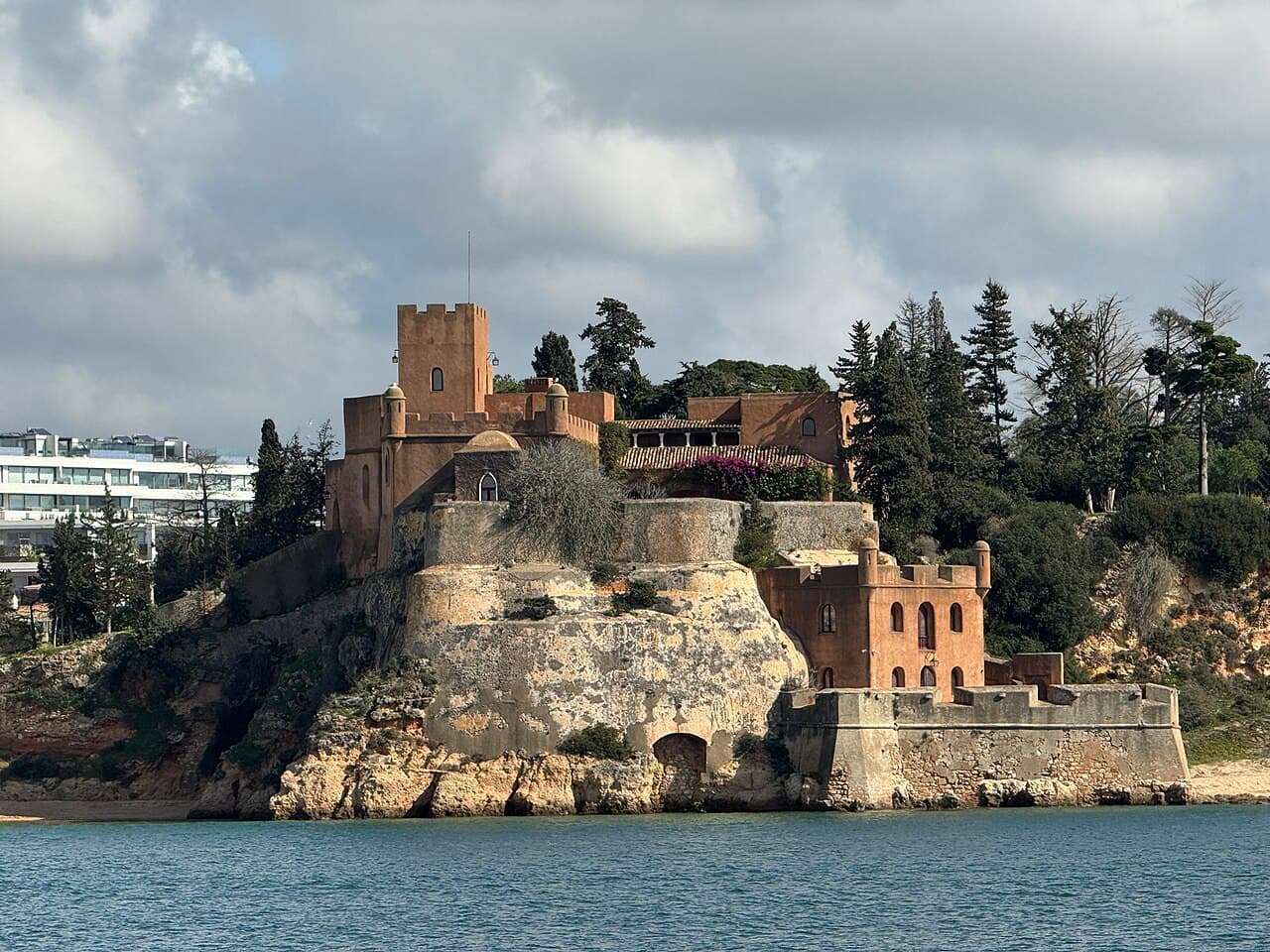
Fort of São João do Arade — Portugal castle

Fort of São João do Arade

Fort of São João do Arade
Ferragudo, Portugal
Renaissance (15th–17th c.)
Well Preserved

The Fort of São João do Arade, also known as the Castle of Arade, is a significant 16th-century Renaissance bastioned fortress located in the civil parish of Ferragudo within the municipality of Lagoa, in the Algarve region of Portugal. This fortification was constructed during a period marked by the evolution of military architecture, reflecting the transition from medieval fortresses to modern bastioned designs that were better suited to withstand artillery assaults.

Historical context and strategic importance

Built in the 16th century, the Fort of São João do Arade was part of a broader defensive network established along the southern coast of Portugal. Its primary role was to protect the entrance of the Arade River and the surrounding coastline from pirate raids and potential invasions during a time when the Algarve was a critical maritime frontier. The fort's location in Ferragudo allowed control over naval traffic and provided a strategic vantage point overseeing the river estuary and the Atlantic Ocean.

Architectural features and design

The fort exemplifies the Renaissance military architectural style, characterized by its bastioned fortress design. This style emerged as a response to the increasing use of gunpowder artillery, necessitating angled bastions and thick walls to deflect cannon fire. The Fort of São João do Arade features robust stone walls and angular bastions that project outward, allowing defenders to cover all approaches with overlapping fields of fire.

Layout and defensive structures

The fortress is roughly polygonal in shape, with bastions positioned at key points to maximize defensive coverage. The walls are constructed from local stone, providing both durability and the ability to absorb artillery impacts. Inside, the fort contains a central courtyard, barracks, and storage facilities that supported the garrison stationed there. The entrance is fortified with a gatehouse designed to withstand assault and control access.

Adaptations and restorations

Over the centuries, the Fort of São João do Arade underwent various modifications to adapt to changing military technologies and strategic needs. While it retains much of its original Renaissance bastioned character, some restoration efforts have been undertaken to preserve its structure and historical integrity. These efforts ensure that the fort remains a tangible link to Portugal's coastal defense history.

Role in regional defense and maritime security

The fort played a crucial role in protecting the Algarve coast during periods of heightened maritime conflict, including threats from pirates and foreign naval powers. Its position allowed for early warning and defense against incursions, contributing to the security of the nearby town of Portimão and the surrounding settlements. The Fort of São João do Arade was part of a network of coastal fortifications that collectively safeguarded Portuguese interests along the southern seaboard.

Present-day significance and visitor experience

Today, the Fort of São João do Arade stands as a well-preserved example of Renaissance bastioned fortifications in Portugal. It attracts visitors interested in military history, architecture, and the cultural heritage of the Algarve. The fort offers panoramic views of the Arade River estuary and the Atlantic, providing insight into its strategic importance. Interpretive signage and guided tours help visitors understand the fort's historical context and architectural features.

Visitors can explore the courtyards, bastions, and ramparts, gaining a sense of the defensive capabilities and daily life of the soldiers who once manned the fortress. The site is accessible and provides an educational experience that highlights the evolution of coastal defense mechanisms in Portugal during the Renaissance.

Frequently asked questions (FAQ)

What is the best time to visit the Fort of São João do Arade?
The best time to visit is during the spring and autumn months when the weather is mild and the site is less crowded. Summer offers warmer temperatures but can be busy with tourists.
Is the fort accessible to visitors year-round?
Yes, the Fort of São João do Arade is generally open to visitors throughout the year, though opening hours may vary seasonally. It is advisable to check local information before planning your visit.
Can I explore the entire fort on foot?
Visitors can walk around the main areas of the fort, including the bastions, courtyards, and ramparts. Some restricted areas may be off-limits for safety reasons.
Are guided tours available at the fort?
Guided tours are sometimes offered, providing detailed historical and architectural insights. It is recommended to inquire locally about availability during your visit.
Is there an entrance fee to visit the Fort of São João do Arade?
Entrance fees vary depending on the season and any special events. Some visits may be free, while others require a small ticket purchase. Checking with local tourism offices is advised.

Photo gallery

Fort of São João do Arade
Click to view

Photo by Andrew Milligan sumo•CC BY 4.0

1 photo • Click any image to view in full screen

Information

Bastioned Fortress

Loading map...

Visitor reviews

No reviews yet. Been here? Write the first review and help other travelers!

Write the first review

Visited this castle? Share your experience

Your review helps other travelers and adds first-hand knowledge to our encyclopedia.

Write a review

(5/5)

0/2000 characters

Your review will be visible after admin approval

Nearby castles

6.4 km

Castle of Alvor

Portimão, Portugal

The Castle of Alvor stands as a significant historical monument located in the municipality of Portimão, Portugal. This hill castle occupies a strategic position on a low elevation near the Atlantic coast, with origins tracing back to one of the earliest fortified settlements in the region. Its history spans over two millennia, reflecting a succession of Mediterranean civilizations and military powers that shaped its development and architectural character. The site was initially fortified by the ancient Lusitanians during the 7th century B.C.E., marking it as a place of longstanding human occupation and defense. The location’s strategic importance attracted the attention of the Phoenicians and Greeks, who established trading and maritime activities here. The Carthaginians later took control, with the renowned commander Hannibal capturing the settlement in 436 B.C.E. and renaming it Portus Annibalis. The site was also known as Barcínia and Ipses in different periods, reflecting its evolving cultural influences. During the Roman era, the settlement retained its significance as a center of commerce and regional governance. The continuity of occupation through antiquity underscores the site’s enduring strategic and economic value. The moorish period and fortification In 716, the site fell under the control of Moorish forces, who transformed it into a fortified location by the 9th century. This fortress, known as a hisn in Arabic, was part of a coastal defense network that included nearby strongholds such as Estômbar, Portimão, and Albufeira. The castle’s layout and construction during this period reflect typical Islamic military architecture, emphasizing robust defensive walls and strategic vantage points overlooking the coastline. The alcáçova, or fortified citadel, remains the most prominent surviving feature of the castle. It occupies roughly 960 square meters on a low hill approximately five meters high. The walls are primarily built from large limestone blocks combined with red sandstone fragments sourced from nearby Silves, along with smaller stones, ceramic pieces, and lime mortar. This combination of materials illustrates the adaptive reuse of local resources and the layering of construction techniques over centuries. Architectural features of the alcáçova The walls of the alcáçova are thick, measuring about 1.7 meters in thickness, with the southwest section rising to approximately six meters in height. A narrow staircase at the southern corner, roughly half a meter wide, indicates the former presence of a chemin de ronde, a walkway used by defenders to patrol the walls. The main gate on the northern wall features a bent or elbow design, a defensive architectural element intended to slow attackers. This gate is about 2.5 meters wide and retains hinge sockets positioned around 2.6 meters above ground, suggesting it once held heavy wooden doors. The entrance was likely protected by an albarrã tower, a projecting defensive tower extending beyond the main wall line, enhancing the castle’s protection against siege tactics. Foundations of an eastern tower and a substantial wall, possibly a barbican, provide further evidence of the castle’s layered fortifications designed to defend the main gate and interior spaces. Medieval reconquest and later modifications The castle’s control shifted during the turbulent period of the Christian Reconquista. In 1189, King Sancho I of Portugal, aided by German and Danish crusaders, captured Alvor. This conquest inflicted significant damage on the population and structures. However, the Almohads recaptured the site in 1191, maintaining Islamic control until 1240, when King Afonso III definitively reclaimed it for the Christian kingdom. Following its reconquest, the castle underwent reconstruction commissioned by King Denis around 1300. This rebuilding effort underscored the castle’s revived strategic importance in controlling the southwestern Algarve coast. In the 16th century, King Sebastian ordered additional fortifications around the town in 1573, although these defensive walls were not fully completed. Records from 1606 indicate the castle still housed heavy artillery, reflecting its ongoing military role. Impact of the 1755 earthquake and modern preservation The 1755 Lisbon earthquake devastated much of the region, including the Castle of Alvor, reducing it largely to ruins. The earthquake’s impact marked the end of the castle’s military significance and led to the gradual abandonment of its defensive functions. Over time, residential buildings occupied the interior spaces of the alcáçova until the ruins were recognized for their historical value. In 1984, the site was declared a Property of Public Interest, highlighting its cultural and heritage significance. Archaeological excavations conducted between 1986 and 1988 uncovered layers of the castle’s complex past, including pre-Islamic fortifications and Moorish additions. These studies also revealed secondary defensive structures closer to the coastline, emphasizing the site’s long-term military importance. Current remains and urban context The surviving remains focus on the alcáçova, which retains its roughly rectangular layout typical of Islamic fortresses in the region. The site is integrated within the modern urban fabric of Alvor, near Rua Poeta António Aleixo and Largo do Castelo, close to the municipal market. This location continues to mark the historical heart of the town. The castle’s walls, constructed from a combination of limestone and red sandstone, stand as a testament to the adaptive building practices over centuries. The presence of a chemin de ronde, the bent main gate, and the foundations of defensive towers illustrate the castle’s layered defensive design. The eastern tower’s remains offer commanding views of the Atlantic coast, underscoring the castle’s strategic maritime role. Today, the Castle of Alvor remains a valuable archaeological and cultural site. Its ruins provide insight into the diverse historical phases it experienced, from ancient Lusitanian fortifications through Roman, Moorish, and medieval Christian periods. Visitors can explore the remnants of its military architecture and appreciate the site’s significance in Portugal’s coastal defense history.

High Medieval (11th–13th c.)
Details
10.9 km

Silves Castle

Silves, Portugal

Silves Castle, known locally as Castelo de Silves, is a prominent late-medieval fortress situated in the historic town of Silves in the Algarve region of southern Portugal. This castle stands as a significant monument reflecting the region's complex history, marked by Roman, Visigothic, Moorish, and Portuguese influences. Built primarily from large, striking red sandstone blocks and taipa—a hardened mixture of mud and sandstone typical of Moorish construction—the castle's imposing walls and towers dominate the town's skyline. The origins of Silves Castle trace back to earlier fortifications from the late Roman or Visigothic periods around the 4th or 5th centuries. However, the castle as it stands today was largely constructed during the Moorish occupation that began circa 715 AD. Known then as Xelb, Silves served as the regional capital under Moorish rule. The castle formed part of the extensive city walls that protected the town, which was strategically located near the now silted-up Arade River. Historical significance and military conflicts The castle's history is marked by numerous sieges and changes of control between Christian and Moorish forces. In 1060, Ferdinand I, King of León and Castile, captured Silves, but the Moors soon regained it. A notable event occurred in 1189 during the Third Crusade when Portuguese Christian forces, supported by thousands of English, German, and Flemish Crusaders en route to the Holy Land, besieged the castle. After a six-week siege, the Moors surrendered under an agreement that allowed them to leave unharmed. However, the Crusaders violated this pact, slaughtering the departing Moors and pillaging the town. Subsequent attempts to retake Silves included an unsuccessful siege by Yacub Ben Yussuf in 1190 and a more successful campaign in 1191. During the 1190 siege, Richard the Lionheart notably assisted the Christian defenders. The town changed hands again in 1198 when King Sancho I of Portugal, aided by German Crusaders, recaptured Silves but dismantled the castle to prevent its reuse by enemies. Finally, in 1242, the castle was conquered by Don Paio Peres Correia, Master of the Order of Santiago, during the reign of King Alfonso III. Alfonso III ordered the castle's reconstruction, underscoring its strategic importance. A statue of this king now stands just outside the castle gate, commemorating his role in Silves' history. After this period, the town's prominence gradually declined. Architectural features and layout Silves Castle is one of the largest castles in the Algarve region, enclosing an area approximately 125 by 100 meters. Its defensive walls are up to four meters thick and are reinforced by eleven square towers. Two of these towers function as barbicans, connected to the ramparts by supporting arches that sustain the walkway along the walls. The castle has two main entrances: the primary gate, flanked by two towers, and a smaller postern gate known as the 'traitors' gate'. This latter gate is located near a projecting tower on the northern wall, which served as the castle's keep. This keep tower was bricked up during one of the restoration phases. Four of the towers were modified during the 14th and 15th centuries, featuring Gothic doorways, vaulted halls, and stones marked by medieval masons, reflecting the architectural styles of that period. Inside the castle walls, no original buildings remain intact, but partially excavated foundations reveal the layout of former structures. Two cisterns survive: a smaller one approximately 60 meters deep of Roman origin, and a larger cistern known as El Moura Encantada ('the enchanted Moorish woman'). This larger cistern, supported by four vaults and tall columns, is linked to a local legend about a Moorish princess mourning her lost love. Today, this cistern is used for small exhibitions. Damage, restoration, and current condition The castle has endured significant damage over the centuries, notably from two major earthquakes in 1722 and 1755, which compromised parts of its structure. Restoration efforts began in the 20th century, with significant work carried out in 1940 to preserve and stabilize the castle's remaining walls and towers. Today, Silves Castle is considered well preserved and is a key heritage site managed as a public monument. Cultural and touristic importance Silves Castle is a major tourist attraction in the Algarve, offering visitors panoramic views over the town of Silves and the surrounding countryside. Its rich history, combined with its imposing medieval architecture and evocative legends, makes it a compelling destination for those interested in Portugal's medieval past and Moorish heritage. The castle's location on a hill provides an excellent vantage point, enhancing its defensive qualities and its appeal to visitors. Visitors can explore the castle grounds, walk along the ramparts, and view exhibitions within the larger cistern. The site provides insight into the military, architectural, and cultural history of the Algarve region, illustrating the layered history from Roman times through the Middle Ages to the present day.

Late Medieval (14th–15th c.)
Details
13.1 km

Fort da Ponta da Bandeira

Lagos, Portugal

Fort da Ponta da Bandeira, also known locally as Forte da Ponta da Bandeira, is a prominent 17th-century Renaissance coastal fortress located in the historic city of Lagos in the Algarve region of Portugal. This fortification was constructed as a direct response to the increasing threat of Moorish and European pirate attacks along the Algarvian coast during the late 1600s. The town of Lagos, an important maritime hub, was particularly vulnerable because its medieval walls were set back from the shoreline, leaving the harbor and beach exposed to enemy incursions. Historical context and construction The fort was commissioned under the governance of the Count of Sarzedos, the Governor of the Algarve, to provide immediate coastal defense. Construction began between 1679 and 1683 and was completed in 1690. This period falls within the broader Renaissance era of military architecture in Portugal, characterized by the adaptation of fortifications to withstand artillery attacks and to control strategic maritime access points. Architectural features and design Fort da Ponta da Bandeira is designed as a square fortification featuring circular guard towers at each of its four corners. This layout provided overlapping fields of fire and enhanced defensive capabilities against attackers approaching from sea or land. The fort is surrounded by a small moat that separates it from the adjacent harbor area, with a reconstructed drawbridge serving as the main entrance, emphasizing its defensive purpose. Inside, the fort encloses a courtyard that provides access to various internal structures, including an 18th-century chapel adorned with traditional azulejos—the distinctive Portuguese ceramic tiles known for their blue and white patterns. This chapel reflects the integration of religious spaces within military complexes, serving the spiritual needs of the garrison stationed at the fort. A ramp leads up from the courtyard to the cannon platform on the roof, which served as the primary artillery position. From this elevated platform, defenders could operate cannons to protect the harbor entrance and surrounding coastline. The guard towers are also accessible from the platform, allowing sentries to maintain vigilance over the sea and land approaches. Strategic importance and military role The fort played a crucial role in securing the harbor of Lagos against pirate raids and potential naval invasions during the late 17th and early 18th centuries. Its location on the beach next to the harbor allowed it to control maritime traffic and provide a first line of defense before any hostile forces could reach the town's inner medieval walls. This strategic positioning made it an essential component of the coastal defense system in the Algarve. Current condition and visitor experience Today, Fort da Ponta da Bandeira is well preserved and remains an important cultural and historical landmark in Lagos. Visitors can freely access the courtyard and cannon platform during daytime hours, offering panoramic views of the harbor and the Atlantic Ocean. The fort also houses a small museum that provides insights into its history and the broader maritime heritage of the region. The fort's elegant military architecture, combined with its scenic location, makes it a popular destination for tourists exploring Lagos. Directly opposite the fort stands the historic city gate, creating a picturesque setting that highlights the town's rich defensive heritage. Architectural significance and cultural heritage Fort da Ponta da Bandeira exemplifies Renaissance military architecture adapted to coastal defense needs. Its compact, geometric design with corner towers and moat reflects the evolution of fortifications in response to advances in artillery technology. The use of azulejos in the chapel adds an artistic dimension that connects the fort to Portugal's broader cultural traditions. As a preserved example of a coastal fortress from the late 17th century, the fort contributes to understanding Portugal's maritime defense strategies during a period of intense naval competition and piracy. It remains a tangible link to the historical challenges faced by coastal communities in the Algarve and their responses through architectural innovation.

Renaissance (15th–17th c.)
Details

