The Fort of Santa Catalina (Fuerte de Santa Catalina) in Lima, Peru, is a significant example of military colonial architecture from the 19th century. This bastioned fortress was constructed during the modern period, specifically in the early 1800s, reflecting the Neoclassical architectural style prevalent in military buildings of that era. Although only parts of the fort survive today, it remains in good condition and retains important original features that illustrate its historical and strategic importance.
Historical background and construction
The fort was built on land historically known as "Huerta de los Llanos" and "Huerta Perdida" or "Huerta del Cuero," which were properties belonging to the Monasteries of Santa Catalina de Siena and de la Concepción. Its construction was initiated during the government of Viceroy Gabriel de Avilés in the early 19th century. The project was overseen by Colonel Joaquín de la Pezuela, who later became viceroy himself. The fort was intended as an artillery barracks, part of Lima's defensive system to protect the city from external threats during a period of political instability and colonial tensions.
Architectural features and layout
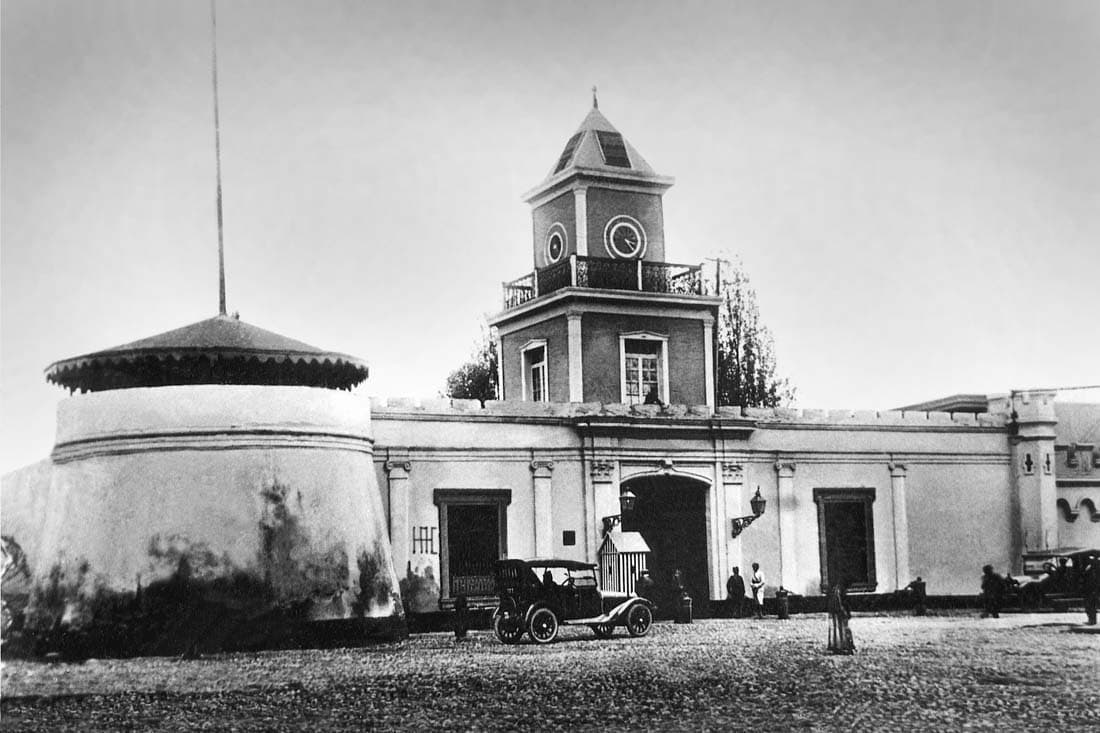
The fort exemplifies the bastioned fortress typology, characterized by angular bastions designed to provide overlapping fields of fire and improved defense against artillery attacks. The surviving structures include the original outer walls, which are robust and thick, constructed to withstand cannon fire. Within the fort's perimeter is the Chapel of Saint Barbara (Capilla de Santa Bárbara), a religious building dedicated to the patron saint of artillerymen, reflecting the fort's military function and the spiritual needs of its garrison.
The overall design follows Neoclassical principles, with an emphasis on symmetry, geometric clarity, and restrained decorative elements, which was typical for military architecture of the period. The fort's layout was functional, facilitating the housing of troops, storage of munitions, and defense operations.
Current status and cultural significance
Today, the Fort of Santa Catalina is partially preserved and serves as the site for the Escuela Taller de Lima, a vocational training school that helps preserve the historical fabric of the fort while promoting traditional craftsmanship. The fort occupies a total area of approximately 25,250 square meters and is officially registered as a property of the Peruvian State in the Margesí of National Heritages, ensuring its protection and conservation.
The fort is one of the few remaining examples of military colonial architecture in Peru, offering valuable insights into the defensive strategies and architectural styles of the early 19th century. Its preservation allows visitors and scholars to study the evolution of fortifications in South America and the role of Lima as a strategic colonial city.
Historical context and military role
The construction of the Fort of Santa Catalina occurred during a turbulent period marked by the decline of Spanish colonial power and the rise of independence movements across South America. As an artillery barracks, the fort played a crucial role in Lima's defense network, protecting the city from potential naval and land attacks. The presence of the fort highlights the military priorities of the Spanish viceroyalty in maintaining control over its territories.
Colonel Joaquín de la Pezuela's involvement underscores the fort's importance, as he was a key military figure who later became viceroy. His leadership in the fort's construction reflects the strategic emphasis placed on strengthening Lima's fortifications during the early 19th century.
Architectural conservation and educational use
The fort's adaptation as the Escuela Taller de Lima demonstrates a successful integration of heritage conservation with educational purposes. This vocational school specializes in training artisans in traditional construction techniques, contributing to the preservation of the fort's fabric and the transmission of cultural heritage skills.
Preserving the fort's Neoclassical bastioned walls and the Chapel of Saint Barbara allows the site to serve both as a historical monument and a living institution fostering craftsmanship and cultural continuity.
Frequently asked questions (FAQ)
- What is the historical significance of Fort of Santa Catalina?
- Fort of Santa Catalina, built in the 17th century, played a crucial role in the defense of the city of Callao against pirates and foreign invasions. It is a testament to colonial military architecture and reflects the strategic importance of the region during the Spanish colonial period.
- When was Fort of Santa Catalina constructed?
- Construction of Fort of Santa Catalina began in 1684 and continued until 1747, making it a prominent example of colonial fortifications in Peru. The fort was designed to protect the port of Callao, which was vital for trade and military purposes.
- Can I visit Fort of Santa Catalina?
- Yes, visitors are welcome to explore Fort of Santa Catalina. The fort offers guided tours that provide insight into its history and architectural features, making it a great destination for history enthusiasts.
- What are the opening hours for Fort of Santa Catalina?
- Fort of Santa Catalina is typically open to visitors from 9:00 AM to 5:00 PM, Tuesday through Sunday. It's advisable to check their official website or contact them directly for any changes in hours or special events.
- Is it possible to access Fort of Santa Catalina by public transportation?
- Yes, Fort of Santa Catalina is accessible by public transportation. Visitors can take local buses or taxis to reach the fort, which is conveniently located near the port area of Callao.
- What is the best time to visit Fort of Santa Catalina?
- The best time to visit Fort of Santa Catalina is during the dry season, which runs from May to September. During these months, the weather is typically sunny and pleasant, making it ideal for exploring the fort and its surroundings.
- Are there any nearby attractions to Fort of Santa Catalina?
- Yes, several attractions are located near Fort of Santa Catalina, including the historic district of Callao and the beautiful beaches along the coastline. Visitors can also explore the nearby maritime museum and enjoy local seafood restaurants.
- What are the ticket prices for visiting Fort of Santa Catalina?
- Ticket prices for Fort of Santa Catalina are generally affordable, with discounts available for students and seniors. It's best to check the official website for the most current pricing and any special rates for group visits.
Photo gallery

Photo by Eugenio Courret•Public domain
Information
Loading map...
Visitor reviews
No reviews yet. Been here? Write the first review and help other travelers!
Write the first reviewVisited this castle? Share your experience
Your review helps other travelers and adds first-hand knowledge to our encyclopedia.