Fort of Bertheaume
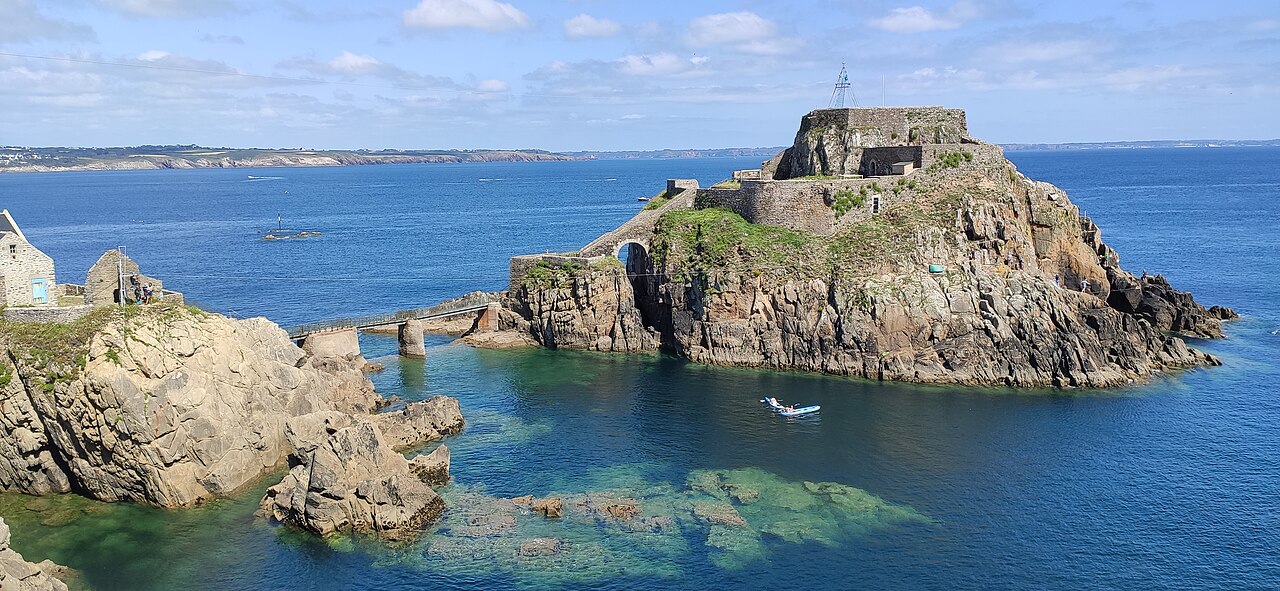
Fort of Bertheaume is a remarkable historic fortress situated on a tidal island near Plougonvelin in the Finistère department of Brittany, France. This strategic location commands the Goulet de Brest, a vital maritime passage leading to the important naval port of Brest. The fort's position atop steep cliffs overlooking the sea has made it a naturally defensible site for centuries, playing a crucial role in the coastal defense of the region.
The site of Fort of Bertheaume has a long history of human activity, dating back to the Mesolithic period, as evidenced by a distinctive flint workshop found nearby. Bronze Age chamber tombs on the adjacent mainland further attest to the area's prehistoric significance. Although Roman artifacts such as pottery shards and tile fragments from the 2nd and 3rd centuries CE have been uncovered, they suggest limited Roman presence, likely related to maritime activity rather than permanent settlement.
During the early medieval era, the region saw the influence of Irish and Welsh monks, with Saint Sané associated with the nearby parish of Plouzané, reflecting early Christian evangelization. The fort's name remains somewhat mysterious, with the Breton name "Kastel Persel" and a possible derivation from Saint Bertram, a figure linked to the founding of Staddford.
Medieval origins and early history
A castle was established on the site by the early 14th century, predating the Breton Succession War (1344-1364). Initially owned by the Viscount of Léon, it later passed to the Duke of Brittany. The strategic importance of the fort was underscored during the English occupation between 1366 and 1397, when it served as a military stronghold. It was during this period that the name "Bertheaume" came into use, likely derived from a saintly figure such as Saint Bertem or Bertellin.
In 1558, the original castle was destroyed during an Anglo-Dutch raid that devastated the surrounding settlements and the nearby Abbey of Saint-Mathieu. This event marked a significant turning point, leading to the fort's reconstruction and modernization in subsequent centuries.
Fortification and military evolution from the 17th century
In 1689, the celebrated military engineer Vauban constructed a battery on the island as part of the coastal defenses protecting Brest from English naval attacks. This battery was instrumental in repelling the 1694 Anglo-Dutch assault on Camaret-sur-Mer, demonstrating the fort's strategic value.
From 1700, under the supervision of artillery officer Benoît de Musinot, the fort underwent significant expansion. This phase introduced a complex fortification system including a bastion, a semi-circular battery, a powder magazine located approximately 13 meters underground, barracks, and storage facilities. The 18th century saw the addition of a lower battery on the fort's east side, enhancing its defensive capabilities.
The fort's defenses extended over two islands, with a smaller island near the mainland added in the 19th century. By 1793, the fort had fallen into disrepair but remained a key element in the coastal defense network.
19th and 20th century military use and modern history
Following the Napoleonic Wars, the fort was disarmed. In 1835, a footbridge was constructed, replacing earlier access by boat or rope bridge and connecting the tidal island to the mainland permanently.
Between 1880 and 1890, the fort's older structures were replaced with modern casemates on the mainland, housing heavy artillery designed to cover the Goulet de Brest. These included two 320mm guns, two 240mm guns, two 160mm guns, and smaller batteries equipped with 95mm quick-firing guns and 240mm mortars, reflecting advances in military technology and artillery range.
During World War I, the fort played a surveillance role, firing a warning shot at a freighter in August 1914 and serving as a site for captive observation balloons monitoring German U-boat activity. However, its guns were soon redeployed to the front lines.
In World War II, the fort was occupied and reinforced by German forces from 1940. Concrete blockhouses were constructed, and the fort was equipped with anti-aircraft guns, 75mm cannons, mortars, and machine guns. It resisted Allied advances until surrendering on 8 September 1944.
Archaeological significance and preservation efforts
After the war, the fort was abandoned by the French Ministry of Defence for approximately 45 years. In 1992, the commune of Plougonvelin acquired the site, initiating archaeological excavations and rehabilitation projects to preserve its rich historical legacy.
Excavations have uncovered significant prehistoric artifacts, including Mesolithic flints distinctive enough to define a regional Mesolithic period named after the site. Bronze Age chamber tombs and limited Roman artifacts have also been found, highlighting the site's long-term human use.
Rehabilitation efforts have included clearing vegetation, rebuilding the footbridge multiple times due to storm damage, and adapting the lower battery for cultural uses such as an exhibition space, open-air theatre, and restaurant. The landward section hosts an open-air theatre surrounded by menhir alignments installed in the 1990s, blending historical preservation with contemporary cultural activities.
Architectural features and layout
The fort's layout is notable for its multi-level batteries arranged on four terraces connected by stairs. Posterns provide access to the base of the walls, facilitating movement and defense. The main construction phase under Benoît de Musinot introduced a bastion and a semi-circular battery, with a powder magazine deeply embedded underground for protection.
The smaller 19th-century island adjacent to the main tidal island contains additional batteries, reflecting the evolving military needs of the 19th century. The modern casemates on the mainland represent a significant shift in coastal defense architecture, designed to house heavy artillery and withstand modern warfare.
During the German occupation, the addition of concrete blockhouses and anti-aircraft emplacements further modified the fort's defensive profile, integrating 20th-century military technology into the historic site.
Cultural and strategic importance
Throughout its history, Fort of Bertheaume has served as a critical defensive point guarding the approaches to Brest, one of France's most important naval ports. Its commanding position over the Goulet de Brest has made it a focal point in regional military strategy from the medieval period through modern times.
The fort also functioned historically as an anchorage for vessels awaiting favorable winds to enter Brest harbor, linking its military role with maritime navigation. It functioned as the northern counterpart to the defenses at Camaret-sur-Mer, together forming a defensive network protecting the Breton coast.
Today, the fort stands as a testament to centuries of military architecture and coastal defense evolution, attracting visitors interested in history, archaeology, and military heritage. Its preservation and adaptive reuse for cultural events ensure that this historic fortress continues to play a vibrant role in the local community.
Frequently asked questions (FAQ)
- How do I access Fort of Bertheaume?
- Fort of Bertheaume is accessible via a footbridge built in 1835 that connects the tidal island to the mainland, allowing visitors to reach it on foot.
- What is the historical significance of Fort of Bertheaume?
- Fort of Bertheaume has served as a key defensive site guarding the Goulet de Brest straits since the medieval period, playing important roles in various conflicts including the Breton Succession War, Anglo-Dutch raids, and both World Wars.
- When was the fort originally built?
- The original castle on the site dates back to the early 14th century, with significant fortifications added in the 17th and 18th centuries under engineers like Vauban and Benoît de Musinot.
- Can I visit the archaeological sites at Fort of Bertheaume?
- Yes, archaeological excavations have uncovered Mesolithic flint workshops and Bronze Age tombs near the fort, and some findings are displayed as part of the site's cultural heritage programs.
- What architectural features are notable at Fort of Bertheaume?
- The fort features multi-level batteries, a bastion, a semi-circular battery, a deep powder magazine, barracks, and 19th-century casemates, along with WWII-era concrete blockhouses added by German forces.
- Is Fort of Bertheaume open year-round?
- Visiting hours may vary seasonally; it is best to check with the local tourist office in Plougonvelin for current opening times and any special events held at the fort.
Information
Website
Visit websiteSources & official resources
Verify the information above using these authoritative references.
Loading map...
Visitor reviews
No reviews yet. Been here? Write the first review and help other travelers!
Write the first reviewVisited this castle? Share your experience
Your review helps other travelers and adds first-hand knowledge to our encyclopedia.