Château de Keroual

Château de Keroual: Renaissance manor castle in Guilers, France
Guilers, France
Renaissance (15th–17th c.)

Château de Keroual is a notable example of a Renaissance manor castle located in Guilers, France. Constructed in the 16th century, this castle reflects the architectural transition from medieval fortifications to more residential and elegant noble estates typical of the Renaissance period. It originally served as a manor house for local nobility, combining defensive elements with more comfortable living quarters.

Architectural features and style

The castle was built in the Renaissance style, characterized by symmetrical layouts, classical proportions, and decorative elements inspired by ancient Roman and Greek architecture. While the castle retains some defensive features, such as thick stone walls and possibly a moat or courtyard enclosure, its primary function was residential rather than military. The manor likely included large windows to allow natural light, ornate fireplaces, and decorative stonework around doors and windows, typical of Renaissance aesthetics.

Layout and construction

The château's plan probably consisted of a central residential block with attached wings forming a courtyard. The use of local stone and traditional masonry techniques would have been prevalent. The interiors, now largely lost or damaged, would have featured wood paneling, plaster ceilings, and carved stone details reflecting the tastes of the period.

Historical context and significance

Built during the Renaissance period, Château de Keroual exemplifies the shift in French noble residences from purely defensive castles to more comfortable and stylistically refined manors. This transition coincided with the relative internal peace in France, allowing aristocrats to focus on comfort and display of status.

The castle's location in Brittany placed it within a region rich in medieval and Renaissance heritage, where many noble families built similar manors. It served as a local seat of power and a symbol of noble prestige in the area.

Damage and current condition

During the German occupation of France in World War II, Château de Keroual was partially destroyed by fire in 1944. This event severely damaged the structure, leaving it in a partially ruined state. Since then, the castle has not been fully restored, and much of its original interior and architectural details have been lost.

Despite its ruined condition, the castle remains an important cultural and historical landmark in Guilers. The surviving walls and architectural fragments offer valuable insight into Renaissance manor construction and noble life in 16th-century Brittany.

Preservation and cultural importance

Efforts to preserve the remains of Château de Keroual focus on stabilizing the ruins and preventing further decay. The site attracts visitors interested in French Renaissance architecture and the history of Brittany's noble estates. It also serves as a poignant reminder of the destruction wrought by war on cultural heritage.

Visitor information

While the castle is not fully restored and access may be limited, visitors can appreciate the exterior ruins and the historical context of the site. The castle's location in Guilers makes it accessible for those exploring the rich heritage of Brittany.

Frequently asked questions (FAQ)

When was Château de Keroual built?
Château de Keroual was constructed in the 16th century during the Renaissance period, reflecting the architectural styles of that era.
What architectural style characterizes Château de Keroual?
The castle is built in the Renaissance style, featuring symmetrical layouts, classical proportions, and decorative stonework typical of the period.
What caused the damage to Château de Keroual?
The castle was partially destroyed by fire during the German occupation in 1944, leaving it in a partially ruined state.
Can visitors access Château de Keroual?
The castle is partially ruined and not fully restored, so access may be limited. Visitors can view the exterior ruins and learn about its historical significance.
Where is Château de Keroual located?
Château de Keroual is located in Guilers, a town in the Brittany region of France.

Information

Lowland Castle

Loading map...

Visitor reviews

No reviews yet. Been here? Write the first review and help other travelers!

Write the first review

Visited this castle? Share your experience

Your review helps other travelers and adds first-hand knowledge to our encyclopedia.
Write a review

(5/5)

0/2000 characters

Your review will be visible after admin approval

Nearby castles

2.1 km
Questel Fort — France castle

Questel Fort

Brest, France

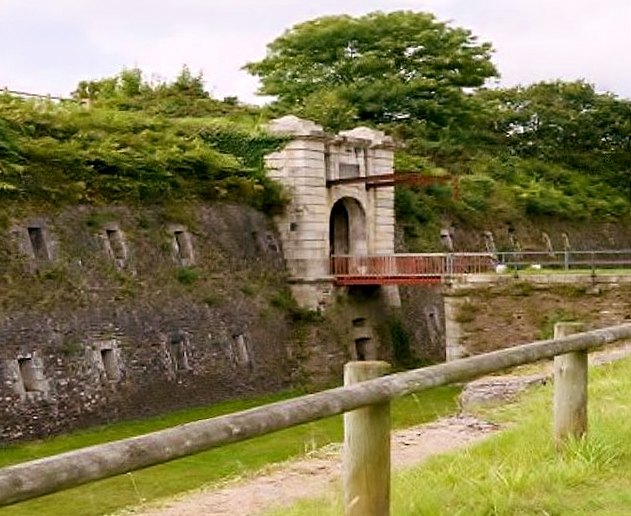
Questel Fort (French: Fort du Questel; Breton: Kreñvlec'h Questel) is a prominent example of an 18th-century bastioned fortress located in the city of Brest, France. Constructed during the post-Renaissance period, it represents the military architectural principles of the renowned French military engineer Sébastien Le Prestre de Vauban, whose designs revolutionized fortifications in the late 17th and early 18th centuries. Questel Fort is a fortified redoubt designed to protect the strategic approaches to Brest, particularly overseeing the valleys of the Moulin du Buis and the Allégoet valley, a tributary of the Penfeld river, preventing enemy forces from establishing positions that could threaten the city and its vital harbor. Architectural design and layout The fort forms a closed quadrangle approximately 100 meters wide, constructed with robust masonry walls known as scarps. These walls are surrounded by deep moats and accessed via a drawbridge, typical of Vauban's defensive schemes. The walls are topped with a chemin de ronde, a covered walkway for musketeers to patrol and defend the perimeter. Above this walkway lies an earthen rampart designed with angled bastions to support artillery placements, with a total of 26 guns positioned to cover all approaches. The fort's layout emphasizes defense in depth, with scarps and counterscarps forming layered defensive walls. The interior includes a central courtyard connected to the parapets by two large underground galleries, allowing safe and concealed movement of the garrison during combat. These galleries also provide access to essential facilities, including toilet facilities—a notable feature at the time reflecting advanced considerations for the garrison's welfare. Strategic importance and historical context Questel Fort was part of a broader network of fortifications designed to protect Brest, a critical naval base on the Atlantic coast of France. It lies between Fort Keranroux to the south and Fort Penfeld to the northeast, forming a defensive chain that includes Fort Montbarey. This strategic positioning allowed coordinated defense against land assaults and naval threats during periods of conflict, particularly in the 18th century when European powers vied for maritime dominance. The fort's construction reflects the military engineering advances of the post-Renaissance era, adapting to the increasing use of artillery in warfare. Its bastioned design allowed defenders to cover all approaches with overlapping fields of fire, minimizing blind spots and enhancing the fortress's resilience against sieges. Garrison and daily life The fort was garrisoned by approximately 200 soldiers, who lived and worked within its walls. The underground galleries and protected walkways allowed the garrison to move safely and efficiently, even under attack. The presence of sanitary facilities within the fort was advanced for its time, indicating a concern for hygiene and the health of the soldiers, which was uncommon in many contemporary military installations. The spacious central courtyard served as a hub for daily activities, drills, and mustering troops. The fort's design balanced defensive needs with the practical requirements of sustaining a military presence in a potentially hostile environment. Current condition and visitor experience Today, Questel Fort is well preserved and forms part of a series of refurbished natural spaces around Brest. Visitors can explore its sheltered green moat, underground galleries, staircases, scarps and counterscarps, and the esplanade that offers views of the surrounding valleys. The site connects to walking trails leading to the banks of the Penfeld river, passing near the Cavale Blanche hospital. The fort is an important cultural and historical landmark, illustrating the evolution of military architecture and the strategic defense of Brest. Its accessible pathways and preserved structures provide insight into 18th-century fortress life and Vauban's enduring influence on fortification design. Architectural features in detail Moats and drawbridge The fort is surrounded by deep moats that serve as a formidable obstacle to attackers. The drawbridge is positioned on the least exposed side, providing controlled access while maintaining the fort's defensive integrity. Chemin de ronde and ramparts The chemin de ronde allows musketeers to patrol the walls under cover, while the earthen ramparts are angled to maximize the effectiveness of the artillery emplacements. These features embody Vauban's principles of combining natural and constructed defenses. Underground galleries The two large underground galleries connect the central courtyard to the parapets, enabling protected movement for the garrison and storage of ammunition and supplies. These galleries are a hallmark of Vauban-style fortifications, enhancing the fort's resilience during sieges.

Post-Renaissance (17th–18th c.)
Details
5.5 km

Castle Brest

Brest, France

Castle Brest, located in the city of Brest, France, stands as a monumental testament to over 1700 years of continuous military history. Positioned strategically at the mouth of the Penfeld River within one of the world's largest natural harbors—the roadstead of Brest—this fortress has played a pivotal role in regional defense from antiquity to modern times. Recognized as the oldest castle still in active use worldwide, it remains a vital military site while also serving as a cultural and historical landmark.The origins of Castle Brest trace back to a Roman castellum established in the late Roman Empire, marking the beginning of its long-standing defensive function. Over the centuries, the site evolved through numerous phases of construction and fortification, reflecting the changing demands of military architecture and technology. The core of the present structure dates to the 11th century, positioning it firmly within the High Medieval period. This era was characterized by the establishment of robust stone fortresses designed to withstand siege warfare and assert feudal control.Historical evolution and architectural developmentRoman origins and early fortificationsThe initial Roman fortress served as a strategic outpost to control naval access and protect the local population. Its placement at the river mouth allowed for surveillance of maritime traffic and defense against seaborne threats. While much of the Roman structure has not survived intact, archaeological evidence confirms its foundational role in the site's military significance.Medieval expansion and fortificationDuring the 11th century, the castle underwent significant expansion, incorporating typical medieval defensive features such as thick curtain walls, towers for archers, and a fortified gatehouse. These enhancements transformed the site into a formidable hill castle adapted to the rugged coastal terrain. The castle's design reflects the architectural principles of the High Medieval period, emphasizing both defense and control over the surrounding region.Vauban's citadel and modern adaptationsIn the late 17th century, the renowned military engineer Sébastien Le Prestre de Vauban redesigned the fortress to meet the era's evolving military needs. Vauban's work introduced bastioned fortifications and star-shaped defensive layouts to improve resistance against artillery. This transformation marked Castle Brest's transition into a bastioned fortress, integrating modern military architecture while preserving its historical core.Architectural features and defensive elementsCastle Brest showcases a complex layering of architectural styles and defensive systems. The original medieval curtain walls are complemented by Vauban's angular bastions and ramparts, creating a multi-tiered defense network. The castle includes moats, drawbridges, and reinforced gates designed to repel invaders. Within its walls lie armories, barracks, and command posts that illustrate its continuous military function.The fortress's location on a rocky promontory enhances its natural defenses, with steep slopes limiting access and providing commanding views of the harbor. The integration of natural topography with constructed fortifications exemplifies strategic military planning across centuries.Cultural significance and preservation statusDeclared a monument historique on 21 March 1923, Castle Brest is not only a military installation but also a protected cultural heritage site. It embodies the historical narrative of Brest and Brittany, reflecting the region's geopolitical importance. The castle is partially accessible to the public, offering insights into its architectural evolution and military history through guided tours and exhibitions.Despite its active military use, conservation efforts have maintained the fortress's structural integrity and historical authenticity. These efforts ensure that Castle Brest remains a living monument, bridging past and present.Visiting castle brestVisitors to Castle Brest can explore its extensive fortifications and enjoy panoramic views of the roadstead of Brest. The castle's location within the city makes it accessible, and it often hosts cultural events that highlight its historical significance. While some areas remain restricted due to military operations, public access areas provide a rich educational experience.Optimal visiting times are during spring and summer when guided tours and exhibitions are most active. Visitors are encouraged to check local schedules for opening hours and ticket information.

High Medieval (11th–13th c.)
Details
5.7 km

Brest Castle

Brest, France

Brest Castle, located in the city of Brest in the Brittany region of France, is a prominent example of a hill castle with a rich military and architectural history. This fortress has played a crucial role in the defense of the region due to its strategic position overlooking the harbor and the approaches to the city. Historical significance and strategic location Situated on a natural elevation, Brest Castle was originally constructed to control access to the important maritime port of Brest, a key naval base for France. Its location on a hill provided commanding views over the surrounding landscape and the Atlantic coast, making it a vital stronghold during numerous conflicts. The castle's history spans several centuries, reflecting the evolving military architecture and strategic needs of the region. Architectural features and fortifications The castle is characterized by robust stone walls, defensive towers, and a complex system of bastions and ramparts designed to withstand artillery attacks. Over time, the fortress was adapted to incorporate advancements in military technology, including the addition of gunpowder artillery defenses during the Renaissance and post-medieval periods. The layout includes a central keep, surrounded by multiple layers of defensive walls and moats, which served to slow and repel attackers. The castle's design reflects a blend of medieval fortification principles with later enhancements typical of the Renaissance and post-Renaissance eras, aimed at countering the growing power of cannon fire. Restoration and current condition Brest Castle has undergone significant restoration efforts to preserve its structural integrity and historical value. These restorations have focused on maintaining the original stonework, repairing damaged sections, and ensuring the fortress remains a prominent cultural landmark. Today, the castle is classified as restored, allowing visitors to explore its well-preserved battlements, towers, and courtyards. Cultural and military heritage Throughout its history, Brest Castle has been a symbol of regional defense and resilience. It has witnessed numerous sieges and military engagements, particularly during periods of conflict between France and foreign powers. The castle's role as a naval defense point underscores its importance in French maritime history. In addition to its military function, the castle serves as a cultural monument, attracting historians, architects, and tourists interested in medieval and early modern fortifications. Its preservation contributes to the understanding of defensive architecture and the historical evolution of military strategies in Brittany. Visiting information and accessibility Visitors to Brest Castle can explore its extensive fortifications, including the curtain walls, gatehouses, and interior chambers. The site often hosts exhibitions and educational programs highlighting its historical and architectural significance. Accessibility features have been implemented to accommodate a wide range of visitors, making it a popular destination for both local and international tourists. Nearby attractions The castle's location in Brest places it near other notable landmarks such as the Brest Naval Museum and the Océanopolis marine science center, providing a comprehensive cultural experience for visitors interested in maritime history and natural sciences.

Details

