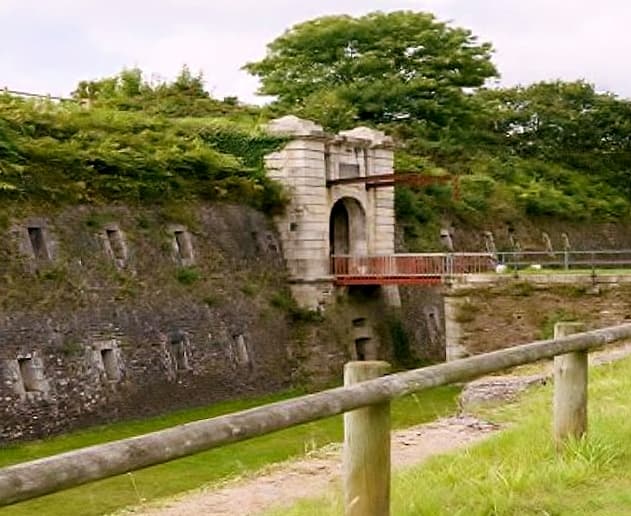
Questel Fort
Questel Fort (French: Fort du Questel; Breton: Kreñvlec'h Questel) is a prominent example of an 18th-century bastioned fortress located in the city of Brest, France. Constructed during the post-Renaissance period, it represents the military architectural principles of the renowned French military engineer Sébastien Le Prestre de Vauban, whose designs revolutionized fortifications in the late 17th and early 18th centuries. Questel Fort is a fortified redoubt designed to protect the strategic approaches to Brest, particularly overseeing the valleys of the Moulin du Buis and the Allégoet valley, a tributary of the Penfeld river, preventing enemy forces from establishing positions that could threaten the city and its vital harbor.
Architectural design and layout
The fort forms a closed quadrangle approximately 100 meters wide, constructed with robust masonry walls known as scarps. These walls are surrounded by deep moats and accessed via a drawbridge, typical of Vauban's defensive schemes. The walls are topped with a chemin de ronde, a covered walkway for musketeers to patrol and defend the perimeter. Above this walkway lies an earthen rampart designed with angled bastions to support artillery placements, with a total of 26 guns positioned to cover all approaches.
The fort's layout emphasizes defense in depth, with scarps and counterscarps forming layered defensive walls. The interior includes a central courtyard connected to the parapets by two large underground galleries, allowing safe and concealed movement of the garrison during combat. These galleries also provide access to essential facilities, including toilet facilities—a notable feature at the time reflecting advanced considerations for the garrison's welfare.
Strategic importance and historical context
Questel Fort was part of a broader network of fortifications designed to protect Brest, a critical naval base on the Atlantic coast of France. It lies between Fort Keranroux to the south and Fort Penfeld to the northeast, forming a defensive chain that includes Fort Montbarey. This strategic positioning allowed coordinated defense against land assaults and naval threats during periods of conflict, particularly in the 18th century when European powers vied for maritime dominance.
The fort's construction reflects the military engineering advances of the post-Renaissance era, adapting to the increasing use of artillery in warfare. Its bastioned design allowed defenders to cover all approaches with overlapping fields of fire, minimizing blind spots and enhancing the fortress's resilience against sieges.
Garrison and daily life
The fort was garrisoned by approximately 200 soldiers, who lived and worked within its walls. The underground galleries and protected walkways allowed the garrison to move safely and efficiently, even under attack. The presence of sanitary facilities within the fort was advanced for its time, indicating a concern for hygiene and the health of the soldiers, which was uncommon in many contemporary military installations.
The spacious central courtyard served as a hub for daily activities, drills, and mustering troops. The fort's design balanced defensive needs with the practical requirements of sustaining a military presence in a potentially hostile environment.
Current condition and visitor experience
Today, Questel Fort is well preserved and forms part of a series of refurbished natural spaces around Brest. Visitors can explore its sheltered green moat, underground galleries, staircases, scarps and counterscarps, and the esplanade that offers views of the surrounding valleys. The site connects to walking trails leading to the banks of the Penfeld river, passing near the Cavale Blanche hospital.
The fort is an important cultural and historical landmark, illustrating the evolution of military architecture and the strategic defense of Brest. Its accessible pathways and preserved structures provide insight into 18th-century fortress life and Vauban's enduring influence on fortification design.
Architectural features in detail
Moats and drawbridge
The fort is surrounded by deep moats that serve as a formidable obstacle to attackers. The drawbridge is positioned on the least exposed side, providing controlled access while maintaining the fort's defensive integrity.
Chemin de ronde and ramparts
The chemin de ronde allows musketeers to patrol the walls under cover, while the earthen ramparts are angled to maximize the effectiveness of the artillery emplacements. These features embody Vauban's principles of combining natural and constructed defenses.
Underground galleries
The two large underground galleries connect the central courtyard to the parapets, enabling protected movement for the garrison and storage of ammunition and supplies. These galleries are a hallmark of Vauban-style fortifications, enhancing the fort's resilience during sieges.
Frequently asked questions (FAQ)
- How do I get to Questel Fort in Brest?
- Questel Fort is located in Brest, Brittany. Visitors can reach the site by local public transport or car, with walking paths connecting it to nearby landmarks such as the Cavale Blanche hospital.
- What are the opening hours for visiting Questel Fort?
- Opening hours may vary seasonally, but the fort is generally accessible during daylight hours. It is recommended to check with local tourist information for the most current visiting times.
- Is Questel Fort wheelchair accessible?
- Due to the historic nature of the fort and its underground galleries, full wheelchair accessibility may be limited. Visitors with mobility concerns should inquire locally about access options.
- What is the historical significance of Questel Fort?
- Questel Fort is a key example of Vauban's bastioned fortress design, playing a vital role in the defense network of Brest during the 18th century, protecting the city and its strategic harbor.
- Can I explore the underground galleries at Questel Fort?
- Yes, visitors can explore the underground galleries which connect the central courtyard to the parapets, offering a unique glimpse into the fort's defensive architecture.
Photo gallery

Information
Loading map...
Visitor reviews
No reviews yet. Been here? Write the first review and help other travelers!
Write the first reviewVisited this castle? Share your experience
Your review helps other travelers and adds first-hand knowledge to our encyclopedia.



