Fort la Latte
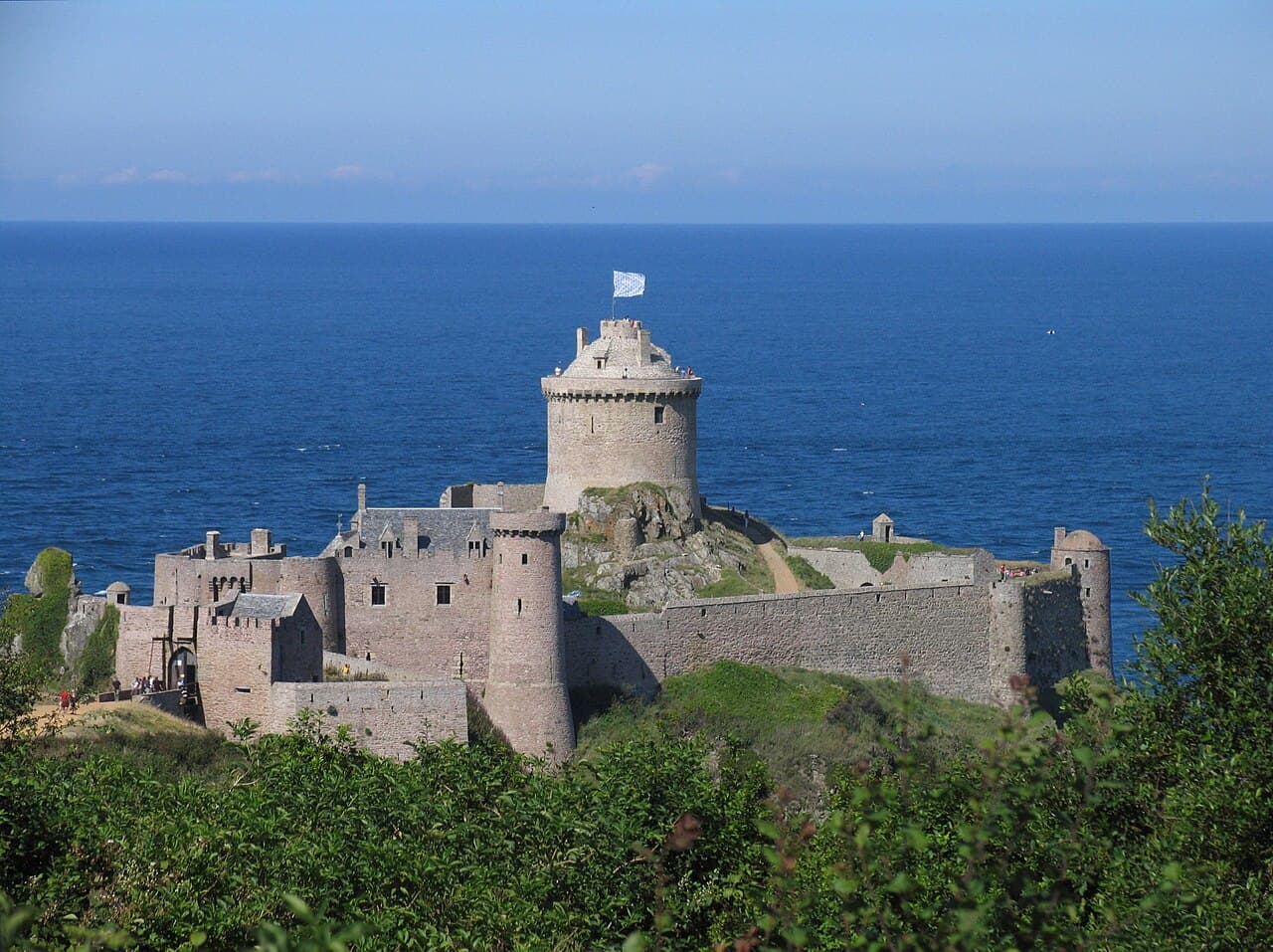
Fort la Latte, also known as Château de la Roche Goyon, is a striking hill castle perched on a rocky promontory overlooking the English Channel near Plévenon in the Côtes-d'Armor department of Brittany, France. Built in the 14th century, this fortress commands panoramic views of the sea and surrounding coastline, reflecting its strategic importance in maritime defense and regional power struggles throughout the medieval and early modern periods.
Medieval origins and early history
The castle was constructed between 1340 and 1370 by Étienne III Gouyon, Lord of Matignon, a prominent Breton nobleman. It was initially known as Roche Goyon Castle, named after the influential Goyon family, whose lineage dates back to early Breton nobility. The site was chosen for its natural defensive advantages — a rocky headland rising approximately 60 to 70 meters above sea level — providing commanding views vital for controlling maritime trade routes between Saint-Malo, Normandy, and the Channel Islands.
The castle's donjon (keep) was built in the late 1360s, embodying the military architecture of the High to Late Medieval period. Its robust granite and sandstone construction features defensive elements such as machicolations for dropping projectiles on attackers, narrow loopholes for crossbows and early firearms, and multiple drawbridges and portcullises securing the entrances.
In 1379, the fortress was besieged by French forces led by Bertrand du Guesclin, a renowned Breton knight and later Constable of France. This siege was part of the broader conflict involving the Duchy of Brittany and the Kingdom of France. Although the castle resisted valiantly, it was confiscated by King Charles V of France but restored to the Gouyon family after the Treaty of Guérande in 1381.
Military engagements and renaissance-era conflict
The castle endured a siege by English troops in 1490 during the turbulent late medieval period, but the defenders successfully repelled the attack. Its military role continued through the French Wars of Religion in the late 16th century. In 1597, the fortress, by then known as Fort la Latte, was besieged and captured by the Catholic League forces due to the allegiance of Jacques II de Goyon, Lord of Matignon, to Henry IV of France.
The Catholic League troops inflicted significant damage, burning and dismantling much of the castle, leading to a period of abandonment. Only the sturdy donjon withstood the assault, symbolizing the resilience of the fortress despite the devastation.
18th-century fortification and military modernization
Recognizing the strategic coastal location, the castle was rebuilt and modernized in the early 18th century under the reign of Louis XIV. Military engineer Sir Garengeau oversaw the transformation, incorporating bastioned fortifications inspired by the designs of Vauban, France’s foremost military architect.
The upgrades included artillery platforms capable of mounting up to eight cannons, some measuring eight meters in length, with firing ranges approaching one kilometer. These fortifications were integral to defending the nearby port city of Saint-Malo against English and Dutch naval threats.
Additional structures from this period include a chapel, governor’s residence, and guardhouse, reflecting the castle's dual military and administrative functions.
19th and 20th-century decline and restoration
After the First French Empire, advances in military technology rendered Fort la Latte obsolete as a defensive fortress. It was decommissioned in 1890 and sold into private ownership in 1892. By this time, the castle had fallen into considerable disrepair.
In 1925, Fort la Latte was classified as a historic monument, recognizing its cultural and architectural significance. Extensive restoration efforts began in 1931 under the stewardship of historian Frédéric Joüon des Longrais, continuing into the 1950s. These works stabilized the structure and restored many of its distinctive medieval and early modern features.
Electricity was only installed in 2001, highlighting the castle's long period of preservation in a largely original state.
Architectural features and defensive design
The castle’s layout exemplifies medieval military architecture adapted to a rugged coastal environment. The donjon stands as the centerpiece, with its circular base adorned by four granite sculptures representing the tetramorph — the angel, lion, eagle, and bull — symbolic of the four evangelists in Christian iconography.
Fort la Latte’s defensive system includes two fortified entrance gatehouses (châtelets), each equipped with drawbridges and portcullises. These are separated by a barbican, an outer courtyard protected by a deep chasm and a second drawbridge on an offset axis to thwart battering rams and direct assaults.
The castle features numerous machicolations and embrasures designed for crossbows, early firearms such as arquebuses, and primitive cannons known as bombards. Visible cannonball damage on the donjon’s stonework attests to its active role in historic sieges.
Within the courtyard, a large rainwater cistern with a capacity of 20,000 liters ensured water supply during sieges. The castle also contains a medieval-style garden and a reconstructed bricole catapult in the barbican, illustrating siege warfare tactics.
The basse-cour (lower courtyard) houses a specialized oven used to heat cannonballs until red-hot, a technique intended to set enemy wooden ships or structures ablaze, though it was rarely employed due to its impracticality and danger.
At the promontory’s tip, the battery basse once held eight artillery pieces on granite tracks that facilitated aiming and repositioning. Military records note that these cannons could be fired approximately once every three minutes under optimal conditions.
Cultural significance and modern tourism
Today, Fort la Latte is one of Brittany’s most visited castles, second only to the Château des Ducs de Bretagne in Nantes. Its dramatic location, well-preserved medieval and early modern architecture, and rich history attract thousands of visitors annually.
The castle has also served as a filming location for numerous movies and television productions since the mid-20th century, enhancing its cultural footprint. Notable visitors include Prince Albert II of Monaco, a descendant of the Goyon-Matignon family, who has made private visits in recent years.
Visitors can explore the castle’s extensive fortifications, towers, courtyards, and exhibitions that detail its military history and architectural evolution. While the site can be crowded during peak seasons, it offers a unique glimpse into the defensive strategies and noble life of medieval Brittany.
Frequently asked questions (FAQ)
- How do I get to Fort la Latte?
- Fort la Latte is located in Plévenon, France, accessible by car or public transport. The nearest major city is Saint-Malo, which is about a 30-minute drive away. There is also a well-marked walking path from the nearby village, making it easy for visitors to reach the castle.
- What is the historical significance of Fort la Latte?
- Fort la Latte was built in the 14th century and played a crucial role in defending the region against pirates and invasions. Its strategic location on a cliff overlooking the sea provided a strong vantage point for monitoring maritime activity. The castle has also been featured in various films, further enriching its historical narrative.
- When was Fort la Latte constructed?
- Fort la Latte was constructed between 1340 and 1370, making it one of the oldest castles in the Brittany region of France. Over the centuries, it has been renovated and restored, maintaining its historical architecture while adapting to the needs of modern visitors.
- Can I explore the interior of Fort la Latte?
- Yes, visitors can explore the interior of Fort la Latte during opening hours. The castle features various rooms, including the keep and living quarters, which offer insights into medieval life. Guided tours are also available to enhance your visit.
- Why is Fort la Latte a popular tourist attraction?
- Fort la Latte is popular due to its stunning cliffside location, rich history, and well-preserved architecture. The panoramic views of the coastline and surrounding landscape provide a breathtaking backdrop for exploration. Additionally, its appearances in films have attracted a wider audience.
- Is it possible to visit Fort la Latte year-round?
- Fort la Latte is generally open to visitors from April to October, with specific opening hours varying by season. During the winter months, the castle may be closed or have limited access, so it's best to check the official website for the most current information before planning your visit.
- What are the ticket prices for visiting Fort la Latte?
- As of the latest information, the ticket prices for Fort la Latte are approximately €8 for adults, with discounts available for children and groups. Tickets can be purchased on-site, and special rates may apply during specific events or guided tours.
- What are the nearby attractions to Fort la Latte?
- Nearby attractions include the picturesque village of Plévenon and the stunning Cap Fréhel, known for its dramatic cliffs and walking trails. The area also boasts beautiful beaches, such as Plage de la Fosse, perfect for a day of relaxation after visiting the castle. Additionally, the coastal paths provide opportunities for hiking and enjoying the natural scenery.
- What is the best time to visit Fort la Latte?
- The best time to visit Fort la Latte is during the late spring and early summer months when the weather is typically warm and sunny. This period also offers longer daylight hours, allowing for ample time to explore the castle and its surroundings. Visiting during weekdays may help avoid larger crowds, especially in peak tourist season.
Photo gallery

Information
Website
Visit websiteSources & official resources
Verify the information above using these authoritative references.
Loading map...
Visitor reviews
No reviews yet. Been here? Write the first review and help other travelers!
Write the first reviewVisited this castle? Share your experience
Your review helps other travelers and adds first-hand knowledge to our encyclopedia.