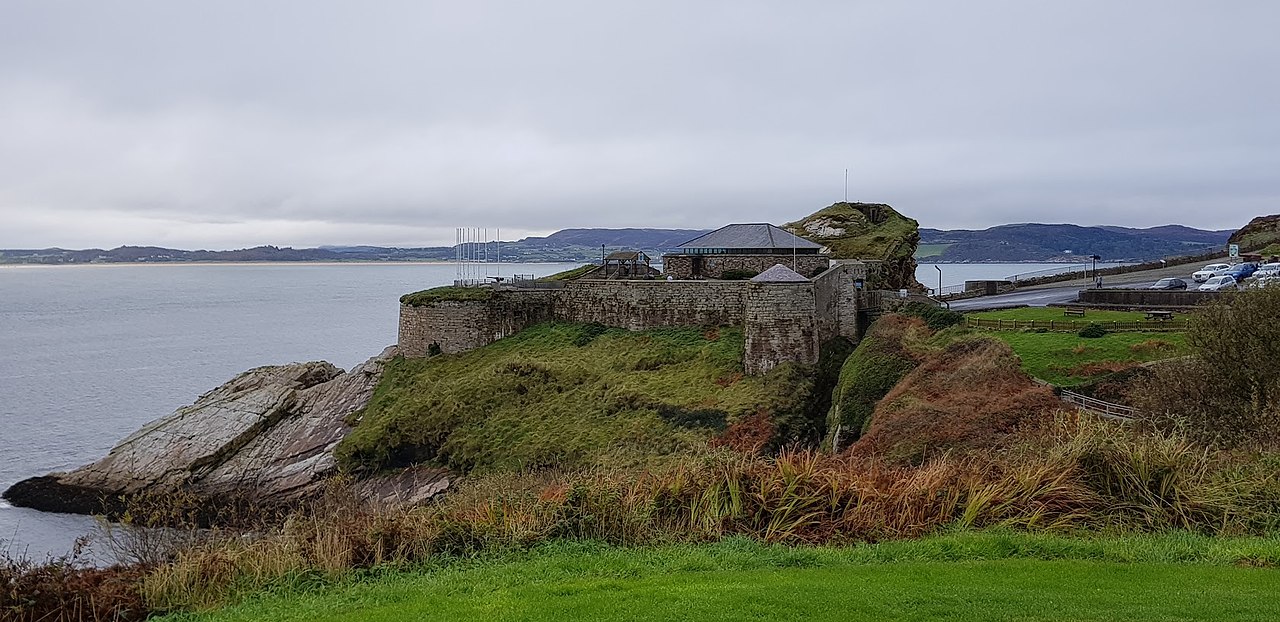
Carrickabraghy Castle
Carrickabraghy Castle (Irish: Caisleán Charraig Bhrachaí) stands prominently on a rocky outcrop at the northwestern tip of the Isle of Doagh, located in the northern reaches of Inishowen Peninsula, County Donegal, Ireland. This 16th-century hill castle occupies a strategic position overlooking Pollan Bay and the surrounding seaways, offering commanding views that once provided vital defense and control over local waterways.
The site of Carrickabraghy Castle is steeped in history dating back to the early medieval period, with the surrounding lands originally divided into three tribal districts or tuatha from the 9th to 13th centuries. The western district, known as Carraig Bhrachai, was governed by the influential Ó Maolfabhail (McFall) clan, who ruled from this area and played a significant role in local power struggles and defense against Viking incursions. The castle's location on a rocky promontory provided natural fortification, enhanced by the tidal isolation of the Isle of Doagh, which made it a formidable stronghold in its time.
Early history and medieval significance
Historical records such as the Annals of the Four Masters document the rule of the McFall clan lords in the Carraig Bhrachai region from the 9th century until the early 13th century. These leaders were notable for their resistance against both rival Irish clans and Viking raiders, often engaging in fierce battles that shaped the political landscape of Inishowen. Local legend recounts a Viking raid during which three Irish princesses were captured, with one escaping and later marrying a local chief, illustrating the castle's role in regional conflict and alliance formation.
The transition to o'doherty control
The historical narrative of Carrickabraghy Castle resumes around the late 16th and early 17th centuries, coinciding with the rise of the O'Doherty clan as dominant regional power in Inishowen. Sean Og O'Doherty, the clan chief and lord of Inishowen, is credited with constructing the extant remains of the castle around 1600. This period was marked by the English conquest of Ireland, and the castle served as a defensive refuge to protect livestock and supplies from English raids. The Isle of Doagh's isolation made it an ideal location for safeguarding resources during these turbulent times.
The castle during the early 17th century conflict
Following Sean Og's death in 1601, a succession dispute ensued between his son Cathaoir Rua (Cahir Roe), his half-brother Feilim Og, and external factions including Aodh Rua O'Donnell and English authorities. Cathaoir Rua ultimately became the last significant Irish lord of Inishowen, ruling with relative stability until the Flight of the Earls in 1607 prompted increased English suspicion and repression.
Cathaoir Rua used Carrickabraghy Castle as a stronghold to plan a rebellion against English rule, which ended in failure and his death in 1608. After these events, the castle was gradually abandoned and fell into ruin by around 1665, reflecting the wider decline of Gaelic lordship in Ulster during the early modern period.
Architectural features and current condition
The surviving ruins of Carrickabraghy Castle consist primarily of fragmentary stone walls built from locally quarried materials, characteristic of early 17th-century defensive architecture. The structure likely functioned as a fortified residence or small stronghold, designed to protect valuable livestock and supplies rather than serve as a large military fortress. Its position on a rocky promontory provided natural defenses, with tidal access further limiting enemy approach.
No detailed interior features such as staircases, gates, or decorative elements have been documented, and no inscriptions or artifacts have been recovered to provide additional insights into the daily life of its occupants. Despite its ruinous state, the castle remains an important cultural landmark, symbolizing the turbulent history of Inishowen and the resilience of its Gaelic clans.
Conservation efforts
In the 21st century, significant conservation and stabilization work was undertaken to preserve the remains of Carrickabraghy Castle. Supported by the National Rural Development LEADER Programme and local fundraising initiatives, these efforts culminated in 2013 with the successful stabilization of the masonry, preventing further deterioration and ensuring the site’s preservation for future generations and historical study.
Cultural and historical legacy
Carrickabraghy Castle stands as a testament to the complex history of Gaelic Ireland, the impact of Viking invasions, and the transformative effects of the English conquest on Ulster. Its ruins evoke the story of powerful clans like the McFalls and O'Dohertys, whose leadership shaped the political and social fabric of Inishowen for centuries.
Today, the castle is a point of interest for visitors exploring the rich heritage of County Donegal, offering a tangible link to Ireland’s medieval past and the struggles endured by its native lords. Its dramatic coastal setting and evocative ruins continue to inspire appreciation for Ireland’s historic castles and the enduring legacy of its ancient clans.
Frequently asked questions (FAQ)
- How do I get to Carrickabraghy Castle?
- Carrickabraghy Castle is located in Clonmany, Northern Ireland, and is accessible by car or public transport. The scenic drive along the coast offers beautiful views, and there is parking available near the castle site for visitors.
- What is the historical significance of Carrickabraghy Castle?
- Carrickabraghy Castle is a 16th-century fortress that played a vital role in the defense of the area against invasions. It is steeped in history and is linked to the O'Doherty clan, making it a significant site for understanding the region's past.
- When was Carrickabraghy Castle built?
- Carrickabraghy Castle was constructed in the late 1500s, specifically around 1580. It was built during a turbulent period in Irish history, reflecting the architectural styles of the time and the strategic importance of the location.
- Can I explore the interior of Carrickabraghy Castle?
- Currently, Carrickabraghy Castle is in a state of ruin, and access to the interior is limited for safety reasons. However, visitors can explore the exterior and enjoy the beautiful coastal views surrounding the castle.
- Why is Carrickabraghy Castle a popular tourist attraction?
- Carrickabraghy Castle attracts visitors due to its stunning coastal location and rich historical background. The picturesque scenery and the castle's ruins provide a perfect backdrop for photography and exploration, making it a must-see for history buffs and nature lovers alike.
- Is it possible to visit Carrickabraghy Castle year-round?
- Yes, Carrickabraghy Castle is open to the public year-round, allowing visitors to enjoy its beauty in every season. However, it is advisable to check the weather conditions and dress appropriately, as the area can be windy and wet.
- What are the opening hours for Carrickabraghy Castle?
- Carrickabraghy Castle is accessible at all times, as there are no specific opening hours. Visitors can explore the site during daylight hours for the best experience and to fully appreciate the surrounding landscape.
- Are there any nearby attractions to visit while in Clonmany?
- Yes, there are several attractions near Clonmany, including the stunning beaches of Ballyliffin and the scenic Wild Atlantic Way. Additionally, the Inishowen Peninsula offers beautiful hiking trails and other historical sites for visitors to explore.
- What are the ticket prices for visiting Carrickabraghy Castle?
- There is no admission fee to visit Carrickabraghy Castle, as it is a public historical site. Visitors can enjoy the castle and its surroundings free of charge, making it an excellent option for a budget-friendly outing.
Information
Website
Visit websiteSources & official resources
Verify the information above using these authoritative references.
Loading map...
Visitor reviews
No reviews yet. Been here? Write the first review and help other travelers!
Write the first reviewVisited this castle? Share your experience
Your review helps other travelers and adds first-hand knowledge to our encyclopedia.