Fort Dansborg
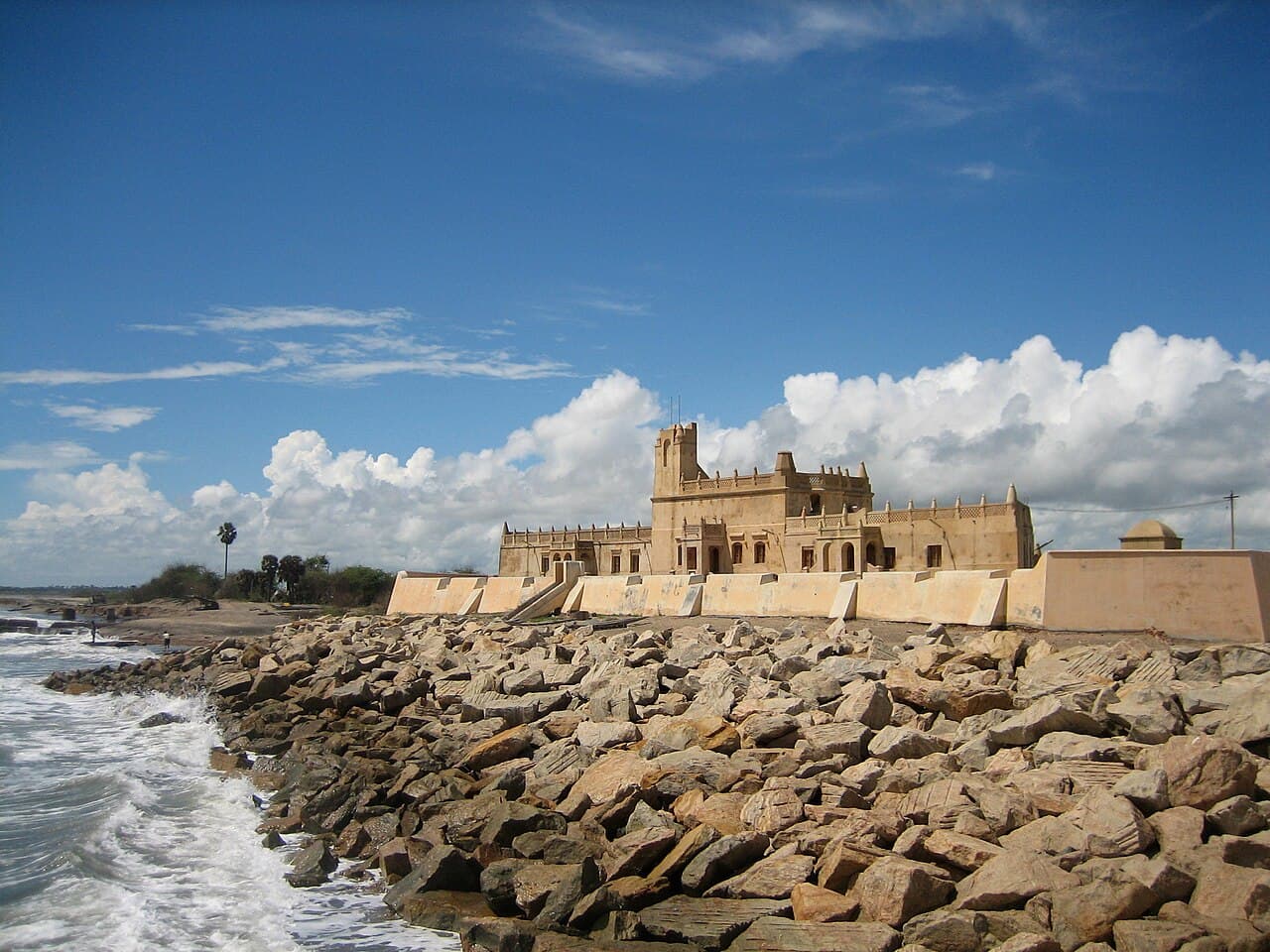
Fort Dansborg, also known locally as the Danish Fort, is a significant bastioned fortress situated on the shores of the Bay of Bengal in Tranquebar (Tharangambadi), within the Mayiladuthurai District of Tamil Nadu, India. Constructed in the early 17th century, it stands as a prominent example of European colonial military architecture in South Asia and is the second largest Danish fort after Kronborg Castle in Denmark.
Historical context and construction
The fort was established following an agreement between the Thanjavur king Ragunatha Nayak and the Danish Admiral Ove Gjedde in 1620. This treaty ceded land to the Danish East India Company, enabling them to build a fortified settlement that would serve as their base for trade and influence in the region. The construction of Fort Dansborg began shortly after, designed primarily as a bastioned fortress to withstand military attacks and secure Danish commercial interests.
The fort's design reflects typical Renaissance military architecture principles, adapted to the tropical coastal environment of India. Its robust bastions, thick walls, and strategic placement on the coastline allowed it to control maritime access and defend against rival European powers and local forces.
Architectural features and layout
Fort Dansborg is constructed mainly from local laterite stone and bricks, materials suited to withstand the humid coastal climate. The fort's layout is rectangular with four bastions at each corner, providing overlapping fields of fire. The bastions are angular, a hallmark of Renaissance fortification design, intended to deflect cannonballs and provide better defensive coverage.
The fort includes several key structures: a large central courtyard, administrative buildings, residential quarters, a chapel, and storerooms. The walls are punctuated by narrow gun ports and embrasures for artillery placement. The main entrance is fortified with a gatehouse and a drawbridge, emphasizing security.
The fort's location on the coast allowed for a natural moat on one side, enhancing its defensive capabilities. The proximity to the sea also facilitated easy resupply and communication with Denmark and other Danish colonies.
Dutch and british periods and decline
Despite its initial importance as a Danish trading post, Fort Dansborg experienced a decline in strategic value after the Danish sold it to the British in 1845. The British East India Company did not prioritize Tranquebar as a major trading hub, leading to the fort's gradual neglect. The town and fort lost much of their commercial and military significance during British rule.
Following Indian independence in 1947, the fort was repurposed by the state government as an inspection bungalow until 1978, when the state's archaeology department assumed control. This transition marked the beginning of efforts to preserve and restore the fort as a heritage monument.
Modern restoration and museum use
Fort Dansborg underwent two major renovations in recent decades. The first restoration occurred in 2001, led by the Tranquebar Association with support from the Danish royal family and Tamil Nadu's archaeology department. This effort focused on structural stabilization and conservation of original features.
The second renovation in 2011 was carried out by the state's tourism department to enhance visitor facilities and promote the fort as a cultural tourism destination. Today, the fort operates as a museum showcasing artifacts related to the Danish colonial empire in India, including weapons, documents, and everyday items from the 17th and 18th centuries.
Cultural significance and tourism
Fort Dansborg remains a rare example of Danish colonial architecture in India and a tangible link to the early European presence on the subcontinent's eastern coast. Its preservation offers valuable insight into the military, economic, and cultural exchanges between Europe and India during the Renaissance period.
The fort attracts historians, architects, and tourists interested in colonial history and coastal fortifications. Its well-preserved bastions and strategic coastal location provide a striking visual and educational experience. The museum's collections contribute to understanding the Danish role in India's colonial past and the broader context of European imperial competition in Asia.
Frequently asked questions (FAQ)
- How do I get to Fort Dansborg?
- Fort Dansborg is located in Tranquebar (Tharangambadi), Tamil Nadu. It is accessible by road from nearby cities like Mayiladuthurai and Karaikal. The nearest railway station is in Mayiladuthurai.
- What is the historical significance of Fort Dansborg?
- Fort Dansborg was built in 1620 by the Danish East India Company and served as their main base in India. It is the second largest Danish fort after Kronborg and reflects Renaissance military architecture adapted to the Indian coastal environment.
- Can I visit the museum inside Fort Dansborg?
- Yes, the fort houses a museum displaying artifacts from the Danish colonial period, including weapons, documents, and household items. It is open daily from 09:00 to 17:00 with a nominal entry fee.
- What are the visiting hours and ticket prices?
- The fort is open daily from 09:00 to 17:00. Tickets cost ₹30 for adults and ₹15 for children.
- Is Fort Dansborg wheelchair accessible?
- The fort has uneven surfaces and some areas with steps, which may limit accessibility for wheelchair users. Visitors are advised to check with the site management for specific accommodations.
Photo gallery

Information
Opening hours
09:00-17:00, daily
Ticket prices
₹30 adult, ₹15 child
Current owner
State archaeology department
Loading map...
Visitor reviews
No reviews yet. Been here? Write the first review and help other travelers!
Write the first reviewVisited this castle? Share your experience
Your review helps other travelers and adds first-hand knowledge to our encyclopedia.