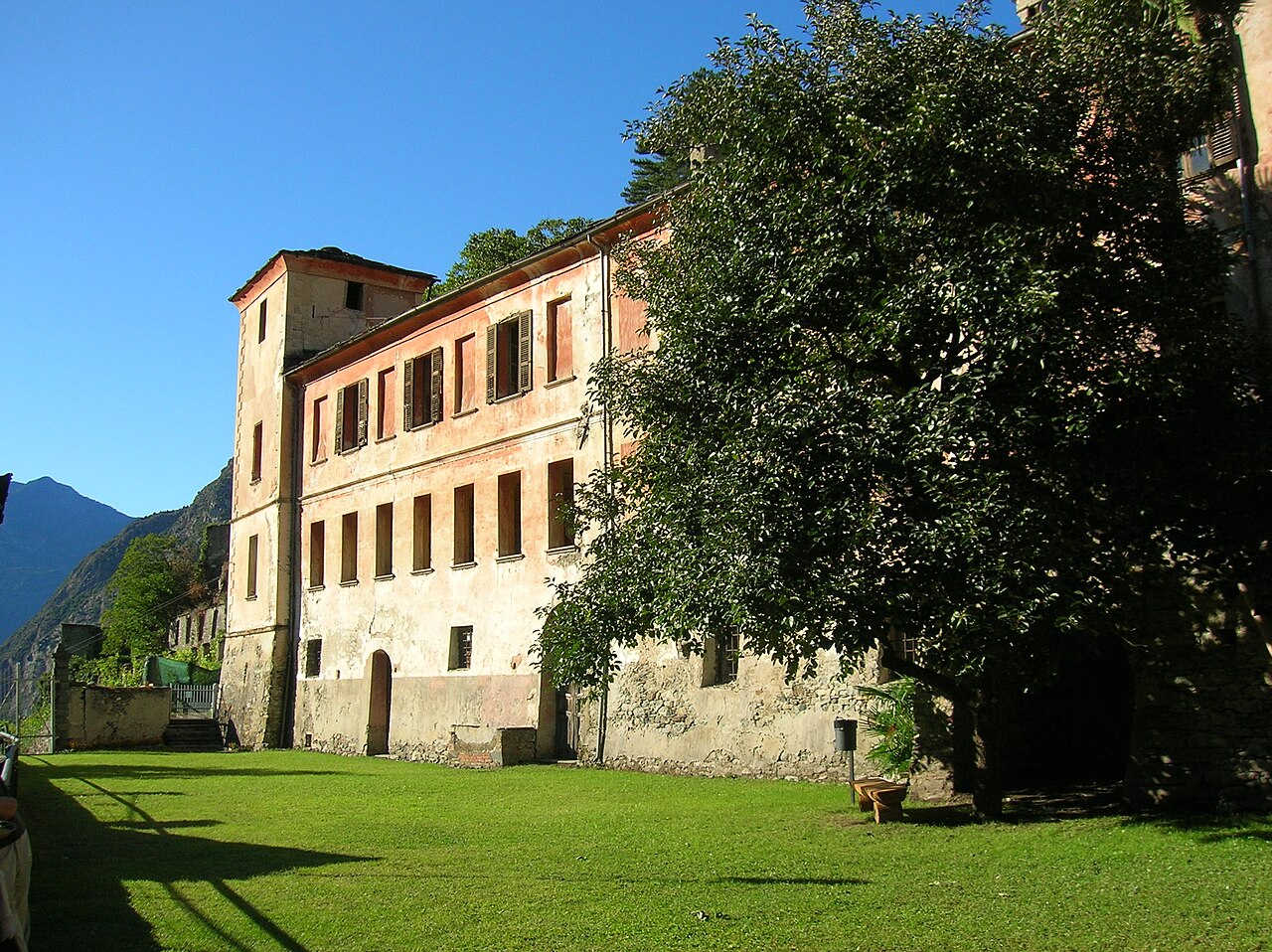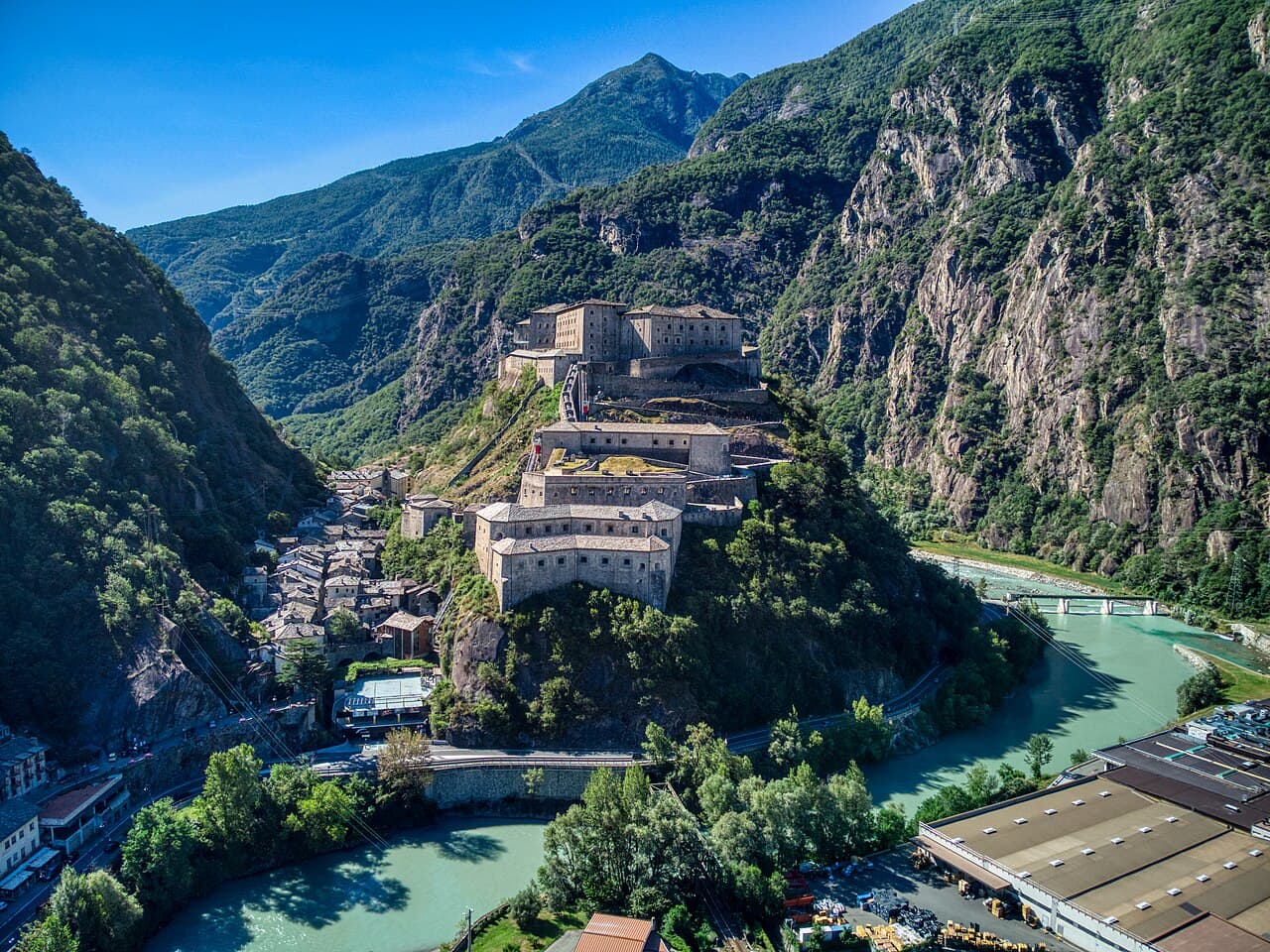
Fort Bard is a remarkable example of a 19th-century hill castle located in the municipality of Bard, Italy, perched strategically on a rocky prominence overlooking the narrow gorge of the Dora Baltea river. This fortress has played a pivotal role in controlling the vital passage between the Po Valley and Savoy, a position recognized and utilized since the early medieval period. Originally established as a fortified post by the Ostrogoths in the 6th century under the command of Theodoric the Great, the site evolved through centuries of military and political upheaval into the imposing complex that stands today.
Early history and medieval significance
The earliest fortifications at the site date back to the 5th and 6th centuries, with the Ostrogoths recognizing the natural defensive advantages of the rocky outcrop. The fortress initially housed a garrison of approximately 60 soldiers tasked with controlling this key transit point. During the early medieval period, the fort was governed by the Viscounts of Aosta and was described in 1034 as an "impregnable oppidum," highlighting its formidable defensive capabilities.
By the mid-13th century, control had passed to the local feudal lords, the Counts of Bard, who likely served as vassals to the Bishopric of Aosta. Around this time, Amadeus IV of Savoy seized the fortress, integrating it into the expanding Savoyard state and establishing a permanent military presence. From this point onward, the castle's defenses were continually strengthened to meet evolving military needs.
Fortification enhancements and military role in the early modern period
During the 17th century, the strategic importance of Fort Bard intensified. In 1661, Charles Emmanuel II, Duke of Savoy, centralized the duchy's artillery at Fort Bard after dismantling nearby fortresses such as the castles of Verrès and Saint-Germain. This consolidation led to significant upgrades in the fort's defenses, including the addition of artillery batteries and reinforced walls designed to withstand contemporary siege warfare.
The fortress gained fame during the War of the Spanish Succession in 1704 when Victor Amadeus II of Savoy successfully repelled French forces attempting to advance into Italy. This victory underscored Fort Bard's enduring military significance and its role as a bastion of Savoyard power in the region.
Napoleonic campaign and destruction
Fort Bard's most notable military episode occurred in May 1800 during Napoleon Bonaparte's Italian campaign. A French army of approximately 40,000 troops was stalled for two weeks by a determined Austro-Piedmontese garrison of just 400 soldiers stationed at the fort. This unexpected resistance forced Napoleon to alter his plans and take an alternative route into the Po Valley and Turin, delaying his campaign.
Frustrated by this setback, Napoleon famously referred to the fortress as the "vilain castel de Bard" and ordered its complete destruction to prevent it from being a future obstacle to French military operations. The fort was razed, leaving the site in ruins for several decades.
Reconstruction in the 19th century
Concerned about renewed French threats, King Charles Felix of Sardinia commissioned the reconstruction of Fort Bard in 1830. The project was entrusted to the renowned Italian military engineer Francesco Antonio Olivero, who oversaw an extensive rebuilding process completed in 1838. The new fortress was designed with modern military architecture principles, featuring multiple autonomous defensive structures arranged on different levels.
The lower levels include the Opera Ferdinando and the Opera Mortai, the latter named for its mortar batteries and shaped like pincers to provide overlapping fields of fire. These buildings contain robust casemates—armored chambers designed to protect artillery and troops during attacks—allowing mutual defense between sections of the fort.
The central part of the complex is occupied by the Opera Vittorio, while the upper levels house the Opera Gola and Opera Carlo Alberto. Together, these structures form a layered defense system capable of withstanding sustained assaults.
The fortress contains 283 rooms capable of accommodating up to 416 soldiers, with capacity doubled by the use of ground bedding. A large internal courtyard serves as a parade ground and is surrounded by 176 service rooms including arsenals and barracks. Ammunition and food supplies sufficient for three months were stored in large warehouses within the Opera Mortai, guarded by approximately 50 artillery pieces.
Decline and modern restoration
By the late 19th century, advances in military technology and changes in political landscapes rendered Fort Bard obsolete as a defensive structure. The fort fell into disuse but was repurposed as a military prison and later as a powder magazine for the Italian Army until 1975. Ownership then transferred to the Autonomous Region of Valle d'Aosta.
After partial reopening in the 1980s, the fort underwent a lengthy and meticulous restoration that lasted over a decade. In 2006, Fort Bard reopened as the Museum of the Alps, showcasing exhibitions on ancient, modern, and contemporary art, as well as photography. The complex also hosts permanent exhibitions including the Children's Alps, The Prisons, and a forthcoming Museum of the Fortress.
The large courtyards of the Opera Carlo Alberto and Opera Gola are used for cultural events such as musical and theatrical performances during the summer months. Conference halls like the Hall of White Arches and the Olivero Hall provide venues for educational and community gatherings.
Architectural features and layout
Fort Bard occupies an area of approximately 14,467 square meters at an elevation of 384 meters above sea level. Its layout is characterized by a complex system of interconnected buildings and defensive works spread across multiple levels, designed to maximize defensive coverage of the narrow valley below.
The fortress's architecture reflects the military engineering advancements of the early 19th century, combining traditional masonry with innovative casemate designs that offer protection against artillery fire. The use of autonomous structures capable of mutual defense was a key feature, allowing the fort to maintain resilience even if parts were breached.
A network of covered walkways and staircases connects the various sections, enabling secure movement of troops during combat. The presence of multiple entrances, including an ancient southern gate, preserves historical access routes while facilitating modern visitor circulation.
Cultural significance and popular media
Fort Bard has transcended its military origins to become a significant cultural landmark in the Aosta Valley. Its restoration and adaptation into a museum complex have made it a center for heritage preservation and public education about the Alps and regional history.
The fortress gained international recognition when it was featured as the fictional secret base of the organization HYDRA in the 2015 film Avengers: Age of Ultron. Additionally, the fort was a filming location for the 2018 movie Never Passed by Christian Orlandi, further cementing its place in contemporary popular culture.
Visitor information and ongoing preservation
Today, Fort Bard welcomes visitors year-round, offering a unique blend of historical architecture, military heritage, and cultural exhibitions. The ongoing preservation efforts ensure that the fortress remains a well-maintained example of 19th-century military architecture, providing insight into the evolution of defensive strategies over centuries.
The site's museums and event spaces contribute to a vibrant cultural scene, attracting tourists and scholars interested in history, architecture, and the natural beauty of the Aosta Valley.
Frequently asked questions (FAQ)
- How do I get to Fort Bard?
- Fort Bard is located in Bard, Aosta Valley, Italy. It is accessible by car via the A5 motorway or by regional train to Bard station, followed by a short walk to the fortress.
- What can I see at Fort Bard?
- Visitors can explore the Museum of the Alps, permanent exhibitions on local history and art, historic prisons, and enjoy cultural events held in the courtyards during summer.
- When was Fort Bard originally built?
- The original fortress dates back to the 5th-6th century, established by the Ostrogoths, with the current structure rebuilt in the 19th century by the House of Savoy.
- Is Fort Bard wheelchair accessible?
- While some areas of Fort Bard are accessible, the rocky terrain and historic structures mean that full wheelchair access is limited. Visitors are advised to check accessibility details before visiting.
- Why was Fort Bard important historically?
- Fort Bard controlled a strategic passage between Italy and France, playing key roles in medieval defense, the War of the Spanish Succession, and Napoleon's Italian campaign.
Photo gallery

Information
Opening hours
Year-round, daily
Ticket prices
Varies by exhibition
Architect
Francesco Antonio Olivero
Current owner
Autonomous Region of Valle d'Aosta
Website
Visit websiteSources & official resources
Verify the information above using these authoritative references.
Loading map...
Visitor reviews
No reviews yet. Been here? Write the first review and help other travelers!
Write the first reviewVisited this castle? Share your experience
Your review helps other travelers and adds first-hand knowledge to our encyclopedia.