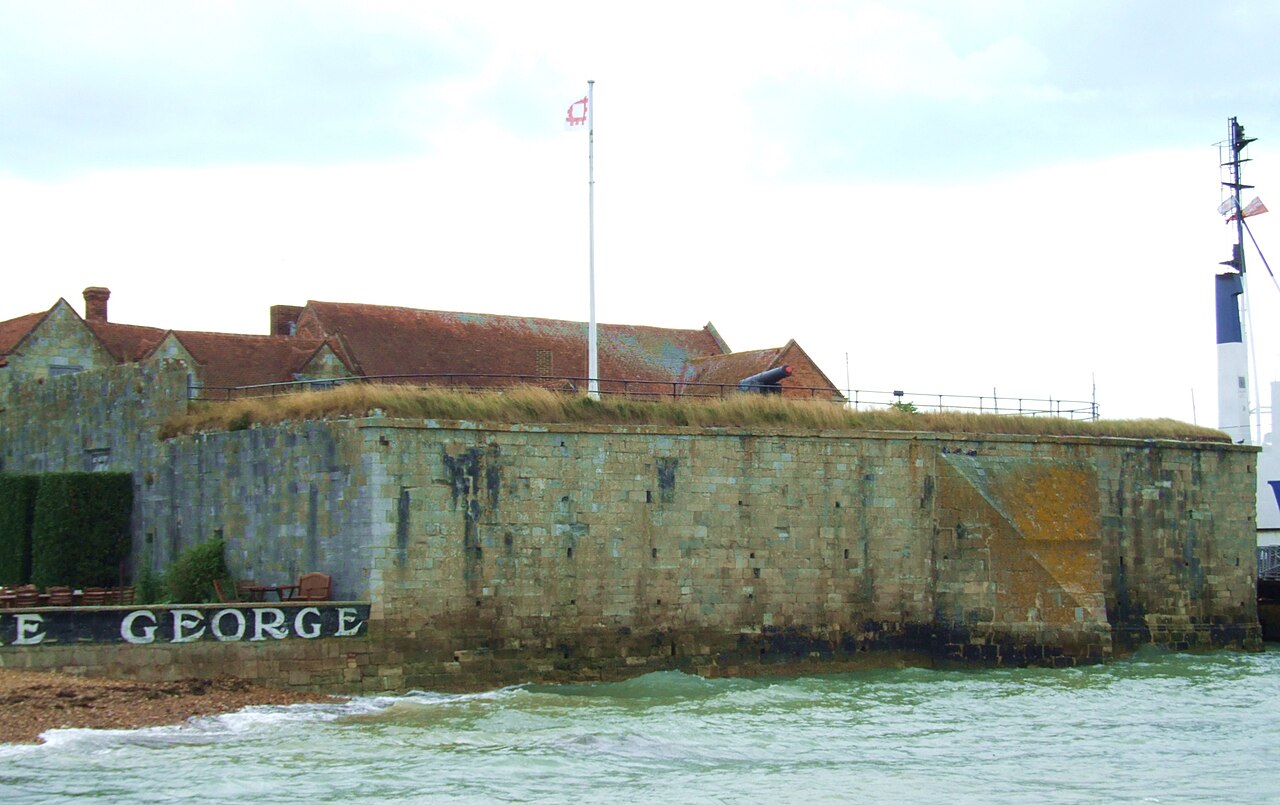
Fort Albert
Fort Albert is a distinctive tower fort located beneath the cliffs south-west of Fort Victoria on the Isle of Wight. Constructed between 1852 and 1856, it forms part of the series of coastal defenses commissioned by the Royal Commission on the Defence of the United Kingdom during the mid-19th century. These fortifications, often referred to as Palmerston forts after then-Prime Minister Lord Palmerston, were built in response to growing fears of a French invasion under Napoleon III. Fort Albert was specifically designed to guard the strategic Needles Passage, a narrow channel crucial for naval access to the Solent and the important naval base at Portsmouth.
Architectural design and construction
The fort is a compact tower fort characterized by its circular, multi-tiered structure, which was intended to provide overlapping fields of fire over the surrounding waters. Its design was influenced by contemporary American coastal forts, particularly those of the Third System, though on a smaller scale. The construction took approximately four years, culminating in 1856. Despite its robust appearance, the fort's masonry construction was vulnerable to the newly developed rifled artillery which had greater range and penetrating power than traditional smoothbore cannon.
To compensate for this vulnerability, additional batteries were constructed on the cliffs above Fort Albert, providing higher ground for artillery that could better engage enemy ships at range. These cliff-top batteries formed an integrated defensive system with the fort below, enhancing the overall protection of the Needles Passage.
Military significance and obsolescence
Fort Albert was completed just as military technology was rapidly evolving. The introduction of armoured warships and advances in naval artillery quickly rendered many traditional coastal forts obsolete. By 1858, only two years after its completion, Fort Albert's original defensive role was significantly diminished. However, it continued to serve a strategic purpose into the late 19th century.
In 1886, Fort Albert was selected as a testing and deployment site for the pioneering Brennan torpedo, an early guided torpedo system developed in the United Kingdom. This marked a shift in the fort's function from traditional artillery defense to a more modern form of coastal defense technology. After this period, the fort was equipped only with smaller caliber guns, reflecting its reduced frontline military importance.
Later history and current status
Fort Albert remained in military use until 1957, after which it was decommissioned and sold into private hands. The fort has since been converted into private residential flats, and as a result, there is no public access to the site or the adjacent cliff tops that overlook it. Its location and private ownership mean that the fort is best viewed from the sea or from nearby vantage points such as Hurst Castle on the mainland.
The cliff-top battery above Fort Albert is now part of a chalet estate at Brambles Chine, a location that is also passed by participants in the annual Needles Half Marathon, providing a unique way to glimpse this historic military site during the event.
Strategic importance of the Needles Passage
The Needles Passage has long been recognized as a critical maritime route due to its narrow channel and proximity to the naval dockyards at Portsmouth. Fort Albert's position was carefully chosen to maximize control over this passage, enabling defenders to monitor and engage hostile vessels attempting to enter the Solent. Its integration with nearby forts like Fort Victoria and Hurst Castle created a layered defensive network that was a key element of Britain's coastal defense strategy in the 19th century.
Architectural features and fortifications
Fort Albert's architecture includes thick masonry walls designed to withstand bombardment, multiple gun emplacements arranged on different levels, and a central parade ground. The fort's circular design allowed for 360-degree defense, though its primary focus was seaward. The cliff-top batteries featured heavy artillery positioned on open platforms, providing long-range firepower to complement the fort below.
Internally, the fort contained barracks, ammunition magazines, and storage rooms, all arranged to support the garrison and maintain operational readiness. The adaptation of the fort for the Brennan torpedo installation required modifications to accommodate the torpedo's launching apparatus and control systems.
Preservation and public engagement
Although Fort Albert is not open to the public, its preservation as private residential flats has helped maintain the structure's integrity. Its visibility from the sea and surrounding areas continues to attract interest from historians, military enthusiasts, and visitors to the Isle of Wight. The fort remains an important example of mid-19th-century coastal defense architecture and military innovation.
Frequently asked questions (FAQ)
- How do I view Fort Albert if it is privately owned and not open to the public?
- Fort Albert can be best viewed from the sea or from nearby vantage points such as Hurst Castle. The cliff-top battery above the fort is visible from Brambles Chine, a chalet estate accessible to the public.
- What was the original purpose of Fort Albert?
- Fort Albert was built in the mid-19th century as part of Lord Palmerston's coastal defenses to protect the Needles Passage from potential French naval attacks during the reign of Napoleon III.
- When was Fort Albert constructed and completed?
- Construction of Fort Albert began in 1852 and was completed in 1856 after four years of building work.
- Why did Fort Albert become obsolete shortly after completion?
- The rapid development of rifled artillery and armoured warships in the late 1850s rendered Fort Albert's traditional masonry defenses vulnerable and less effective against modern naval threats.
- What role did Fort Albert play in the development of the Brennan torpedo?
- In 1886, Fort Albert was selected as one of the UK sites for testing and deploying the Brennan torpedo, an early guided torpedo system, marking a shift towards modern coastal defense technologies.
Information
Current owner
Private owner
Loading map...
Visitor reviews
No reviews yet. Been here? Write the first review and help other travelers!
Write the first reviewVisited this castle? Share your experience
Your review helps other travelers and adds first-hand knowledge to our encyclopedia.