Fort Al Jalali
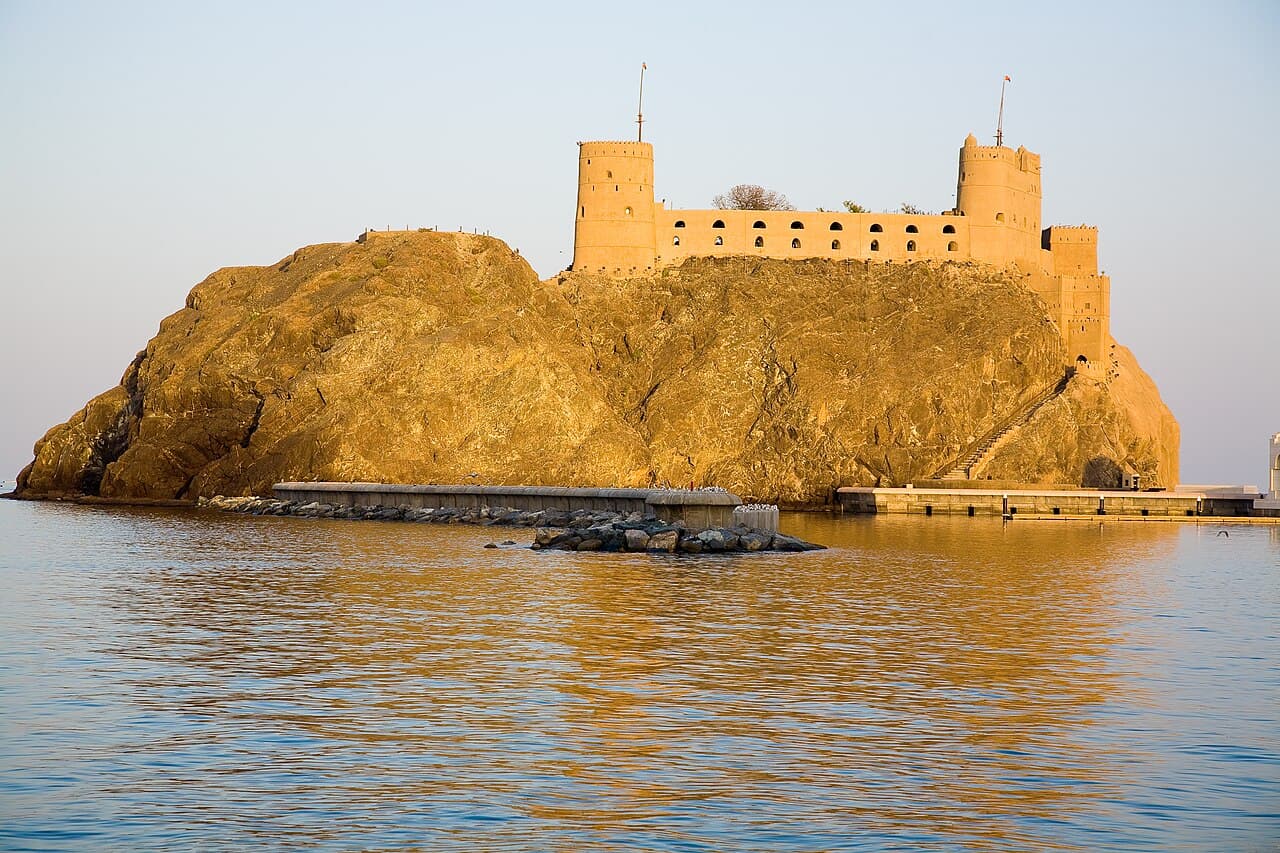
Fort Al Jalali is a prominent hill castle located in the municipality of Muscat, Oman, strategically perched on a rocky promontory overlooking the eastern side of Muscat harbor. Constructed by the Portuguese Empire in the late 16th century during their efforts to dominate maritime trade routes, the fort was built between 1586 and 1588 under the reign of King Philip I of Portugal. It stands on the foundations of an earlier Omani fortress, underscoring the site's longstanding military significance in controlling access to the vital Arabian Peninsula waters.
Historical context and construction
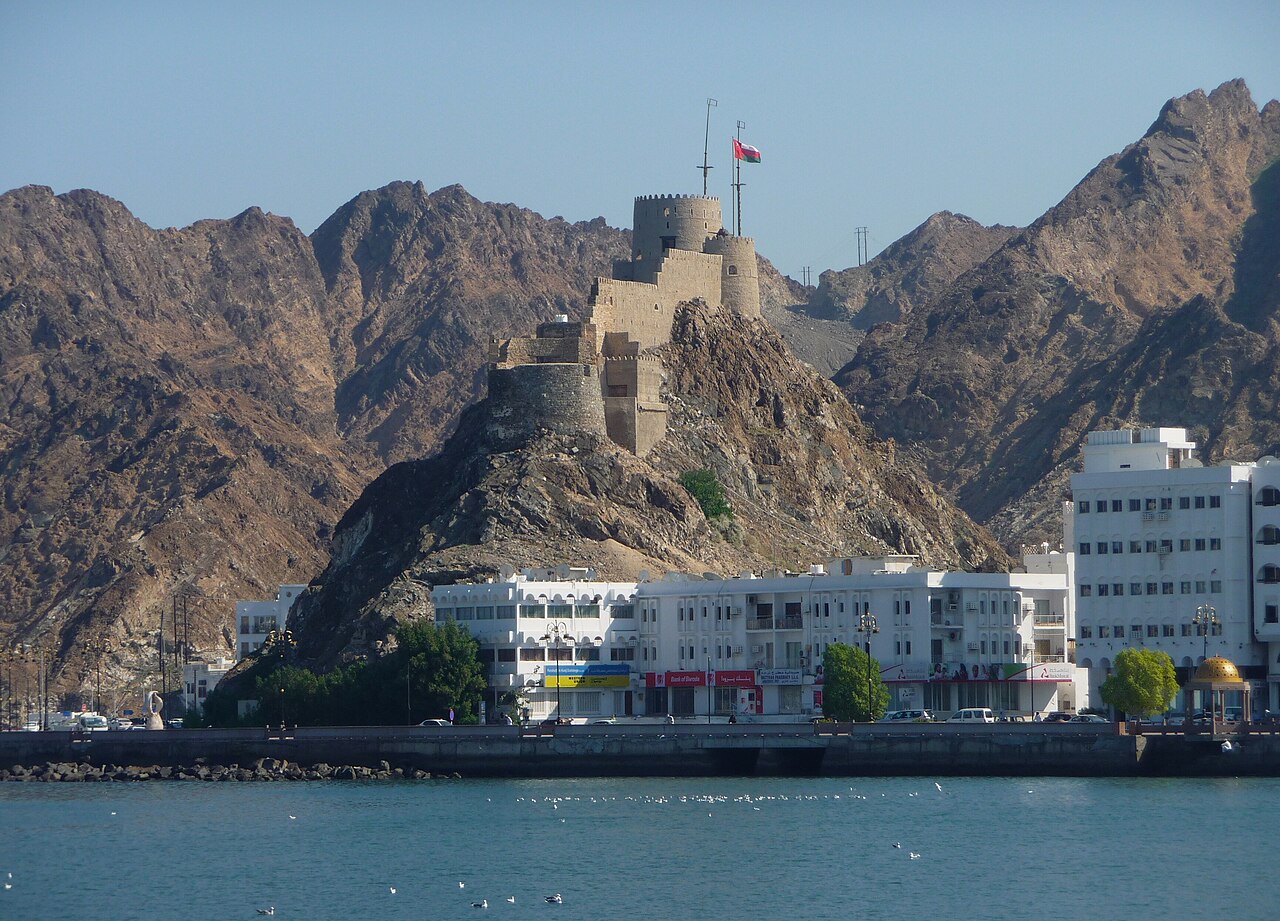
The fort's establishment followed repeated Ottoman attacks on Muscat, which had been raided twice, emphasizing the need for a robust defensive structure. Fort Al Jalali, alongside its twin Fort Al Mirani on the harbor's western side, formed a defensive system that controlled the natural harbor, protected by surrounding mountains and a rocky island. The Portuguese designed the fort to withstand artillery and infantry assaults, incorporating thick stone walls and strategically placed gun ports for cannon placement.
The fort's initial construction included leveling the rocky summit and steepening the surrounding cliffs to prevent enemy scaling. Its two main towers are linked by a curtain wall punctuated with cannon embrasures, commanding sweeping views of the harbor. The Portuguese also built a cistern to secure water supply during sieges, a critical feature for prolonged defense.
Omani capture and subsequent renovations
In 1650, Omani forces captured Fort Al Jalali after a significant siege, marking the decline of Portuguese influence in the region and the rise of Oman as a maritime power. The fort subsequently witnessed turbulent times during the Omani civil wars (1718–1747), when it was seized twice by Persian troops invited by rival Imams. These occupations caused damage that necessitated extensive rebuilding.
Renovations began in 1749 under the leadership of Ahmad bin Said al-Busaidi, founder of the Al Said dynasty. His work transformed the fort from a passive defense post into an active military base. Significant additions included large central buildings and new round towers, enhancing the fort's defensive and operational capabilities.
Role as a prison and political stronghold
Throughout the 18th and 19th centuries, Fort Al Jalali played a dual role as a military stronghold and a prison. It housed members of the royal family and political opponents, reflecting its importance in Omani internal power struggles. Into the 20th century, it continued as Oman's main prison, detaining approximately 200 inmates, including prisoners from the Jebel Akhdar War (1954–1959) and the Dhofar Rebellion (1962–1976). The prison conditions became notorious, leading to its closure in the 1970s.
Architectural features and layout
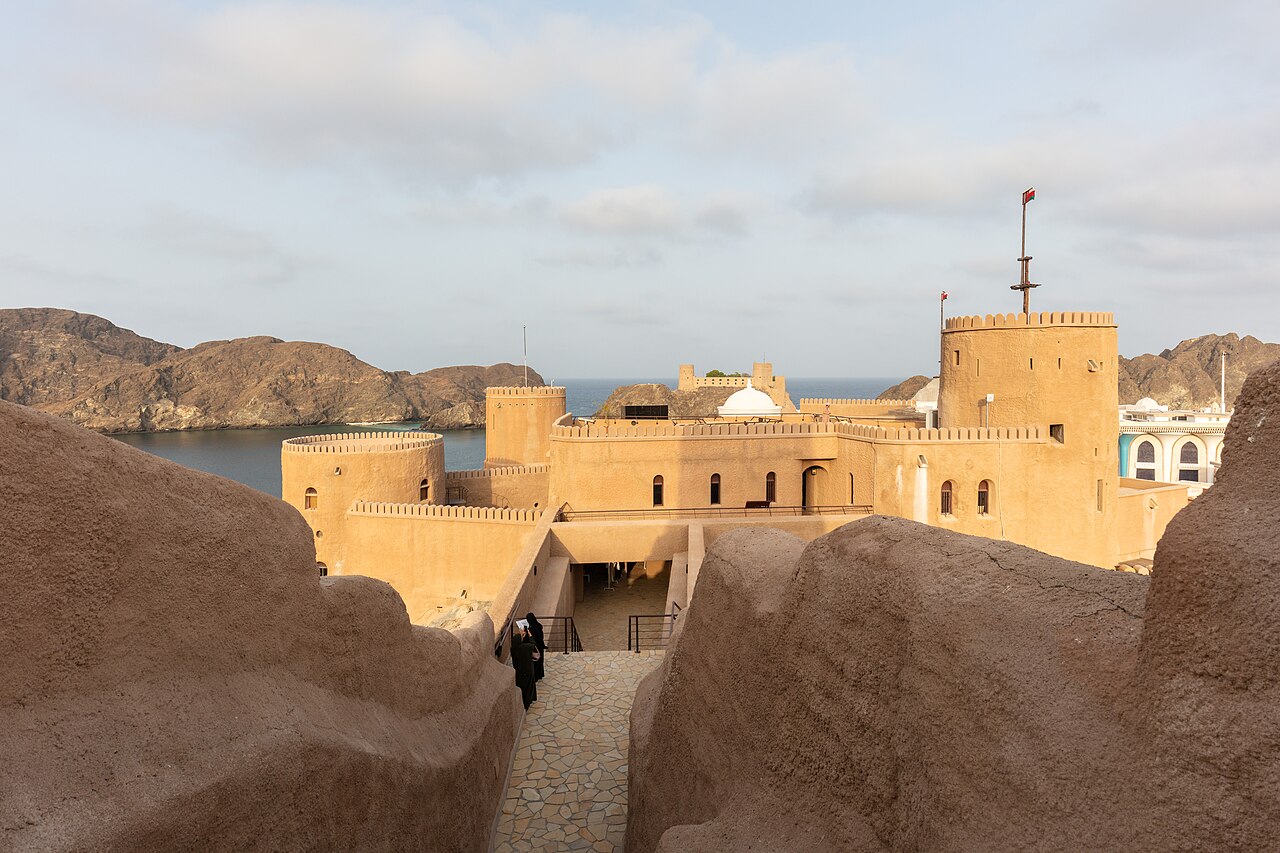
The fort's architecture is characterized by its adaptation to the rugged terrain, with stone and mortar construction blending into the rocky outcrop. The interior is organized around a central courtyard, which is unusually landscaped with trees, fountains, pools, and gardens, providing a contrast to the military nature of the fortress. Surrounding the courtyard are multiple rooms, enclosures, and towers arranged on several levels, interconnected by a complex network of stairways designed to control internal movement defensively.
Heavy wooden doors reinforced with iron spikes secure key areas, a typical defensive feature intended to delay attackers. The fort retains original cannons positioned at gun ports, along with ropes and cannonballs, illustrating its artillery heritage. The presence of old muskets and matchlock firearms further enriches its arms collection.
Additional displays include maps and historical illustrations, such as a plaque detailing the winds and currents of Muscat bay, highlighting the strategic maritime knowledge essential to the fort's operation. Domestic artifacts like rugs, pottery, jewelry, household utensils, and incense holders are exhibited within the central square tower, offering insight into the daily and ceremonial life of its occupants. A dining hall overlooking the courtyard was reserved for important guests.
One notable feature is an old manually operated breeze-maker device, now mechanized, demonstrating innovative ventilation solutions adapted to the local climate.
Modern adaptations and cultural significance
Historically, access to Fort Al Jalali was via a steep stone staircase ascending from the harbor. Modern developments include a funicular railway that facilitates easier ascent and a heliport constructed on adjacent reclaimed land, blending medieval martial architecture with contemporary infrastructure. The fort was restored in 1983 and converted into a private museum focusing on Omani cultural history, although access is restricted to dignitaries.
Fort Al Jalali continues to hold ceremonial importance during royal events in Muscat harbor, symbolizing Oman's maritime heritage and its historical resilience against foreign powers. Its preservation allows visitors and scholars to explore a rich legacy of military architecture, cultural artifacts, and the complex history of Oman's emergence as a regional power.
Frequently asked questions (FAQ)
- When was Fort Al Jalali built and by whom?
- Fort Al Jalali was built between 1586 and 1588 by the Portuguese Empire under King Philip I of Portugal to secure Muscat harbor.
- What role did Fort Al Jalali play in Omani history?
- The fort marked the decline of Portuguese influence after its capture by Omani forces in 1650 and served as a military base, prison, and ceremonial site throughout Oman's history.
- Can visitors tour Fort Al Jalali?
- Fort Al Jalali operates as a private museum accessible only to dignitaries, so general public tours are not available.
- What are the main architectural features of Fort Al Jalali?
- Key features include two main towers connected by a wall with gun ports, a central courtyard with gardens, heavy wooden doors with iron spikes, and a cistern for water storage.
- How is Fort Al Jalali accessed today?
- Today, access is facilitated by a funicular railway and a heliport, replacing the original steep stone staircase from the harbor.
Photo gallery

Information
Current owner
Omani government
Loading map...
Visitor reviews
No reviews yet. Been here? Write the first review and help other travelers!
Write the first reviewVisited this castle? Share your experience
Your review helps other travelers and adds first-hand knowledge to our encyclopedia.