Fort Friedrichsburg Gate
Fort Friedrichsburg Gate in Kaliningrad is the surviving entrance of the former Feste Friedrichsburg, a significant Renaissance fortification constructed in 1657 during the Second Northern War. Commissioned by Frederick William of Brandenburg-Prussia, the fort was strategically located on the southern shore of the Pregel River at the western edge of Königsberg. It replaced a former tollhouse and was integrated into the city's expanded defensive ring built between 1626 and 1634.
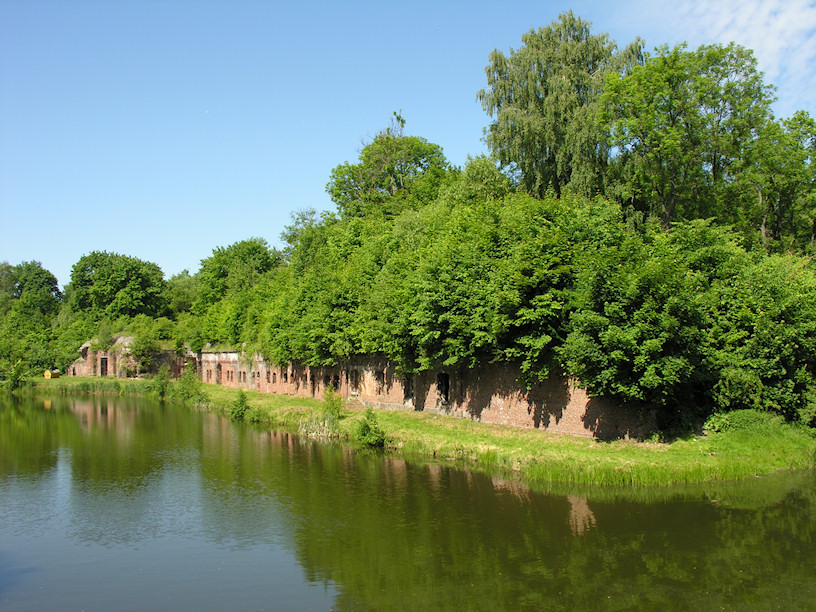
The fort's primary role was to defend the city from western approaches, control river traffic from the Frisches Haff, and suppress potential civil unrest. Its design was the work of Christian Otter, a court mathematician and professor at the Albertina University, reflecting the military engineering principles of the period. The fort was a square-shaped complex featuring four bastions named Smaragd, Perle, Rubin, and Diamant, constructed from a combination of earthworks, bricks, and defensive ditches.
Architectural design and fortifications
The original fortifications included only the northeastern bastion equipped with a cavalier and ravelin. Over time, additional defensive structures were added, including ravelins on the western and southern fronts, a cavalier on the southwestern bastion, and a covered way along the counterscarp. These enhancements likely took place during the Seven Years' War (1758–1762) when the fort was occupied by the Imperial Russian Army. However, these additions were not depicted on the 1815 plan by Valerianus Müller, indicating possible later modifications or removal.
The fort's interior housed a command building, lodging for the garrison, supplies, and prisons. It maintained a small permanent garrison of approximately 150 soldiers but was designed to accommodate larger forces if necessary. A garrison church, built in 1671, served the military personnel until 1816. An armory was constructed in 1796 but was dismantled by 1892.
Historical significance and military use
Peter I of Russia studied the fort during his European tour in 1697, highlighting its strategic importance. The fort also functioned as a state and military prison until 1825, notably incarcerating Ludwig Yorck von Wartenburg for insubordination between 1780 and 1781.
During the reign of King Frederick William IV of Prussia, the fort underwent significant remodeling in 1852. This included the construction of the imposing Friedrichsburg Gate, new defensive walls, and expansion of the citadel with four round towers. Despite these upgrades, by the late 19th century, the fort's military role diminished, and it was primarily used for storage.
Decline and modern restoration
In 1910, the fort was sold to the Prussian Eastern Railway to facilitate the construction of new tracks for Königsberg's goods station, leading to the dismantling of most of the fortifications. The Segelclub RHE relocated from Friedrichsburg to Contienen in 1914. Following World War II and the transfer of Königsberg to Soviet control as Kaliningrad, the site was repurposed for storage and automobile exhibitions.
During the 2010s, efforts began to restore the surviving Friedrichsburg Gate as part of the Museum of the World's Oceans. The gate remains a significant architectural relic representing the city's military history and Renaissance fortification techniques.
Location and surrounding districts
The fort was situated near the districts of Vorstadt to the east, Nasser Garten to the southwest outside the city walls, and Lastadie to the north across the river. Its position on the western edge of Königsberg allowed control over key access points and river traffic, essential for the city's defense and commerce during the 17th and 18th centuries.
Architectural features of the friedrichsburg gate
The Friedrichsburg Gate itself, completed during the reign of King Frederick William IV, exemplifies mid-19th-century military architecture with its stately design and robust construction. It served as the main entrance to the fort and was part of the broader modernization efforts that included new walls and round towers enhancing the fort's defensive capabilities.
Frequently asked questions (FAQ)
- What is the historical significance of Fort Friedrichsburg Gate?
- Fort Friedrichsburg Gate is a significant historical site in Kaliningrad, built in the early 18th century as part of the city's fortifications. It serves as an example of Prussian military architecture and reflects the region's complex history, particularly during the time of the Teutonic Knights and later Prussian rule.
- When was Fort Friedrichsburg Gate constructed?
- Fort Friedrichsburg Gate was constructed between 1715 and 1725 under the orders of King Frederick I of Prussia. It was designed to serve as a defensive structure and has withstood various historical changes over the centuries.
- Is it possible to visit Fort Friedrichsburg Gate?
- Yes, Fort Friedrichsburg Gate is open to visitors, allowing you to explore its impressive architecture and learn about its history. Guided tours are often available, providing deeper insights into the castle's significance and features.
- What are the opening hours for Fort Friedrichsburg Gate?
- Fort Friedrichsburg Gate typically operates from 10 AM to 6 PM, with extended hours during peak tourist seasons. It's recommended to check the official website or local listings for any changes in hours before your visit.
- Can I purchase tickets in advance for Fort Friedrichsburg Gate?
- Yes, tickets can often be purchased in advance through the official website or authorized ticket outlets. Buying tickets ahead of time is recommended, especially during the high tourist season, to avoid long queues.
- What is the best time to visit Fort Friedrichsburg Gate?
- The best time to visit Fort Friedrichsburg Gate is during the late spring and early autumn months when the weather is mild and pleasant. This timing also allows you to enjoy nearby parks and attractions without the summer crowds.
- Are there any nearby attractions to Fort Friedrichsburg Gate?
- Yes, nearby attractions include the Kaliningrad Cathedral and the Museum of the World Ocean, both of which offer unique insights into the rich history and culture of Kaliningrad. These sites can easily be included in a day trip itinerary.
- How accessible is Fort Friedrichsburg Gate for visitors with disabilities?
- Fort Friedrichsburg Gate has made efforts to improve accessibility for visitors with disabilities. However, it is advisable to check specific accessibility features in advance to ensure a comfortable visit.
Information
Loading map...
Visitor reviews
No reviews yet. Been here? Write the first review and help other travelers!
Write the first reviewVisited this castle? Share your experience
Your review helps other travelers and adds first-hand knowledge to our encyclopedia.