Forchtenstein Castle
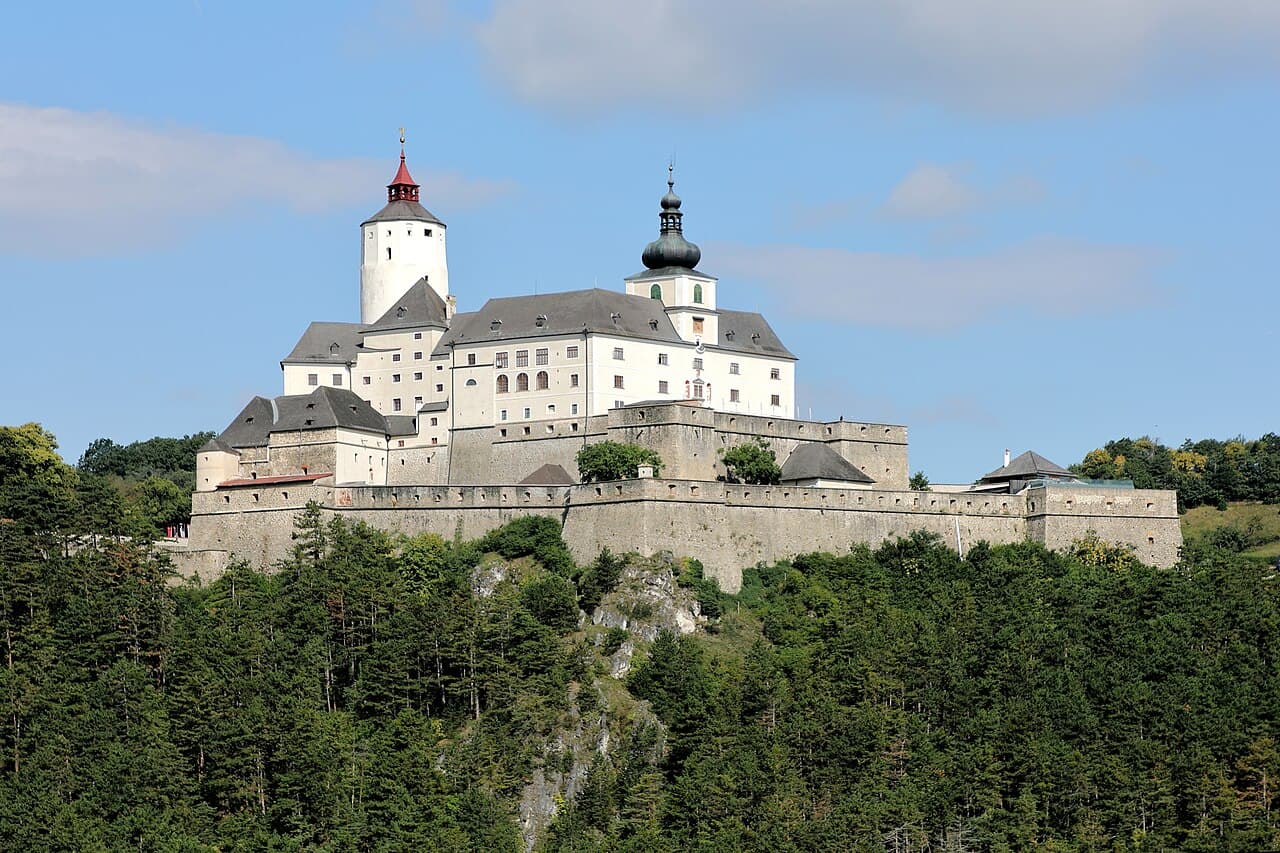
Forchtenstein Castle stands as a remarkable example of a late medieval hill castle perched 511 metres above sea level in the Burgenland region of Austria. Originating in the early 15th century, this fortress was initially constructed by the Lords of Mattersburg, who later adopted the name Lords of Forchtenstein. The castle’s strategic location atop a rocky hill overlooking the Wulka valley was chosen to control a vital trade route between the Danube and the Mediterranean, underscoring its military and economic importance during the Middle Ages.
The castle’s most prominent original feature is its towering 50-metre high keep, which served both defensive and symbolic purposes. Known as the Black Tower, this structure was once clad in black rock, now removed, and contains a notorious 12-metre deep prison pit used for condemned prisoners. Historical accounts recount the grim use of this prison by Rezallia, wife of Lettus of Forchtenstein, who sentenced many to death from within the tower itself, including her husband upon his return from military service.
Early history and habsburg ownership
Following the extinction of the male line of the Lords of Forchtenstein around 1450, the castle passed into the hands of the House of Habsburg. For nearly 170 years, the Habsburgs owned the fortress, leasing it to various noble families such as the Counts of Weissbriach and Hardegg. During this period, the castle’s structure remained largely unchanged, maintaining its defensive character without significant architectural modifications.
The esterházy era and baroque transformation
In 1622, Emperor Ferdinand II granted Forchtenstein Castle to Nikolaus Esterházy, founder of the western Hungarian Esterházy line, elevating him to the rank of Count. Recognizing the castle’s deteriorated state, Nikolaus initiated extensive fortification and refurbishment projects between 1630 and 1634. He commissioned the Viennese builder Simon Retacco and later the Italian architect Domenico Carlone to oversee the works. Skilled Italian craftsmen and stonemasons from the imperial quarry at Kaisersteinbruch, including Ambrosius Petruzzy, Pietro Maino Maderno, and Mathias Lorentisch, contributed to the castle’s reconstruction. The use of durable Kaiserstein limestone for portals, fountains, and cannonballs was a hallmark of this phase, with stone transported by large wagons drawn by six oxen.
Nikolaus’s son, Paul Esterházy, further expanded and ornamented the castle in the late 17th century. Under Paul’s direction and architect Domenico Carlone’s guidance, the fortress was transformed into a Baroque residence featuring elaborate frescoes, ornate portals with religious and allegorical sculptures, and a notable equestrian statue of Paul himself. This period marked a shift from purely military functions to a more refined aristocratic dwelling.
The treasure vault and collections
Following Paul Esterházy’s death in 1713, Forchtenstein Castle’s role evolved into that of a secure repository for the family’s extensive collections. These included weapons, archives, chronometers, exotic animal preparations, and other curiosities. The castle housed Europe’s last preserved Baroque art and wonder chamber in its original location, showcasing rare clocks, ivory carvings, and precious objects displayed in original glass-paned cabinets renowned as works of art themselves.
Access to the treasure vault was highly restricted, protected by a secret passage and a door requiring two separate keys simultaneously—one held by the Count and the other by his treasurer. This secure arrangement ensured the treasures remained intact even through turbulent periods, including World War II.
18th-century renovations and later history
In the latter half of the 18th century, master builder Ferdinand Mödlhammer undertook significant renovations, raising the roof truss and refurbishing the castle’s interiors. These enhancements preserved the castle’s architectural integrity while updating its living spaces and defensive structures.
Throughout the 19th century, Forchtenstein Castle remained a principal residence of the Esterházy family, symbolizing their aristocratic prestige. However, geopolitical changes following World War I, notably the separation of Austria and Hungary in 1921, divided the Esterházy estates. While the family’s financial records remained at Forchtenstein, their archives were relocated to the Hungarian Federal Archive in Budapest.
Modern era and cultural significance
From 1954 to 1983, the castle served as a venue for an annual theatrical festival, contributing to the region’s cultural landscape. Today, it remains under the ownership of the Esterházy private foundation and functions as a museum dedicated to preserving the family’s history and treasures.
The castle complex includes a robust defensive system of multi-level bastions and walls, accessible only through a single western gate once protected by a drawbridge. The main tower continues to dominate the skyline, symbolizing centuries of military and aristocratic power.
Restoration efforts have preserved the castle’s historic fabric, including wall repairs and the construction of a wooden viewing walkway. The historic cellar vault is maintained and occasionally used for events, maintaining the castle’s role as a living monument.
Architectural highlights
Forchtenstein Castle’s architecture reflects a blend of late medieval fortress design and Baroque refinement. The original bergfried or main tower served as a watchtower and last line of defense. The extensive use of Kaiserstein limestone during the 17th-century reconstruction provided both durability and aesthetic appeal.
The castle’s courtyard is adorned with some of the largest and most impressive frescoes north of the Alps, illustrating religious and political themes. The Baroque chapel within the castle is richly decorated with stucco and frescoes, historically reserved for noble weddings and now accessible to the public for ceremonies and events.
The fortress also features a unique secret treasure vault with an ingenious dual-key security system, exemplifying the Esterházy family’s wealth and desire for safeguarding their valuables.
The black tower and prison pit
The Black Tower remains one of the castle’s most intriguing features. Originally clad in black rock, it housed a deep prison pit used for capital punishment. This grim chamber is a stark reminder of the castle’s medieval judicial practices and the harsh realities of noble rule during the era.
Visiting forchtenstein castle
Today, Forchtenstein Castle welcomes visitors interested in history, architecture, and aristocratic heritage. The museum displays the Esterházy family’s collections, including military artifacts, Baroque art, and curiosities from their extensive archives.
The castle’s picturesque setting and historic ambiance make it a sought-after location for weddings and cultural events. Its Baroque chapel remains a popular venue, celebrated for its artistic decoration and historical significance.
Visitors can explore the castle’s fortified walls, towers, and courtyards, gaining insight into centuries of European noble life and military architecture. Guided tours provide detailed information about the castle’s history, architecture, and the Esterházy family legacy.
Opening hours and ticket prices vary seasonally, and visitors are advised to check the official website or local tourist information for current details. The castle is accessible by car and public transport, located near the town of Forchtenstein in the Burgenland region.
Frequently asked questions (FAQ)
- How do I get to Forchtenstein Castle?
- Forchtenstein Castle is conveniently located just 10 kilometers from the city of Eisenstadt in Austria. You can reach it by car via the A2 motorway, or by taking public transport with a train to Eisenstadt followed by a short bus ride. Ample parking is available on-site for visitors driving to the castle.
- What is the historical significance of Forchtenstein Castle?
- Forchtenstein Castle has a rich history dating back to the 13th century and served as a stronghold for the Esterházy family. It played a crucial role during various conflicts in Central Europe and is renowned for its well-preserved architecture and historical artifacts. Today, it stands as a testament to the region's feudal past and offers insight into the noble lifestyle of the time.
- When was Forchtenstein Castle built?
- Construction of Forchtenstein Castle began in the late 13th century, with significant expansions and renovations occurring over the centuries. The castle was strategically built on a hill to provide a defensive advantage and has been a key location in numerous historical events. Its architecture reflects various styles that have evolved through its long history.
- Can I visit Forchtenstein Castle year-round?
- Yes, Forchtenstein Castle is open to visitors year-round, although specific opening hours may vary by season. It's advisable to check the official website for the latest updates on opening times and any potential closures for maintenance or special events. A visit during the warmer months often allows for a more enjoyable experience due to the outdoor areas.
- Why is Forchtenstein Castle a popular tourist attraction?
- Forchtenstein Castle attracts visitors due to its stunning views, fascinating history, and impressive collection of artifacts, including armor and weaponry from various periods. The castle's architecture and picturesque setting make it a perfect spot for photography and exploration. Additionally, guided tours provide in-depth insights into its history and significance.
- Is it possible to take guided tours of the castle?
- Yes, guided tours of Forchtenstein Castle are available and highly recommended for a more enriching experience. These tours offer detailed information about the castle's history, architecture, and notable artifacts. Audio guides are also available in multiple languages for those who prefer to explore at their own pace.
- What are the ticket prices for visiting Forchtenstein Castle?
- Ticket prices for Forchtenstein Castle vary depending on age and group size, with discounts available for students and seniors. Children under a certain age often receive free admission. It’s best to check the official website for the most current pricing and any special offers that might be available during your visit.
- What are the opening hours for Forchtenstein Castle?
- Forchtenstein Castle typically opens at 10 AM and closes at 5 PM, but these hours can vary depending on the season. During peak tourist seasons, the castle may have extended hours to accommodate visitors. Always verify the current opening hours on the official website before planning your visit.
- What are some nearby attractions to Forchtenstein Castle?
- In addition to Forchtenstein Castle, visitors can explore the beautiful city of Eisenstadt, home to the Haydn Museum and Esterházy Palace. The surrounding area offers scenic hiking trails and vineyards, perfect for those looking to enjoy nature and local wine. Plan a full day to take advantage of all that this historic region has to offer.
Photo gallery

Information
Website
Visit websiteSources & official resources
Verify the information above using these authoritative references.
Loading map...
Visitor reviews
No reviews yet. Been here? Write the first review and help other travelers!
Write the first reviewVisited this castle? Share your experience
Your review helps other travelers and adds first-hand knowledge to our encyclopedia.