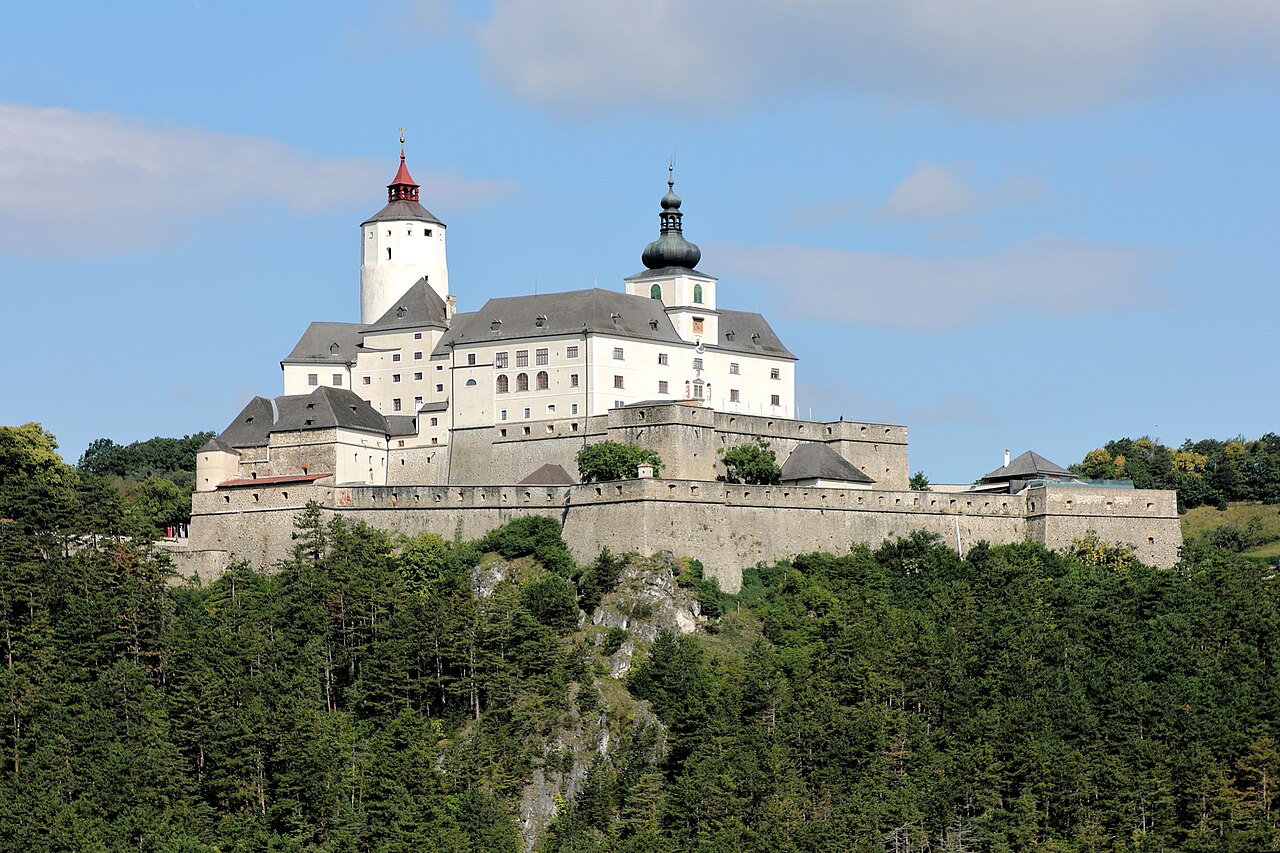
Kobersdorf Castle
Kobersdorf Castle stands as a significant example of a Renaissance castle built upon the foundations of an earlier 13th-century moated fortress in Kobersdorf, Austria. The site’s history extends back to the era of Ludwig the German (806-876), with the first documented mention of the castle dating to 1229. This early fortress played a strategic role during the turbulent medieval period, enduring its first siege in 1270 and experiencing several captures and recaptures through the late 13th century.
Medieval origins and early history
The original fortress was constructed as a defensive stronghold, surrounded by a moat, typical of medieval fortifications. Its strategic importance is highlighted by its involvement in regional conflicts, including the siege of 1270 and subsequent battles in 1280 and 1289. The peace treaty of Hainburg in 1291, concluded by Duke Albrecht I and King Ándrás III, marked a significant moment in the castle’s history, stabilizing the region for a time.
Ownership and noble connections
In 1319, the castle and its estates were sold by King Karl Robert to Count Simon II of Forchtenstein-Mattersburg. The Forchtenstein family had notable ties to the Spanish court through the brothers of Tota, a Spanish court lady of the Hungarian king. These family members had distinguished themselves in the Spanish Reconquista, earning the right to incorporate the Spanish eagle into their coat of arms. Around 1430, Count Wilhelm Forchtenstein-Mattersburg undertook artistic decoration of the fortress, of which only the baptistery remains today. He also shifted the family’s main residence from Forchtenstein to Kobersdorf.
Late gothic and renaissance transformations
The castle changed hands multiple times during the 15th century. In 1445, Wilhelm Forchtenstein pawned the estates to Duke Albrecht VI of Austria, who sold it to his brother, Emperor Friedrich III, in 1451. Following Wilhelm’s death in 1466, the estates were subject to complex legal and political disputes involving the Hungarian kingdom and the Austrian Habsburgs. Notably, Matthias Corvinus, King of Hungary, briefly conquered Kobersdorf in 1458, but it remained under Austrian control according to the peace of Sopron in 1463.
During this period, significant architectural additions were made in the late Gothic style, including the construction of a western rampart and a larger chapel in 1482. These elements reflected the evolving military and religious functions of the castle.
In 1529, the Weisspriach family expanded the fortress into a castle, incorporating Renaissance architectural features and extending the ramparts. This transformation marked a shift from purely defensive purposes to a more residential and representative function, blending military robustness with Renaissance aesthetics.
Turkish siege and decline
The castle’s military significance was tested again in 1683 during the Ottoman wars, when the Turks captured Kobersdorf and ordered the demolition of the original fortress structures that had coexisted with the Renaissance castle. This event marked the end of the castle’s role as a fortress.
Ownership under the esterházy family and later uses
In 1704, the estate was sold to Paul I. Fürst Esterházy, after which the castle ceased to be a primary residence. This change contributed to the preservation of its architectural style but also led to gradual neglect. Over the centuries, the castle served various functions, including quarters for French officers in 1809, a military prison during World War I and World War II, and a station for the Russian Red Army after World War II.
A fire in 1876 caused significant damage to the roof, further impacting the castle’s condition. Despite these challenges, parts of the castle have survived and are now used for cultural events such as concerts, exhibitions, and seminars. The castle is also available for private events like weddings and celebrations, with guided tours offered by arrangement.
Architectural features and preservation
Kobersdorf Castle showcases a blend of late Gothic and Renaissance architectural styles, visible in its ramparts, chapel, and residential structures. The castle’s layout reflects its evolution from a medieval fortress to a Renaissance residence, with defensive walls adapted to the changing needs of warfare and comfort.
The surviving baptistery from the early fortress period is a rare example of medieval artistic decoration. The Renaissance expansions introduced more refined elements such as symmetrical layouts and decorative stonework, typical of the period’s architectural trends in Central Europe.
Current status and visitor information
Today, Kobersdorf Castle is a partially preserved Renaissance castle open to the public by guided tours. It serves as a cultural venue hosting various events throughout the year. Its preservation allows visitors to appreciate the layers of history embedded in its walls, from medieval fortifications to Renaissance elegance.
Frequently asked questions (FAQ)
- How do I get to Kobersdorf Castle?
- Kobersdorf Castle is easily accessible by car and is located just off the A2 motorway. If you are using public transport, you can take a train to the nearby town of Oberpullendorf and then a taxi or local bus to the castle.
- What is the historical significance of Kobersdorf Castle?
- Kobersdorf Castle dates back to the late Middle Ages and has served as a noble residence and a strategic stronghold. Its rich history includes being owned by the prominent Esterházy family, which played a crucial role in the region's history and culture.
- When was Kobersdorf Castle built?
- The construction of Kobersdorf Castle began in the 13th century, with significant renovations and expansions occurring in subsequent centuries. This long history has resulted in a unique blend of architectural styles from different periods.
- Can I take guided tours of Kobersdorf Castle?
- Yes, guided tours are available and highly recommended for visitors who want to learn more about the castle's fascinating history and architecture. Tours are typically conducted in both German and English, offering insights into the castle's past and its significance in the region.
- Why is Kobersdorf Castle a popular tourist destination?
- Kobersdorf Castle is popular due to its stunning architecture, beautiful surroundings, and rich historical background. Visitors appreciate the opportunity to explore the castle's grounds, learn about its history, and enjoy cultural events held throughout the year.
- Is it possible to host events at Kobersdorf Castle?
- Yes, Kobersdorf Castle offers facilities for hosting various events such as weddings, conferences, and cultural gatherings. The picturesque setting and historical ambiance make it an ideal location for memorable occasions.
- What are the opening hours for Kobersdorf Castle?
- Kobersdorf Castle is open to visitors from Tuesday to Sunday, with specific hours varying by season. It is advisable to check the official website for the most current opening times and any special closures.
- What are the ticket prices for visiting Kobersdorf Castle?
- Ticket prices for Kobersdorf Castle vary depending on age and type of tour. Discounts are often available for children, students, and seniors, making it an affordable outing for families and groups.
- What is the best time to visit Kobersdorf Castle?
- The best time to visit Kobersdorf Castle is during the spring and early autumn months when the weather is mild and pleasant. Additionally, various cultural events and exhibitions are often held during these seasons, enhancing the visitor experience.
- Are there any nearby attractions to Kobersdorf Castle?
- Yes, there are several attractions near Kobersdorf Castle, including the scenic Burgenland countryside and local wineries that offer tastings. Additionally, the nearby towns of Oberpullendorf and Rechnitz provide opportunities for exploring regional culture and history.
Information
Website
Visit websiteSources & official resources
Verify the information above using these authoritative references.
Loading map...
Visitor reviews
No reviews yet. Been here? Write the first review and help other travelers!
Write the first reviewVisited this castle? Share your experience
Your review helps other travelers and adds first-hand knowledge to our encyclopedia.