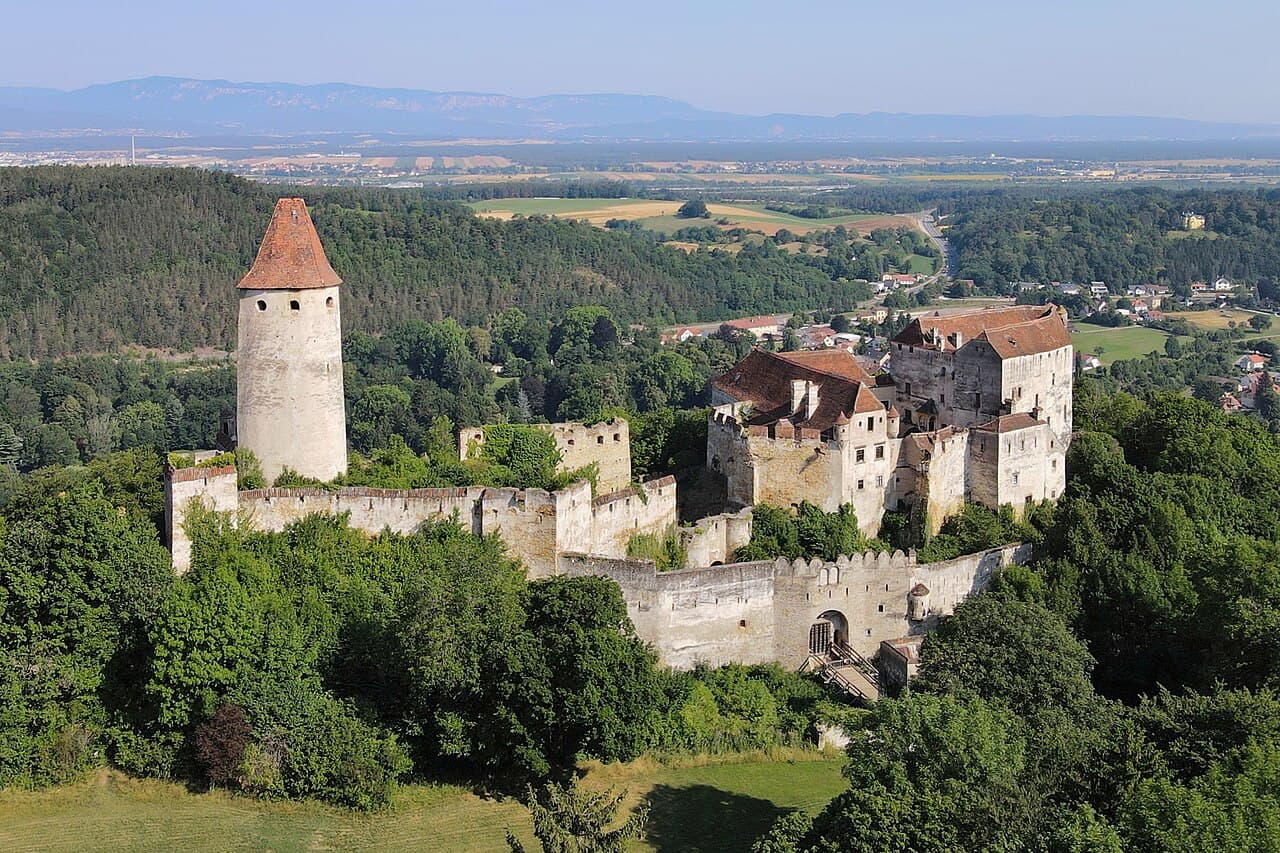
Burg Seebenstein
Burg Seebenstein is a remarkable hilltop castle located in the municipality of Seebenstein, Austria, perched strategically above the Pitten valley. This castle complex is notable for its division into two main parts: the Old Castle, dating primarily from the 13th century, featuring a distinctive round bergfried or keep, and the New Castle, constructed between the 15th and 17th centuries, which served as a grand palace with Renaissance enhancements and fortified defenses.
The castle's origins trace back to the early medieval period, with its founding attributed to Gottfried von Wels-Lambach around 1045. Its location on a prominent hill was chosen for its commanding views over the valley, which was historically a vital trade route established by Roman legionaries. This strategic position made Burg Seebenstein an important defensive stronghold throughout the High Medieval period and beyond, particularly in protecting the region of Styria from incursions such as raids by Hungarian cavalry.
Early history and strategic importance
The castle first appears in historical documents between 1159 and 1170, with the emergence of the noble family von Seebenstein, who took their name from the castle itself. Ownership changed hands several times among prominent regional families, including the Formbach, von Wildenstein, von Lichtenstein, and von Königsberg families. Each contributed to the castle's development and fortification, reflecting the shifting political and military landscape of Austria in the medieval era.
In 1379, the castle was acquired by Duke Leopold III of Habsburg but was soon sold to Hans Auer von Herrenkirchen. The castle endured a significant siege in 1488 during the conflicts between the Habsburgs and King Matthias Corvinus of Hungary, demonstrating its strategic military value. Later, in 1683, Burg Seebenstein successfully resisted an Ottoman siege during the Austro-Turkish wars, further cementing its reputation as a resilient fortress.
Architectural evolution and features
The old castle
The Old Castle is centered around the round bergfried, which rises approximately 23 meters high with seven floors separated by wooden ceilings. Originally, the tower featured a higher, more pointed roof, but this was reduced in height during later centuries. The bergfried was built primarily from rubble stone, a typical medieval construction material, and had a high entrance accessed by a drawbridge, which was later sealed in the 17th century to enhance defense.
This part of the castle also contained a residential palace, now largely in ruins, which was supplemented by Renaissance fortifications in the 16th century. The Old Castle functioned as a forework, a fortified outpost protecting the main complex, with a southern entrance accessible only via a drawbridge over two gates. These features illustrate the castle's adaptation to evolving military technologies and the need for layered defense.
The new castle and renaissance transformation
Constructed on a higher part of the hill, the New Castle consists of roughly forty rooms and was developed between the 15th and 17th centuries. This section reflects Renaissance architectural influences and was transformed into a palace-castle complex with updated fortifications suited to the period's military demands.
The New Castle houses a significant museum collection, including medieval weapons, paintings, tapestries, and art objects. Among the highlights is a statue of the Virgin Mary sculpted by Veit Stoß, a renowned late Gothic artist, and formerly a "Madonna" by Tilman Riemenschneider. The castle chapel, notable for its unique triangular floor plan, contains an altar wing from around 1550 and marble sculptures of Saints Peter and Paul attributed to Nikolaus Gerhaert, one of the most important sculptors of the late Gothic period.
The residential wings surrounding the courtyard were mainly built or remodeled in the 16th century. In 1734, the northwest wing's second floor was converted into a Baroque ballroom, which later served as a gathering hall for the Wildensteiner Knightly Society. The castle interior also features a library with a celestial globe created by the cartographer Peter Anich, as well as collections of musical instruments, porcelain, and Gothic statues.
Cultural significance and preservation
Throughout its history, Burg Seebenstein has been more than a military fortress; it has served as a cultural and social center. In the late 18th century, the castle hosted the Wildensteiner Knightly Society on Blue Earth, a chivalric organization founded by Anton David Steiger, a scientist and entrepreneur. This society used parts of the castle as its meeting place until its dissolution in 1824.
In the 19th century, the castle fell into decline as the von Pergen family built a new residence in the valley below. However, efforts to preserve and romanticize the site began with Prince Johann I von Lichtenstein commissioning artificial ruins to enhance the castle's picturesque landscape.
During the 20th century, the castle experienced partial restoration under the ownership of the von Nehammer family. Lilly Nehammer-Prinz funded restorations focused on the residential buildings, converting them into a museum space showcasing medieval art. Remarkably, Burg Seebenstein avoided damage during World War II and remains privately owned today by Christine Vopara, Lilly's grandniece.
The castle grounds and natural setting
Burg Seebenstein is surrounded by dense forest and lies at the heart of a large natural park, offering visitors a scenic and tranquil environment. The castle's hilltop location provides commanding views of the Pitten valley and surrounding landscape, emphasizing its historical role as a watchpoint and defensive position.
The combination of medieval, Renaissance, and Baroque architectural elements, alongside its rich collections and well-preserved features, make Burg Seebenstein a significant cultural heritage site. Its preservation allows visitors to explore centuries of Austrian history, art, and architecture within a single, evocative location.
Frequently asked questions (FAQ)
- How do I get to Burg Seebenstein?
- Burg Seebenstein is located in the town of Seebenstein in Lower Austria, accessible by car or regional public transport. The castle sits on a hill, so be prepared for a short uphill walk from the parking area or bus stop.
- What are the opening hours for visiting Burg Seebenstein?
- Visiting hours may vary seasonally, but the castle is generally open to visitors during daylight hours. It is advisable to check the official website or contact the current owner for the most accurate and up-to-date information.
- Is there an entrance fee to visit Burg Seebenstein?
- Entrance fees may apply for guided tours or museum access within the castle. Prices can vary, so visitors should verify current ticket costs before their visit.
- What can I see inside Burg Seebenstein?
- Inside Burg Seebenstein, visitors can explore a collection of medieval weapons, paintings, tapestries, and sculptures including works by Veit Stoß and Nikolaus Gerhaert. The castle chapel and Baroque ballroom are notable highlights.
- Can I visit the castle chapel at Burg Seebenstein?
- Yes, the chapel is part of the New Castle complex and features a unique triangular floor plan with valuable altar wings and marble sculptures. It is accessible during guided tours or special events.
- Is Burg Seebenstein wheelchair accessible?
- Due to its hilltop location and historic architecture, Burg Seebenstein has limited wheelchair accessibility. Visitors with mobility concerns should inquire in advance about available accommodations.
Photo gallery

Information
Sources & official resources
Verify the information above using these authoritative references.
Loading map...
Visitor reviews
No reviews yet. Been here? Write the first review and help other travelers!
Write the first reviewVisited this castle? Share your experience
Your review helps other travelers and adds first-hand knowledge to our encyclopedia.



