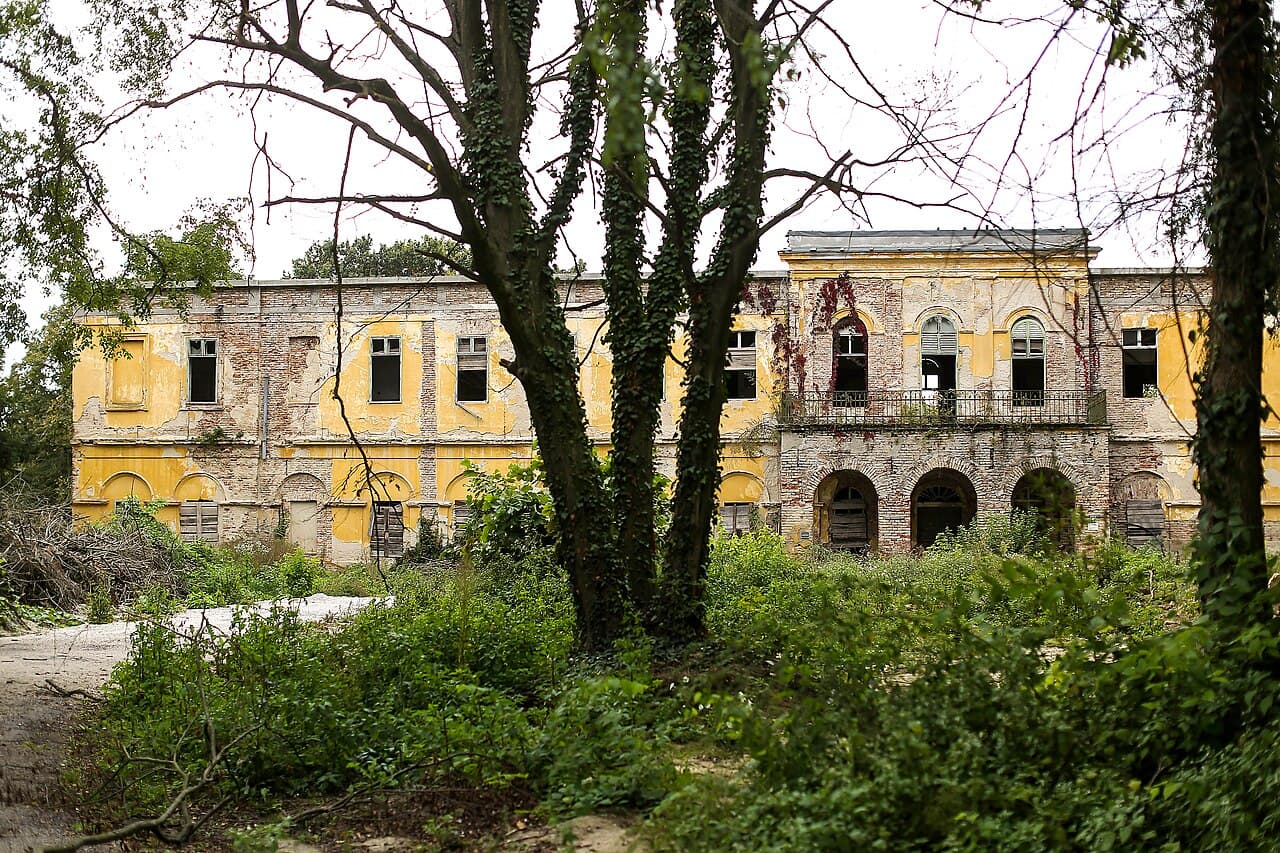
Festetics Mansion, Alsóbogát — Hungary castle

Festetics Mansion, Alsóbogát

Festetics Mansion, Alsóbogát: a baroque palace in Hungary
Post-Renaissance (17th–18th c.)
Well Preserved

The Festetics Mansion in Alsóbogát, Hungary, is a notable example of Baroque architecture that reflects the grandeur of Hungarian aristocratic residences. Unlike traditional defensive castles, this mansion served as a luxurious noble residence and a symbol of wealth and status during the 18th century. It is situated in a rural setting, surrounded by landscaped gardens and parkland, typical of aristocratic estates of the period.

Historical background of Festetics Mansion

The mansion was constructed in the 18th century by the Festetics family, an influential noble family in Hungary known for their patronage of the arts and culture. The Festetics family played a significant role in Hungarian history, especially in the development of the region's cultural and architectural heritage. The mansion was primarily built as a residence rather than a fortress, reflecting the peaceful conditions of the era and the shift in aristocratic lifestyles from military defense to comfort and display.

Architectural features and style

The mansion exemplifies Baroque architectural style, characterized by its symmetrical layout, ornate decorations, and grand facades. The building typically includes a central block with two wings, creating a U-shaped plan that opens onto a formal garden or courtyard. The facades often feature decorative elements such as pilasters, stucco work, and sculptural details that emphasize the elegance and artistic taste of the owners.

The interior of the mansion is equally impressive, with richly decorated rooms, frescoed ceilings, and elaborate woodwork. The design aimed to provide a comfortable and opulent living environment, with spacious halls for social gatherings and private chambers for the family.

Estate grounds and surroundings

The mansion is set within extensive grounds that include formal gardens, tree-lined avenues, and possibly water features such as ponds or fountains. These landscaped areas were designed to complement the architectural grandeur of the mansion and provide a serene environment for leisure and outdoor activities. The estate's layout reflects the Baroque ideal of harmonizing architecture with nature.

Current condition and significance

Today, the Festetics Mansion is well preserved and serves as a cultural heritage site that offers insight into the lifestyle of Hungarian nobility in the 18th century. It attracts visitors interested in historic architecture, aristocratic history, and the evolution of Hungarian estates. The mansion's preservation allows for the appreciation of Baroque design principles and the artistic achievements of the period.

Visiting information and cultural impact

The mansion is accessible to the public during specific visiting hours, often featuring guided tours that explain its architectural details and historical context. It may host cultural events, exhibitions, and educational programs that promote Hungarian heritage. Visitors can explore the mansion's interiors, gardens, and surrounding parkland, gaining a comprehensive understanding of aristocratic life in historical Hungary.

Frequently asked questions (FAQ)

What is the historical significance of Festetics Mansion?
Festetics Mansion, located in Alsóbogát, is a stunning example of the Hungarian Baroque architectural style and serves as a symbol of the Festetics family's influence in the region. Constructed in the 18th century, it reflects the cultural and historical developments of Hungary during that period.
When was Festetics Mansion built?
The construction of Festetics Mansion began in the late 18th century, specifically around 1760, and was completed in the early 19th century. It was built as a hunting lodge and later transformed into a family residence, showcasing the wealth and status of the Festetics family.
Can I visit Festetics Mansion, and what are the opening hours?
Yes, you can visit Festetics Mansion! The mansion is open to visitors from Tuesday to Sunday, with guided tours available throughout the day. It is recommended to check the official website for the most current opening hours and any special events.
What are the ticket prices for visiting Festetics Mansion?
Ticket prices for Festetics Mansion vary depending on the type of tour you choose. Generally, adult tickets are priced around 2,000 HUF, while discounts are available for students and seniors, making it accessible for all visitors.
Is it possible to explore the gardens surrounding Festetics Mansion?
Yes, visitors can enjoy the beautifully landscaped gardens around Festetics Mansion, which are an integral part of the estate. The gardens feature a variety of flora and provide a serene atmosphere for leisurely walks and exploration.
When is the best time to visit Festetics Mansion?
The best time to visit Festetics Mansion is during the spring and early autumn months when the weather is pleasant and the gardens are in full bloom. Additionally, visiting during these times often allows you to enjoy various cultural events and festivals hosted at the mansion.
What nearby attractions can I explore after visiting Festetics Mansion?
After visiting Festetics Mansion, consider exploring the nearby town of Keszthely, which is home to the famous Helikon Castle and the Balaton Museum. Additionally, Lake Balaton, one of Hungary's most popular tourist destinations, is just a short drive away and offers various recreational activities.
How do I get to Festetics Mansion from Budapest?
To reach Festetics Mansion from Budapest, you can take a train or bus to Keszthely and then use local transportation or a taxi to get to Alsóbogát. The journey typically takes about two to three hours, making it a convenient day trip from the capital.
Is Festetics Mansion accessible for visitors with disabilities?
Yes, Festetics Mansion is committed to providing accessible facilities for all visitors. The mansion has made efforts to ensure that entrances and pathways accommodate those with mobility challenges, allowing everyone to enjoy the rich history and beauty of the estate.

Photo gallery

Festetics Mansion, Alsóbogát
Click to view

Photo by Villabogart•CC BY-SA 4.0

1 photo • Click any image to view in full screen

Information

Lowland Castle

Loading map...

Visitor reviews

No reviews yet. Been here? Write the first review and help other travelers!

Write the first review

Visited this castle? Share your experience

Your review helps other travelers and adds first-hand knowledge to our encyclopedia.
Write a review

(5/5)

0/2000 characters

Your review will be visible after admin approval

Nearby castles

25.1 km
Szigliget Castle — Hungary castle

Szigliget Castle

Szigliget, Hungary

Szigliget Castle stands prominently on a volcanic hill rising 234 meters above Lake Balaton in Hungary. Constructed in the 13th century by Favus Abbot of Pannonhalma and completed in 1262, this hill castle played a vital role in the region's medieval defensive network. Originally built by the Benedictine monks of the Pannonhalma Abbey, the castle was a fortified religious site that also served as an administrative center. Its strategic location on a former island, now a peninsula due to 19th-century water regulation, gave it commanding views over the lake and surrounding lands. The castle's initial construction featured a palace wing flanked by two towers, enclosed within thick stone walls. This layout formed a compact, defensible complex approximately 75 meters long and 20 meters wide. The robust fortifications reflected the architectural style and military needs of the High Medieval period, with a focus on stone masonry and simple but effective defensive elements. Historical development and ownership In 1262, King Béla IV acquired the castle through a land exchange and entrusted its management to the Móriczhidai family, members of the noble Pok clan. Over the following centuries, the castle changed hands multiple times, reflecting the turbulent political landscape of medieval Hungary. In 1441, ownership was granted to Kolos Jeromos Némai by King Ulászló I, but by 1445, the influential Újlaki family controlled the fortress until 1521. Subsequently, the Tóti-Lengyel family held the castle for several centuries. During the 16th century, Szigliget Castle became a critical military stronghold in the defense against the advancing Ottoman Empire. Commanded by notable military leaders such as Bálint Magyar and István Lengyel (1567–1581), the fortress withstood significant pressure. A notable siege in 1531, led by Imre deák Martonfalvay, was documented in detail, describing the combat and subsequent rebuilding efforts from 1531 to 1540. These renovations included strengthening walls and expanding the fortress to better resist artillery and infantry assaults. Architectural features and defensive structures The castle's architecture evolved with the changing military technologies and threats. The upper section retains the original palace wing and two towers from the 13th century. Below lies the larger northern section, developed mainly in the 15th and 16th centuries, measuring approximately 75 by 50 meters. This area includes a distinctive rondel, a circular bastion designed to provide overlapping fields of fire and improved defense against attackers. Complementing the main fortress was the Óvár, or old castle, a smaller fortification situated on a nearby hill. This outpost functioned as a lookout and naval base for Hungarian naszád ships, which patrolled Lake Balaton to prevent Turkish raids. The coordinated defense system integrated land and naval elements, highlighting the strategic importance of controlling both the lake and surrounding territory. Damage, decline, and restoration efforts The castle suffered significant damage in 1645 due to a large fire but was rebuilt under the direction of Boldizsár Lengyel. Later, in 1697, a lightning strike ignited stored gunpowder in one of the towers, causing a devastating explosion that destroyed much of the structure. Following the end of Ottoman occupation, the castle's military relevance diminished, and in 1702, Emperor Leopold ordered its demolition. Local inhabitants repurposed the castle's stones for other building projects, accelerating its decline. In the 20th century, several restoration initiatives helped stabilize and preserve the ruins. Major efforts occurred in 1913, 1953, and 1965–66, focusing on reinforcing walls and partially reconstructing key elements. More recently, the castle has been included in Hungary's National Castle Program launched around 2017–2018, aiming to enhance conservation and promote cultural tourism. Cultural significance and visitor experience Szigliget Castle is a prominent cultural landmark, offering visitors panoramic views of Lake Balaton and the surrounding countryside. The ruins attract history enthusiasts and tourists interested in medieval architecture and Hungarian heritage. The site provides insight into the defensive strategies employed during the High Medieval and Early Modern periods, showcasing the evolution of fortification techniques across centuries. Visitors can explore the remains of the palace wing, towers, and the northern rondel bastion, gaining an appreciation for the castle's strategic design. Archaeological investigations continue to reveal details about the Óvár and the naval defenses on Lake Balaton, enriching the historical narrative of the site. Overall, Szigliget Castle stands as a testament to Hungary's medieval resilience and the complex interplay of religious, military, and noble influences shaping its history.

High Medieval (11th–13th c.)
Details
25.4 km
Rezi Castle — Hungary castle

Rezi Castle

Rezi, Hungary

Rezi Castle stands as a striking example of a medieval hill castle strategically perched on a dolomite rock outcrop at the northern edge of the Keszthely Plateau in Hungary. Built in the late 13th century by members of the noble Péc family, notably Apor and Lukács, it was established to oversee the lands granted by King Ladislaus IV in 1282. The castle's location offered commanding views over the Szántó Basin, utilizing the natural steep slopes of the rocky promontory as a formidable defensive advantage. Historical significance and ownership through the centuries The castle's history is deeply intertwined with the turbulent feudal conflicts of medieval Hungary. Throughout the 14th and 15th centuries, Rezi Castle changed hands multiple times among prominent noble families and royal authorities. In 1321, it was recaptured from the Kőszegi family by royal forces led by Alexander Köcski, reflecting the ongoing power struggles of the period. Under the reign of King Louis I, the castle came into possession of the Lackfi brothers, influential nobles who played a significant role in Hungarian politics. After the Lackfi family's fall from grace in 1397, control of Rezi Castle reverted to the crown. Subsequently, it was entrusted to various religious and noble figures, including bishops of the Albeni family and later the Pethő family. The Pethő family maintained ownership from the early 15th century until the extinction of their male line in 1729, marking a long period of relative stability for the fortress. Despite occasional interruptions such as a brief Habsburg occupation in 1490 and confiscation during the civil war of 1440, the castle's military importance declined by the mid-16th century. However, its defenses were reinforced in response to increasing Ottoman incursions, especially after raids in 1554. The castle's decline accelerated towards the end of the 16th century. Ottoman forces occupied and set fire to Rezi Castle in 1589. By 1592, official records described the fortress as ruined, noting the deliberate destruction of its two gate towers to prevent further military use. Despite this, the ruins remained a prominent landmark in the region for centuries. Following the extinction of the Pethő family, ownership passed to the Hungarian treasury. In 1741, the estate was acquired by the Festetics family, who retained control until the nationalization of properties after 1945. Between 2000 and 2012, archaeological excavations and restoration efforts stabilized and partially reconstructed the ruins, preserving the castle's historical legacy. Architectural features and defensive design Rezi Castle's design masterfully integrates with its natural setting. The fortress occupies a steep rise of dolomite rock, which provides natural protection through sharply sloping sides that hinder attackers. The castle's defensive system included a deep dry moat excavated around the rock, enhancing its impregnable character. The inner ward was enclosed by a curtain wall fortified with two gate towers, which controlled access and served as key defensive points. The elongated courtyard within these walls contained a prominent residential tower at the rear, which combined both living quarters and defensive functions, forming the heart of the castle's inner defenses. In the late 16th century, the castle underwent fortification enhancements documented by the Italian military engineer Giulio Turco. His illustrations depict the dry moat and the distinctive double-towered curtain walls, highlighting the strategic military adaptations made in response to the Ottoman threat. Ruins and archaeological significance Excavations have revealed the foundations and remnants of the castle's walls and towers, with clear evidence of fire damage and intentional dismantling, particularly the destruction of the two gate towers to prevent reuse. Today, these ruins remain partially preserved and have been stabilized and partially reconstructed to maintain the castle's overall form. The surviving structures rest on the original rocky foundation, showcasing the medieval builders' adept use of natural terrain for defense. While no detailed inscriptions or decorative elements have been found, the site holds significant historical value as a well-defined example of a medieval Hungarian fortress adapted to its landscape. Access to Rezi Castle's ruins is free, allowing visitors to appreciate the site's historical and architectural importance while enjoying panoramic views of the surrounding landscape. Cultural heritage and modern preservation efforts The castle is an important cultural landmark in Hungary, reflecting the region's medieval history and architectural traditions. The long-term stewardship by noble families such as the Pethő and Festetics has contributed to the preservation of its legacy. Modern archaeological and restoration campaigns between 2000 and 2012 have been crucial in stabilizing the ruins and preventing further decay. These efforts have included structural reinforcement and partial reconstruction, ensuring that Rezi Castle remains an accessible and educational site for historians, architects, and tourists alike. Rezi Castle continues to attract visitors interested in medieval architecture, military history, and Hungarian heritage, offering a tangible connection to the past amidst its dramatic natural setting.

Late Medieval (14th–15th c.)
Details
28.4 km

Castle Fácános

Hungary, Hungary

Castle Fácános, located in Fonyód, Hungary, stands as a significant relic of the turbulent 16th century when the region faced repeated Ottoman incursions. This hill castle was strategically constructed to fortify the area and protect local inhabitants during a period marked by conflict and shifting power dynamics. The castle's history is deeply intertwined with the early settlement of Fonyód, originally under the ownership of the Lád clan following the Hungarian conquest and later controlled by the Pannonhalma Abbey, reflecting its ecclesiastical ties. The earliest documented mention of Castle Fácános dates to 1548, but the fortification efforts began earlier, around 1544, under the guidance of Boldizsár Lengyel, a nobleman from Lengyeltóti. He reinforced the existing Árpád-era church and its surroundings, creating what became known as the Lower Castle (Alsóvár). This transformation included the construction of protective walls and moats, a direct response to the Ottoman conquest of Buda in 1541, which heightened the need for robust local defenses. Architectural features and fortifications The castle's layout was a roughly 60 by 60-meter square enclosure, featuring a double-layered defense system comprising an outer and inner ward. This design was typical of medieval fortifications aimed at providing multiple lines of defense. The walls were primarily wooden palisades, supplemented by water-filled moats that served to slow and deter attackers. The main entrance faced what is now Szent István Street, controlled by drawbridges spanning the outer moat and connecting the outer and inner courtyards. Within the inner ward, the foundational remains of the fortified Árpád-period church mark the castle's core. This stone foundation served as a refuge during sieges. Surrounding the church were thick defensive walls enclosing several wooden buildings, including a watchtower used for surveillance and early warning against enemy advances. Although the original wooden structures have largely decayed, reconstructions based on historical plans have provided insights into their original form. Historical significance and military role Castle Fácános was a vital defensive stronghold during the Ottoman-Hungarian conflicts. Under the command of Palonai Magyar Bálint, who inherited the fortress through marriage, the castle's fortifications were enhanced to withstand repeated Ottoman attacks. The castle successfully resisted several sieges until 1575, the year of Magyar Bálint's death and the castle's eventual capture and destruction by Ottoman forces. The castle's importance is underscored by its inclusion in a detailed 1569-70 plan created by the imperial engineer Giulio Turco. This plan not only documented the castle's layout but later became instrumental in archaeological excavations conducted in the mid-20th century. Archaeological excavations and preservation efforts Between 1957 and 1959, archaeologist Jenő Fitz led excavations at the site, utilizing Giulio Turco's historic plans to accurately identify the castle's footprint and structural elements. These studies revealed the configuration of the moats, surviving wall footings, and the layout of the Lower Castle, enriching understanding of the castle's defensive architecture. From the late 1950s until 2013, the site hosted the Fonyódi Hadijátékok, annual reenactments commemorating the castle's military history. Although these events have ceased, the wooden structures built for them remain on site, gradually succumbing to natural decay. Current state and visitor experience Today, Castle Fácános exists primarily as an archaeological site with visible earthworks and stone foundations that outline its former stronghold. Visitors can explore the remains of the fortified church, the moats, and the castle's general layout within a park setting that also serves as a playground. While the wooden reconstructions have deteriorated, the site offers a tangible connection to Hungary's 16th-century defensive heritage and the historical struggles against Ottoman expansion. The castle's location on a hill provided strategic oversight of the surrounding landscape, a critical factor in its defensive capabilities. Its design reflects the adaptation of medieval fortification techniques to the challenges posed by the Ottoman threat, emphasizing layered defenses and controlled access points. Architectural style and construction period Castle Fácános is classified as a hill castle built during the high to late medieval period, specifically in the mid-16th century. Its construction incorporated traditional medieval defensive elements such as wooden palisades, moats, and a central fortified church, blending ecclesiastical architecture with military needs. The use of wood and earthworks, rather than extensive stone masonry, reflects the urgent and resource-conscious nature of fortifications built during this era of frequent conflict. Historical context and ownership The castle's history is closely linked to the broader geopolitical struggles in Hungary during the 16th century, particularly the Ottoman expansion following the fall of Buda. Ownership transitioned from noble families like the Lád clan and Lengyel family to ecclesiastical authorities such as the Pannonhalma Abbey, illustrating the intertwined secular and religious interests in regional defense. Palonai Magyar Bálint's role in maintaining and enhancing the castle's defenses highlights the importance of noble leadership in local military organization. The castle's eventual fall in 1575 marked a significant moment in the Ottoman conquest of the region, ending its active military role but leaving a lasting historical legacy.

Details