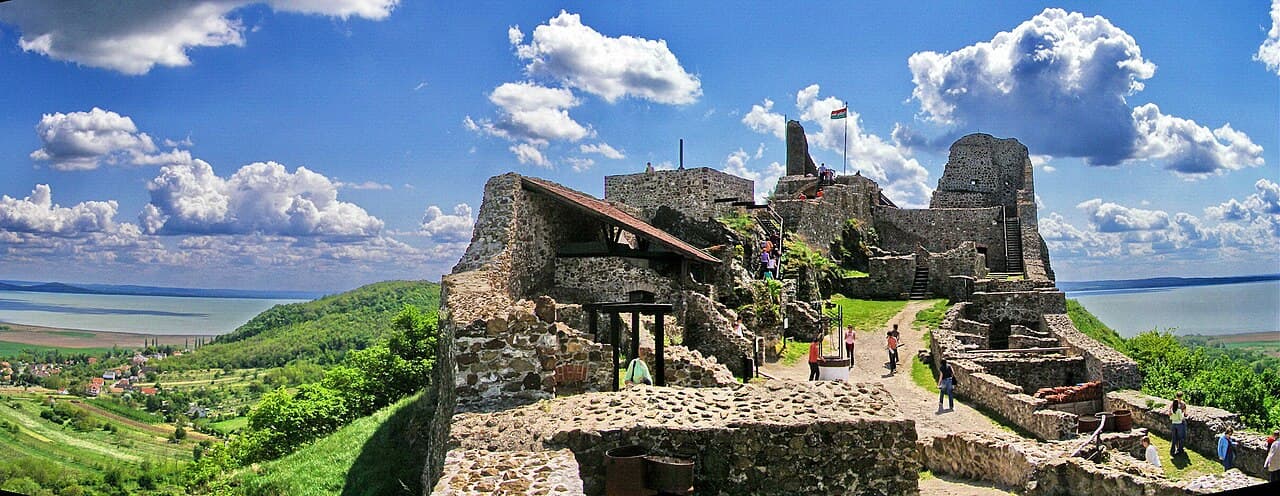
Szigliget Castle
Szigliget Castle stands prominently on a volcanic hill rising 234 meters above Lake Balaton in Hungary. Constructed in the 13th century by Favus Abbot of Pannonhalma and completed in 1262, this hill castle played a vital role in the region's medieval defensive network. Originally built by the Benedictine monks of the Pannonhalma Abbey, the castle was a fortified religious site that also served as an administrative center. Its strategic location on a former island, now a peninsula due to 19th-century water regulation, gave it commanding views over the lake and surrounding lands.
The castle's initial construction featured a palace wing flanked by two towers, enclosed within thick stone walls. This layout formed a compact, defensible complex approximately 75 meters long and 20 meters wide. The robust fortifications reflected the architectural style and military needs of the High Medieval period, with a focus on stone masonry and simple but effective defensive elements.
Historical development and ownership
In 1262, King Béla IV acquired the castle through a land exchange and entrusted its management to the Móriczhidai family, members of the noble Pok clan. Over the following centuries, the castle changed hands multiple times, reflecting the turbulent political landscape of medieval Hungary. In 1441, ownership was granted to Kolos Jeromos Némai by King Ulászló I, but by 1445, the influential Újlaki family controlled the fortress until 1521. Subsequently, the Tóti-Lengyel family held the castle for several centuries.
During the 16th century, Szigliget Castle became a critical military stronghold in the defense against the advancing Ottoman Empire. Commanded by notable military leaders such as Bálint Magyar and István Lengyel (1567–1581), the fortress withstood significant pressure. A notable siege in 1531, led by Imre deák Martonfalvay, was documented in detail, describing the combat and subsequent rebuilding efforts from 1531 to 1540. These renovations included strengthening walls and expanding the fortress to better resist artillery and infantry assaults.
Architectural features and defensive structures
The castle's architecture evolved with the changing military technologies and threats. The upper section retains the original palace wing and two towers from the 13th century. Below lies the larger northern section, developed mainly in the 15th and 16th centuries, measuring approximately 75 by 50 meters. This area includes a distinctive rondel, a circular bastion designed to provide overlapping fields of fire and improved defense against attackers.
Complementing the main fortress was the Óvár, or old castle, a smaller fortification situated on a nearby hill. This outpost functioned as a lookout and naval base for Hungarian naszád ships, which patrolled Lake Balaton to prevent Turkish raids. The coordinated defense system integrated land and naval elements, highlighting the strategic importance of controlling both the lake and surrounding territory.
Damage, decline, and restoration efforts
The castle suffered significant damage in 1645 due to a large fire but was rebuilt under the direction of Boldizsár Lengyel. Later, in 1697, a lightning strike ignited stored gunpowder in one of the towers, causing a devastating explosion that destroyed much of the structure. Following the end of Ottoman occupation, the castle's military relevance diminished, and in 1702, Emperor Leopold ordered its demolition. Local inhabitants repurposed the castle's stones for other building projects, accelerating its decline.
In the 20th century, several restoration initiatives helped stabilize and preserve the ruins. Major efforts occurred in 1913, 1953, and 1965–66, focusing on reinforcing walls and partially reconstructing key elements. More recently, the castle has been included in Hungary's National Castle Program launched around 2017–2018, aiming to enhance conservation and promote cultural tourism.
Cultural significance and visitor experience
Szigliget Castle is a prominent cultural landmark, offering visitors panoramic views of Lake Balaton and the surrounding countryside. The ruins attract history enthusiasts and tourists interested in medieval architecture and Hungarian heritage. The site provides insight into the defensive strategies employed during the High Medieval and Early Modern periods, showcasing the evolution of fortification techniques across centuries.
Visitors can explore the remains of the palace wing, towers, and the northern rondel bastion, gaining an appreciation for the castle's strategic design. Archaeological investigations continue to reveal details about the Óvár and the naval defenses on Lake Balaton, enriching the historical narrative of the site.
Overall, Szigliget Castle stands as a testament to Hungary's medieval resilience and the complex interplay of religious, military, and noble influences shaping its history.
Frequently asked questions (FAQ)
- How do I get to Szigliget Castle?
- Szigliget Castle is accessible by car or local bus from nearby towns. It is located on a hill in the village of Szigliget, Veszprém region, Hungary.
- What is the best time to visit Szigliget Castle?
- The best time to visit is during the warmer months from late spring to early autumn when the weather is pleasant and the views of Lake Balaton are spectacular.
- Can I explore the castle ruins on my own?
- Yes, visitors can freely explore the castle ruins. Informational signs are available to guide you through the historical and architectural highlights.
- Is Szigliget Castle suitable for families?
- Absolutely. The castle ruins offer an engaging experience for families, with open spaces for children to explore and panoramic views that appeal to all ages.
- Are there guided tours available at Szigliget Castle?
- Guided tours are sometimes offered, especially during peak tourist seasons. It is advisable to check with the local visitor center for availability and schedules.
Photo gallery

Information
Opening hours
9:00-18:00, daily
Ticket prices
€3 adult, €1.5 child
Current owner
State museum
Website
Visit websiteSources & official resources
Verify the information above using these authoritative references.
Loading map...
Visitor reviews
No reviews yet. Been here? Write the first review and help other travelers!
Write the first reviewVisited this castle? Share your experience
Your review helps other travelers and adds first-hand knowledge to our encyclopedia.


