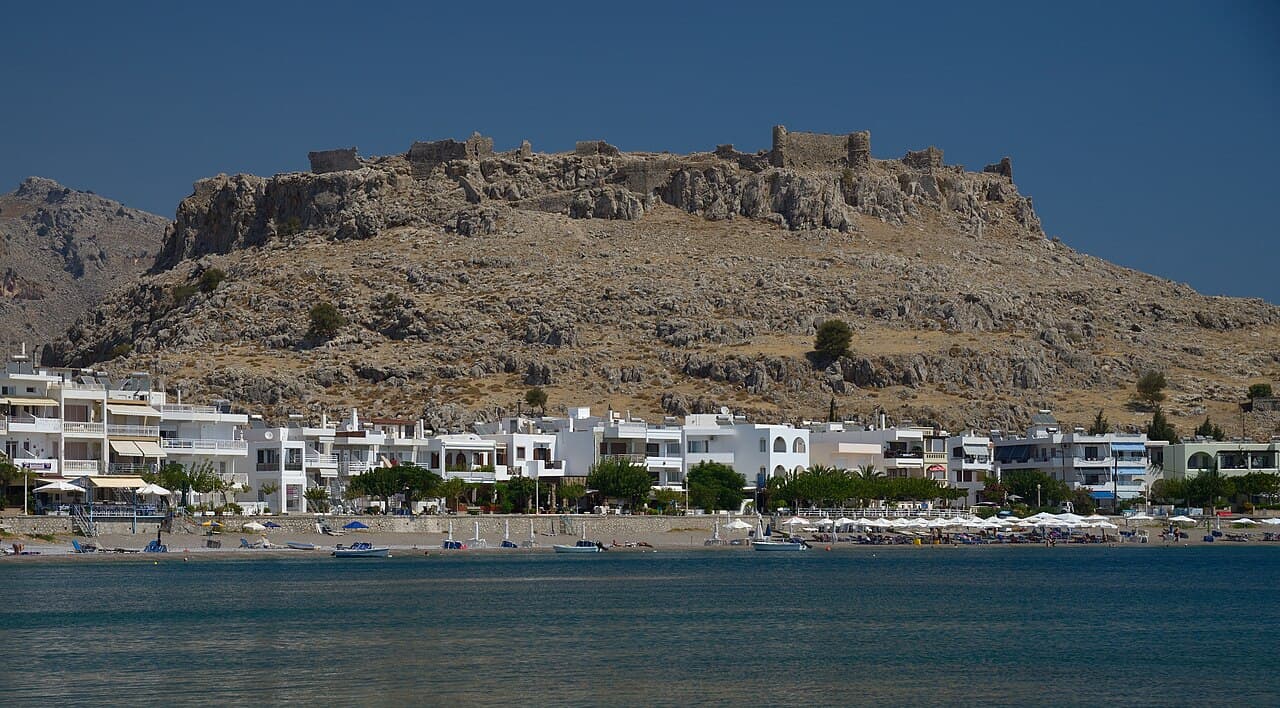
Feraklos
Feraklos Castle stands as a remarkable example of a Renaissance bastioned fortress located on the eastern coast of the island of Rhodes, Greece. Perched atop a steep hill rising 85 meters above sea level, the castle commands sweeping views of the surrounding landscape, including the nearby beaches of Agia Agathi and Charaki and the village of Malona. Its strategic location reflects its historical role as a military stronghold controlling fertile lands and coastal anchorages.
The origins of Feraklos Castle trace back to the Byzantine period, when an earlier fortification occupied the site. By the early 14th century, the castle had become a base for Arab pirates, exploiting its defensible position for maritime raids. On 20 September 1306, the Knights Hospitaller (also known as the Order of St. John) captured Feraklos, marking their first conquest on Rhodes as they began their island-wide campaign. Despite this early acquisition, the castle fell into disuse and ruin by 1408, as recorded in contemporary documents.
Restoration and military significance in the renaissance
The castle’s revival occurred during the late 15th century under the leadership of two notable Grand Masters of the Knights Hospitaller: Giovanni Battista Orsini (1467–1476) and Pierre d’Aubusson (1476–1503). They undertook extensive restoration and fortification efforts to transform Feraklos into a robust bastioned fortress capable of withstanding the evolving threats of the period, particularly from the expanding Ottoman Empire.
The fortress was redesigned with an irregular polygonal layout encompassing approximately 1,700 square meters, with a wall perimeter measuring about 680 meters. The defensive walls incorporated square-shaped battlements (crenellations) and a protective parapet, providing cover for defenders. The northern and northwestern sections of the walls retain elements from the Byzantine era, while the southern portions feature additions from the Hospitaller renovations, including two cylindrical Gothic towers and a single main gate.
Feraklos played a vital role as a refuge for local villagers from nearby settlements such as Malona, Salia, Katagros, Zenodotou, and Kaminari, as decreed in 1474. It also served as a prison for military captives and detained Arab and Turkish merchants captured during naval raids conducted by the Knights Hospitaller in the eastern Mediterranean.
Siege and abandonment
The fortress successfully resisted an Ottoman assault in 1445, demonstrating its defensive strength during early Ottoman attempts to seize Rhodes. However, the strategic situation changed dramatically in the early 16th century. Following the prolonged siege and fall of the city of Rhodes, Feraklos Castle was captured by the forces of Sultan Suleiman the Magnificent on 3 January 1523. The defenders were reportedly massacred, and the fortress was abandoned shortly thereafter.
The Ottomans did not maintain or garrison the castle, which gradually fell into ruin. Today, Feraklos remains a ruined fortress, with only fragments of its walls, towers, and internal structures still visible. Despite the damage, visitors can still appreciate the scale and layout of the fortress, as well as its commanding views over the surrounding countryside and coastline.
Architectural features and surviving elements
The castle’s surviving structures include sections of the original Byzantine walls with their characteristic crenellations on the northern and northwestern sides. To the south, the remains of two round Gothic towers stand as testament to the Hospitaller enhancements. The fortress’s single gate survives near these towers, providing insight into the controlled access points of the complex.
Inside the fortress, remnants of internal chambers and a well-preserved cistern highlight the castle’s capacity to sustain a garrison and local population during sieges. The cistern was essential for collecting and storing water, a critical feature for any fortress in the Mediterranean climate.
Local legends speak of underground passages beneath the castle, adding an element of mystery and intrigue to the site. While these tunnels have not been fully explored or confirmed, they contribute to the cultural heritage and storytelling surrounding Feraklos.
Historical and cultural significance
Feraklos Castle is significant not only for its military history but also as a symbol of the Knights Hospitaller’s presence on Rhodes and their efforts to defend the island against Ottoman expansion. It represents the transitional architectural styles from the Byzantine period through the Renaissance, reflecting the evolving needs of fortress design in response to gunpowder weaponry and changing warfare tactics.
Its capture by the Ottomans marked a pivotal moment in the island’s history, signaling the end of Hospitaller dominance and the beginning of Ottoman rule. Although now a ruin, Feraklos continues to attract visitors interested in medieval and Renaissance military architecture, as well as those fascinated by the layered history of Rhodes.
Visiting feraklos castle today
Today, Feraklos Castle is accessible to visitors who can explore the ruins and enjoy panoramic views of the surrounding landscape. The site offers a tangible connection to Rhodes’ complex history, from Byzantine fortifications to the Knights Hospitaller’s military campaigns and the Ottoman conquest.
While the castle is in a state of ruin, the visible remains provide valuable insights into fortress construction and defensive strategies of the Renaissance period. Visitors can observe the surviving walls, towers, battlements, and cistern, gaining an appreciation for the architectural ingenuity of the time.
Its elevated position above the village of Charaki makes it a popular destination for hikers and history enthusiasts alike. The castle’s location also offers excellent opportunities for photography, especially of the coastal scenery below.
Frequently asked questions (FAQ)
- How do I get to Feraklos Castle?
- Feraklos Castle is located near the village of Charaki on the eastern coast of Rhodes. Visitors can reach the site by car or on foot via local roads and hiking trails from nearby villages.
- What is the historical significance of Feraklos Castle?
- Feraklos Castle was the first fortress captured by the Knights Hospitaller on Rhodes in 1306 and played a key role in the island's defense during the Renaissance period before falling to the Ottomans in 1523.
- Can I explore the ruins of Feraklos Castle?
- Yes, visitors can freely explore the ruins, including surviving walls, towers, and the cistern. The site offers panoramic views and insights into medieval and Renaissance fortress architecture.
- When was Feraklos Castle built and by whom?
- The original fortification dates back to the Byzantine era, but the castle was significantly rebuilt and fortified by the Knights Hospitaller during the late 15th century under Grand Masters Giovanni Battista Orsini and Pierre d’Aubusson.
- Is Feraklos Castle accessible for people with limited mobility?
- Due to its hilltop location and uneven terrain, access to Feraklos Castle may be challenging for visitors with limited mobility. Proper footwear and caution are recommended.
Photo gallery

Information
Loading map...
Visitor reviews
No reviews yet. Been here? Write the first review and help other travelers!
Write the first reviewVisited this castle? Share your experience
Your review helps other travelers and adds first-hand knowledge to our encyclopedia.


