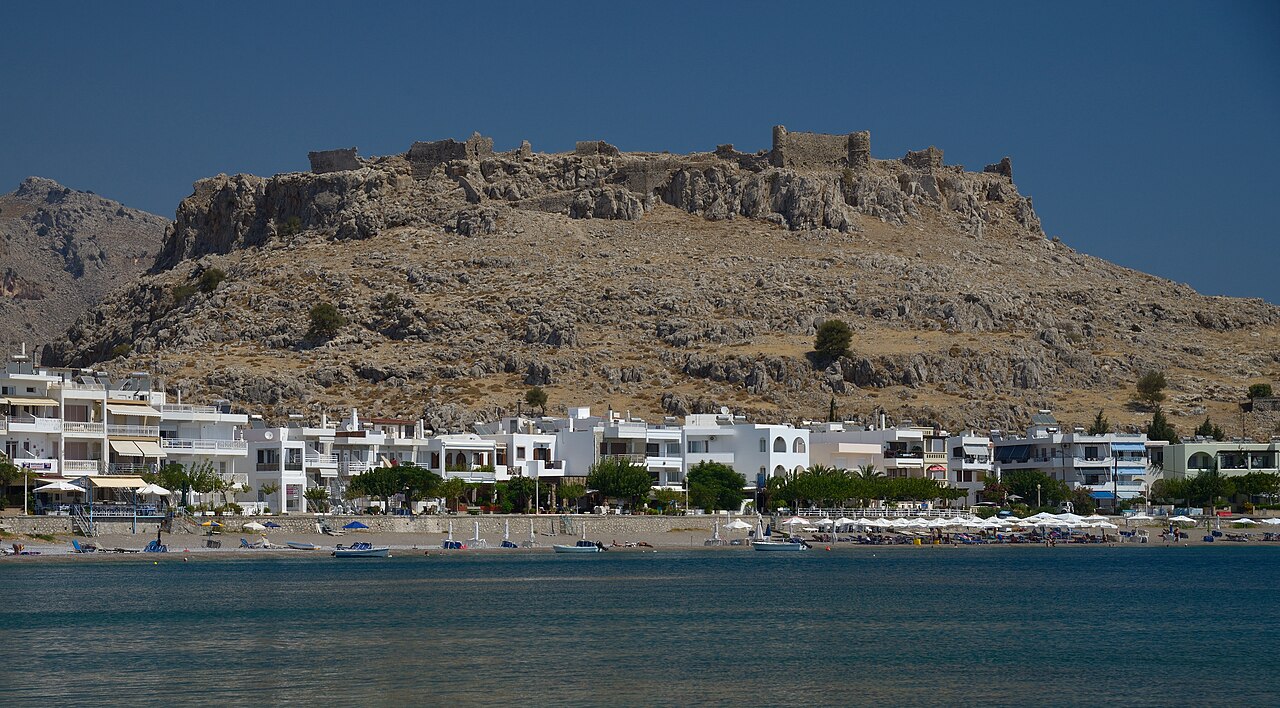
Lardos
Lardos Castle stands as a significant historical monument located approximately 0.5 km from the village of Lardos on the island of Rhodes, Greece. This medieval bastioned fortress occupies a strategic hilltop rising over 40 meters, offering commanding views of the surrounding landscape. The site was initially chosen for its excellent defensive advantages, which were recognized and utilized as early as the Byzantine period in the 12th century.
The original fortress was constructed during the Byzantine era, serving as a crucial fortification to control and monitor the area. Its elevated position on the hill allowed for effective surveillance and defense against potential invaders. The fortification's importance grew significantly in the early 14th century when the Knights of the Order of St. John seized Rhodes in 1309. Seeking to consolidate their control over the island, the knights repurposed existing fortifications, including the Byzantine fortress at Lardos, adapting them to their military needs.
Historical context and strategic importance
The capture of Rhodes by the Knights Hospitaller marked a pivotal moment in the island's history. After their expulsion from the Holy Land, the knights were in search of a new stronghold to establish their order. Rhodes, with its strategic location in the eastern Mediterranean, was ideal for controlling maritime routes and defending against Ottoman expansion.
Upon arrival, the knights found the Byzantine fortress at Lardos in remarkably good condition. Rather than constructing a new castle from scratch, they opted for a pragmatic approach by modifying and reinforcing the existing structure. This decision allowed them to quickly establish a fortified presence in the region. The castle was subsequently granted to the Genoese admiral Vinioli by the Grand Master of the order as a reward for his role in the conquest of Rhodes. This grant included not only the fortress but also the surrounding settlement of Lardos.
Architectural features and layout
The castle's design reflects a typical bastioned fortress style adapted to the topography of the hill. The fortress covers an area of approximately 1030 square meters and is characterized by an elongated polygonal plan. The main entrance was located on the southern side, fortified by two square towers that provided defensive strength and control over access.
The bastions and walls were constructed to withstand the siege warfare tactics of the late medieval period. The square towers served as vantage points for archers and artillery, enabling defenders to cover the approaches with crossfire. The walls, though now largely in ruins, were originally robust and thick, designed to repel attackers and protect the garrison within.
Internal structures and archaeological findings
Excavations within the castle grounds have uncovered remnants of internal buildings, suggesting a complex layout that included residential quarters, storage facilities, and possibly administrative spaces. These findings indicate that the fortress was not merely a military outpost but also a small community hub during its operational period.
Archaeologists have also discovered the remains of smaller defensive structures nearby, as well as mansions dating from the same era. These ancillary buildings highlight the castle's role as a center of local governance and defense, integrating military and civilian functions.
Current condition and visitor experience
Today, Lardos Castle exists as a ruin, with only fragments of the walls and two square towers still standing. One of the towers is almost completely destroyed, while the other remains partially intact, offering a glimpse into the fortress's former strength. The site is peaceful and remote, located about 500 meters from the modern village of Lardos, surrounded by natural landscapes and grazing goats, a stark contrast to its once bustling military activity.
Visitors to the castle can enjoy panoramic views from the hilltop, which provide a sense of the strategic importance the location held in medieval times. The ruins evoke the rich history of Rhodes and the legacy of the Byzantine and Knights Hospitaller periods.
Cultural and historical significance
Lardos Castle is a valuable cultural heritage site that embodies the layered history of Rhodes, reflecting its Byzantine origins and the transformative impact of the Knights of St. John. The fortress illustrates medieval military architecture adapted to the challenges of its era and the geopolitical shifts in the eastern Mediterranean.
The castle's story is intertwined with the broader narrative of Rhodes as a crossroads of civilizations and a contested stronghold in the medieval world. Preserving and studying the ruins contributes to understanding the island's past and the evolution of fortification techniques over centuries.
Access and preservation efforts
While the castle is in a state of ruin, it remains accessible to visitors interested in history and archaeology. Preservation efforts focus on maintaining the structural remnants and protecting the site from further deterioration. The peaceful setting and historical ambiance make Lardos Castle a compelling destination for those exploring the medieval heritage of Rhodes.
Frequently asked questions (FAQ)
- How do I get to Lardos Castle?
- Lardos Castle is located in Lardos, Greece, and is easily accessible by car or public transport from nearby towns. There are local buses that connect to larger cities like Rhodes, making it convenient for visitors to reach the castle.
- What is the historical significance of Lardos Castle?
- Lardos Castle dates back to the Byzantine period and served as an important defensive structure against invasions. Its architecture reflects the strategic military significance of the region during the Middle Ages, making it a fascinating site for history enthusiasts.
- When was Lardos Castle built?
- Lardos Castle was constructed in the 14th century, during a time when the island of Rhodes was a focal point for various powers in the Mediterranean. The castle's construction was part of a broader defensive effort to protect the island from external threats.
- Can I enter Lardos Castle?
- Yes, visitors can enter Lardos Castle and explore its historical features and stunning views of the surrounding landscape. However, it is advisable to check for any specific visiting guidelines or restrictions before your visit.
- Why is Lardos Castle considered an architectural gem?
- Lardos Castle showcases a blend of Byzantine and medieval architectural styles, which makes it unique among other fortifications in the region. Its well-preserved structures and strategic layout provide insight into the military architecture of its time.
- Is it possible to visit Lardos Castle year-round?
- Yes, Lardos Castle is open to visitors year-round, although hours may vary seasonally. It is best to check the local tourism website for the most current opening hours before planning your visit.
- What are the ticket prices for visiting Lardos Castle?
- Entry to Lardos Castle is generally free, making it an accessible destination for all visitors. However, donations for the preservation of the site are welcomed and appreciated.
- What is the best time to visit Lardos Castle?
- The best time to visit Lardos Castle is during the spring and fall when the weather is mild and pleasant for exploring. Summer can be quite hot, so early mornings or late afternoons are ideal for a more comfortable experience.
- Are there any nearby attractions to Lardos Castle?
- Yes, nearby attractions include the beautiful beaches of Lardos and the charming village of Lindos, which is famous for its ancient acropolis and picturesque streets. Visitors can easily combine their trip to Lardos Castle with these nearby sites for a full day of exploration.
Information
Loading map...
Visitor reviews
No reviews yet. Been here? Write the first review and help other travelers!
Write the first reviewVisited this castle? Share your experience
Your review helps other travelers and adds first-hand knowledge to our encyclopedia.