Famagusta
Famagusta Castle, also known as Othello Castle, is a striking example of a late medieval bastioned fortress located in the historic city of Famagusta, Cyprus. Constructed primarily in the 14th century by the Lusignan dynasty, the castle was strategically designed to protect the city's important harbor and to control access through the Sea Gate, one of the two main entrances to the city. Its position integrated seamlessly with the surrounding fortified city walls, underscoring its vital military and administrative role in medieval Cyprus.
The origins and early architecture
The castle's initial construction dates to the early 14th century, although some historians suggest that a fortification existed on the site as early as the late 12th century. The original layout was approximately rectangular, measuring about 56 by 34 meters. The north and east curtain walls doubled as part of the city defenses, while the south-east and south-west corners featured prominent square towers projecting beyond the walls. These towers had bases roughly 9.25 by 9.9 meters with walls over 3 meters thick, indicative of robust defensive construction.
Along the northern wall stood the main building, approximately 45 meters long and 7.6 meters wide. The ground floor served practical purposes such as storage and workshops, while the upper floor contained residential chambers. The most notable room was the Great Hall or refectory, a grand space stretching 28 meters in length, reflecting the castle’s administrative and social functions.
Modifications and Venetian transformation
The original western entrance was later relocated to the south curtain wall near the south-east tower after the western courtyard was built over with service buildings. A new square tower was added at the north-west corner, measuring approximately 11.6 by 12.5 meters. The other corner of the northern wall lacked a tower but included a passageway leading to the port. The castle was surrounded by a water-filled moat, enhancing its defensive capabilities.
In 1372, the castle fell to the forces of Genoa, who occupied the city for nearly a century before the Lusignans regained control. During this Genoese occupation, it is believed that fortifications were strengthened. After the death of the last Lusignan king, James III, in 1474, Cyprus came under the control of the Republic of Venice. The Venetian Republic, facing increasing threats from the Ottoman Empire, undertook significant modernization of Famagusta’s defenses.
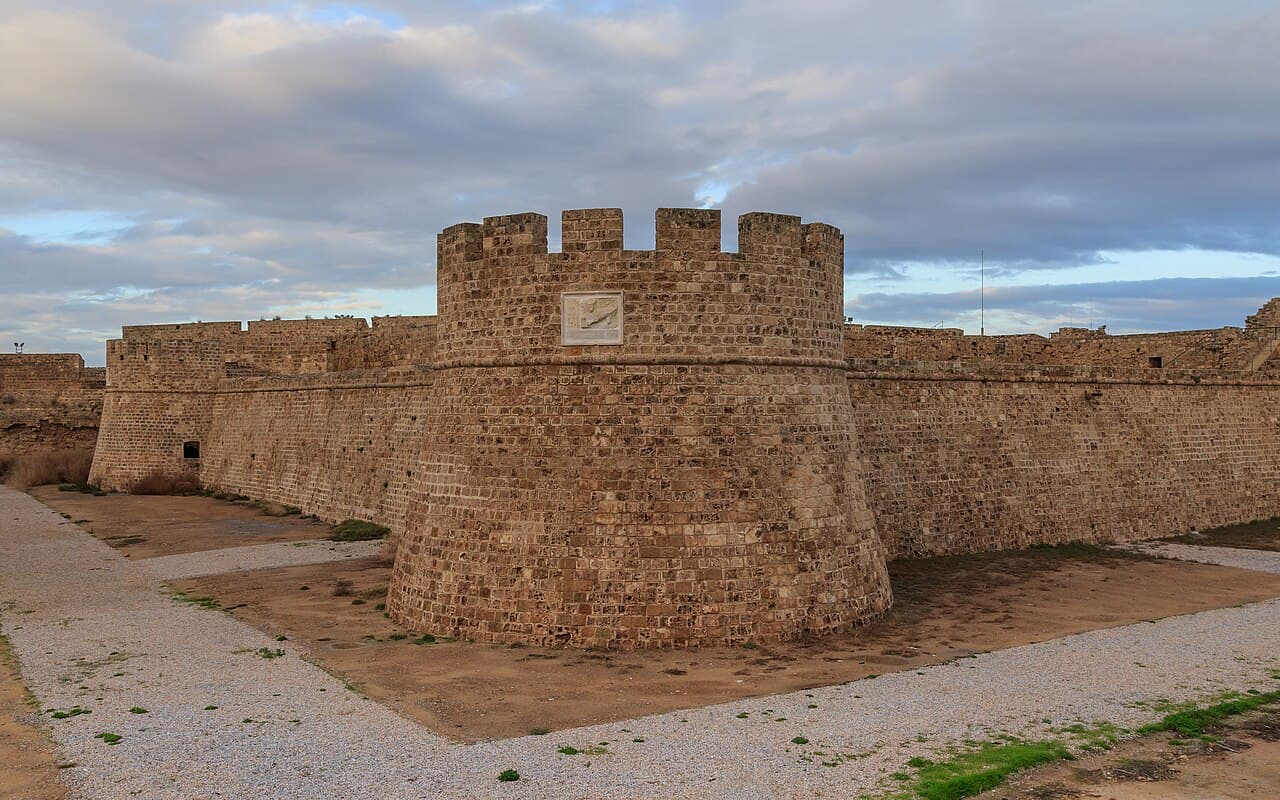
In 1492, the Venetian captain Nicolo Foscarini led a major reconstruction to adapt the castle for artillery warfare. The original square Gothic towers were remodeled into rounded artillery towers capable of mounting cannons. This transformation reflected advances in military technology and the changing nature of siege warfare. The castle’s entrance was adorned with a marble plaque bearing the Lion of Saint Mark, symbolizing Venetian authority, alongside Foscarini’s name and the date of renovation.
The siege of 1570 and Ottoman conquest
In 1570, the Ottoman Empire launched a campaign to conquer Cyprus. Famagusta became the focal point of resistance, with a small Venetian garrison of about 5,000 soldiers holding out against a vastly superior Ottoman force estimated at over 200,000 troops. The siege lasted for ten months and included seven major assaults, during which the Ottomans suffered heavy casualties estimated at nearly 80,000 soldiers.
Despite the defenders’ valiant efforts, the lack of Venetian reinforcements forced the commander, Marco Antonio Bragadino, to surrender. Tragically, the Ottomans violated the terms of capitulation, slaughtering the garrison and subjecting Bragadino to a brutal execution in front of the Cathedral of Saint Nicholas. Following the conquest, Famagusta’s military significance declined under Ottoman rule.
Architectural features and surviving elements
The castle’s current appearance largely reflects the Venetian period renovations. It is characterized by thick, bastioned walls designed to withstand cannon fire, with rounded artillery towers replacing the earlier square towers. The defensive walls rise approximately 10 meters high and are about 4 meters thick, enclosing a compact fortress integrated into the city’s fortifications.
Inside, remnants of the Gothic Lusignan structures remain visible, including the Great Hall, residential chambers, and service areas. The courtyard contains an array of historic cannons and artillery pieces, some over 400 years old, crafted from bronze and iron. These weapons illustrate the castle’s long history of military adaptation and defense.
The castle also features a large vaulted roof with Gothic arches, exemplifying the architectural style of the medieval period. The moat surrounding the castle was drained in 1900 during British colonial rule to reduce malaria risk, altering the original defensive landscape.
Literary and cultural significance
The castle’s popular name, Othello Castle, derives from William Shakespeare’s famous tragedy Othello, which is set in a harbor town in Cyprus. While Shakespeare never visited the island, the story is believed to be inspired by the Venetian governor of Cyprus, Cristoforo Moro, who served in the early 16th century. This connection has cemented the castle’s place in cultural and literary history.
Today, Famagusta Castle functions as a museum, preserving its rich military heritage and architectural grandeur. Visitors can explore the well-preserved fortifications, historic rooms, and extensive artillery collections, gaining insight into the castle’s pivotal role in the defense of Cyprus through centuries of conflict.
Visiting information and legacy
Located within the municipality of Famagusta in northern Cyprus, the castle remains one of the most important medieval fortresses on the island. Its well-preserved condition and extensive historical significance make it a key attraction for tourists interested in medieval architecture, military history, and Shakespearean lore.
The castle is accessible to visitors year-round, offering a unique opportunity to experience a fortress that has witnessed centuries of Mediterranean history. Its blend of Lusignan Gothic and Venetian military architecture provides a fascinating study in the evolution of castle design in response to changing warfare technologies.
Frequently asked questions (FAQ)
- What is the historical significance of Famagusta Castle?
- Famagusta Castle, built in the late 12th century, is a remarkable example of medieval architecture and played a crucial role in the defense of the city during the Crusades. It is known for its impressive fortifications and served as a strategic military stronghold under various rulers, including the Venetians and Ottomans.
- When was Famagusta Castle constructed?
- Construction of Famagusta Castle began in the late 12th century, with significant enhancements made during the Venetian period in the 16th century. The castle's enduring structure showcases the evolution of military architecture over several centuries.
- Can I visit Famagusta Castle?
- Yes, Famagusta Castle is open to visitors who wish to explore its rich history and stunning architecture. While it is advisable to check local guidelines regarding access, the site generally welcomes tourists throughout the year.
- What are the opening hours for Famagusta Castle?
- Famagusta Castle typically opens at 8:00 AM and closes at 7:00 PM, but hours may vary depending on the season and local holidays. It is recommended to verify current hours before planning your visit to ensure you have ample time to explore.
- Is it possible to access Famagusta Castle by public transport?
- Yes, Famagusta Castle is accessible by public transport, with several bus routes connecting the castle to key areas in Famagusta. Additionally, local taxis and ride-sharing options are available for those preferring a more direct route.
- What is the best time to visit Famagusta Castle?
- The best time to visit Famagusta Castle is during the spring and autumn months when the weather is mild, making it comfortable for exploration. Additionally, these seasons typically see fewer tourists, allowing for a more peaceful experience.
- Are there any nearby attractions to Famagusta Castle?
- Yes, nearby attractions include the historic city of Famagusta itself, the Lala Mustafa Pasha Mosque, and the ancient ruins of Salamis. Exploring these sites can provide a deeper understanding of the region's rich history and culture.
- What are the ticket prices for Famagusta Castle?
- Admission to Famagusta Castle is generally affordable, with tickets priced around €2-€5. Discounts may be available for students and seniors, so it is advisable to inquire at the ticket office upon arrival.
- Is Famagusta Castle accessible for individuals with disabilities?
- Famagusta Castle has limited accessibility features due to its historic structure and terrain. However, efforts are made to accommodate visitors with disabilities, and it is recommended to contact the castle administration in advance for specific arrangements.

Information
Loading map...
Visitor reviews
No reviews yet. Been here? Write the first review and help other travelers!
Write the first reviewVisited this castle? Share your experience
Your review helps other travelers and adds first-hand knowledge to our encyclopedia.