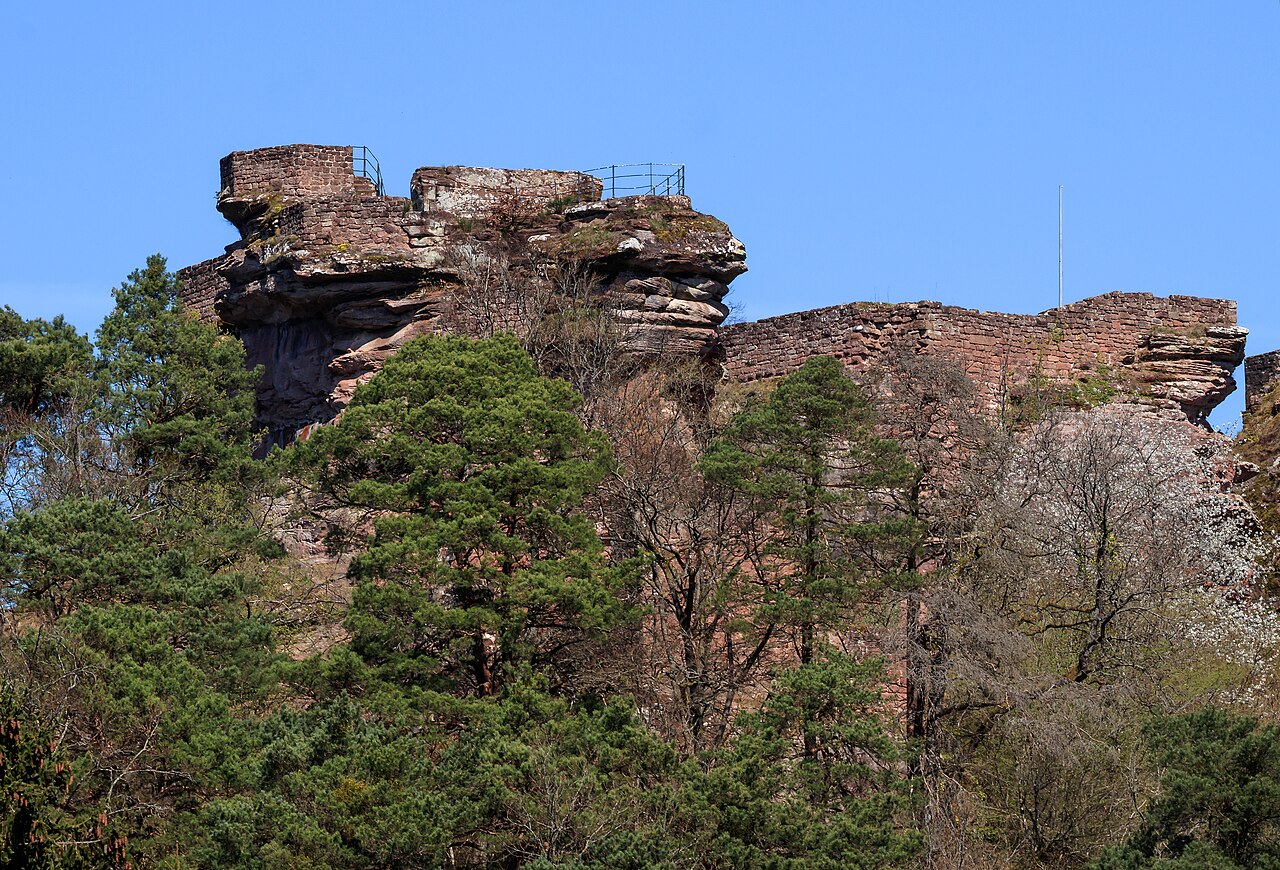
Falkenburg Castle Ruins
Falkenburg Castle is a prominent castle ruin situated on a commanding rock outcrop overlooking the village of Wilgartswiesen in Germany. Its strategic location atop the Falkenstein rock provided a natural defensive advantage and served to protect the surrounding villages and control the local territory. The castle's origins trace back to the 11th century, making it a significant example of high medieval fortification architecture in the region.
Early history and foundation
The construction of Falkenburg Castle likely succeeded the nearby Wilgartaburg, which had become less strategically viable. Historical documents from the time of Archbishop Erkinbald of Mainz mention a rock outcrop called Falkenstein in letters dating to 1019. This rock was recognized as the northernmost border of the principality of Kaiserslautern, indicating its importance in territorial defense and administration.
The castle's initial construction is attributed to Werner I of Bolanden, a vassal of Duke Frederick II of Swabia, around 1125. The Bolanden family played a crucial role in the castle's early development. Records from the family monastery in Hane mention Sigbold of Falkenstein in 1135, one of the earliest individuals to adopt the castle's name as a family title. By 1233, Phillip IV of Bolanden, an imperial ministerialis, explicitly identified himself as being from Falkenstein in legal documents, confirming the castle's established presence and significance.
Medieval ownership and political significance
Throughout the 13th and 14th centuries, Falkenburg Castle changed hands among several noble families, reflecting the complex feudal relationships of the Holy Roman Empire. A Werner of Falkenburg is documented in legal records from 1290. From 1300 to 1313, the castle was enfeoffed to Frederick IV of Leiningen, a notable regional noble.
In 1317, the castle was granted in fee to the Counts Palatine Rudolph II and Rupert I by Louis IV, Holy Roman Emperor. This transfer illustrates the castle's strategic value within imperial politics. Later, in 1375, Emich V of Leiningen acquired ownership, and by 1398, the fiefdom of Falkenstein was elevated to the status of its own county, marking its rising prominence.
Following the extinction of the Bolanden/Falkenstein lineage around 1420, the castle passed to the counts of Virneburg until 1456, when it came under the control of the counts of Dhaun-Oberstein. The Duke of Lorraine assumed high feudal lordship in 1458, further emphasizing the castle's importance in regional power dynamics.
Military history and decline
Falkenburg Castle survived the German Peasants' War of 1524–1525, a significant uprising that affected many castles and noble estates. In 1545, following the decline of the Holy Roman Empire's centralized control, the House of Austria took over administration of the castle through its government in Freiburg.
During the Thirty Years' War (1618–1648), the castle was a site of military contention. It was captured by Spanish troops in 1631 and then by Swedish forces in 1632, before being retaken by troops from Lorraine. The castle's military role ended when it was deliberately demolished by the French Marshal Schönbeck in 1638 to prevent further military use.
After its destruction, the administration of the surrounding Frankenweide region was moved from Falkenburg to the nearby village of Wilgartswiesen.
Architectural features and remains
The ruins of Falkenburg Castle still reveal important details about its original structure. The bergfried (main tower) measured approximately 6.8 by 7.2 metres, with walls 1.8 metres thick and surviving remains up to 2.5 metres high. This tower would have served as a last refuge and lookout point.
Other surviving elements include a cistern for water storage, a fortified gatehouse, a rock chamber carved into the natural stone, and the remains of living quarters known as the palas. Additional wall remnants trace the castle's perimeter defenses on the rocky outcrop.
Restoration and cultural importance
Restoration efforts were undertaken in the 1930s and again in 1970 to stabilize the ruins and preserve them for historical and cultural education. Today, Falkenburg Castle stands as a valuable medieval heritage site offering insights into high medieval castle architecture and the region's turbulent history.
Its location provides visitors with panoramic views of the surrounding Palatinate Forest and the village of Wilgartswiesen, making it a notable destination for those interested in history, architecture, and natural beauty.
Frequently asked questions (FAQ)
- How do I get to Falkenburg Castle ruins in Wilgartswiesen?
- Falkenburg Castle ruins are accessible by hiking trails from the village of Wilgartswiesen. The site is located on a hilltop and requires a moderate walk through forest paths.
- What is the historical significance of Falkenburg Castle?
- Falkenburg Castle played a key role in regional defense and administration from the 11th century through the Thirty Years' War. It was associated with noble families such as the Bolanden and Leiningen and witnessed important military events.
- When was Falkenburg Castle demolished and why?
- The castle was deliberately demolished in 1638 by French Marshal Schönbeck during the Thirty Years' War to prevent its further military use.
- What architectural features remain at Falkenburg Castle ruins?
- Visitors can see the remains of the bergfried, gatehouse, cistern, rock chamber, and palas, which illustrate typical medieval castle construction on a rocky hilltop.
- Is Falkenburg Castle open to the public and are there guided tours?
- The ruins are open to the public year-round with free access. While there are no regular guided tours, local tourist information centers may provide historical brochures and occasional special tours.
Information
Current owner
Municipality
Loading map...
Visitor reviews
No reviews yet. Been here? Write the first review and help other travelers!
Write the first reviewVisited this castle? Share your experience
Your review helps other travelers and adds first-hand knowledge to our encyclopedia.