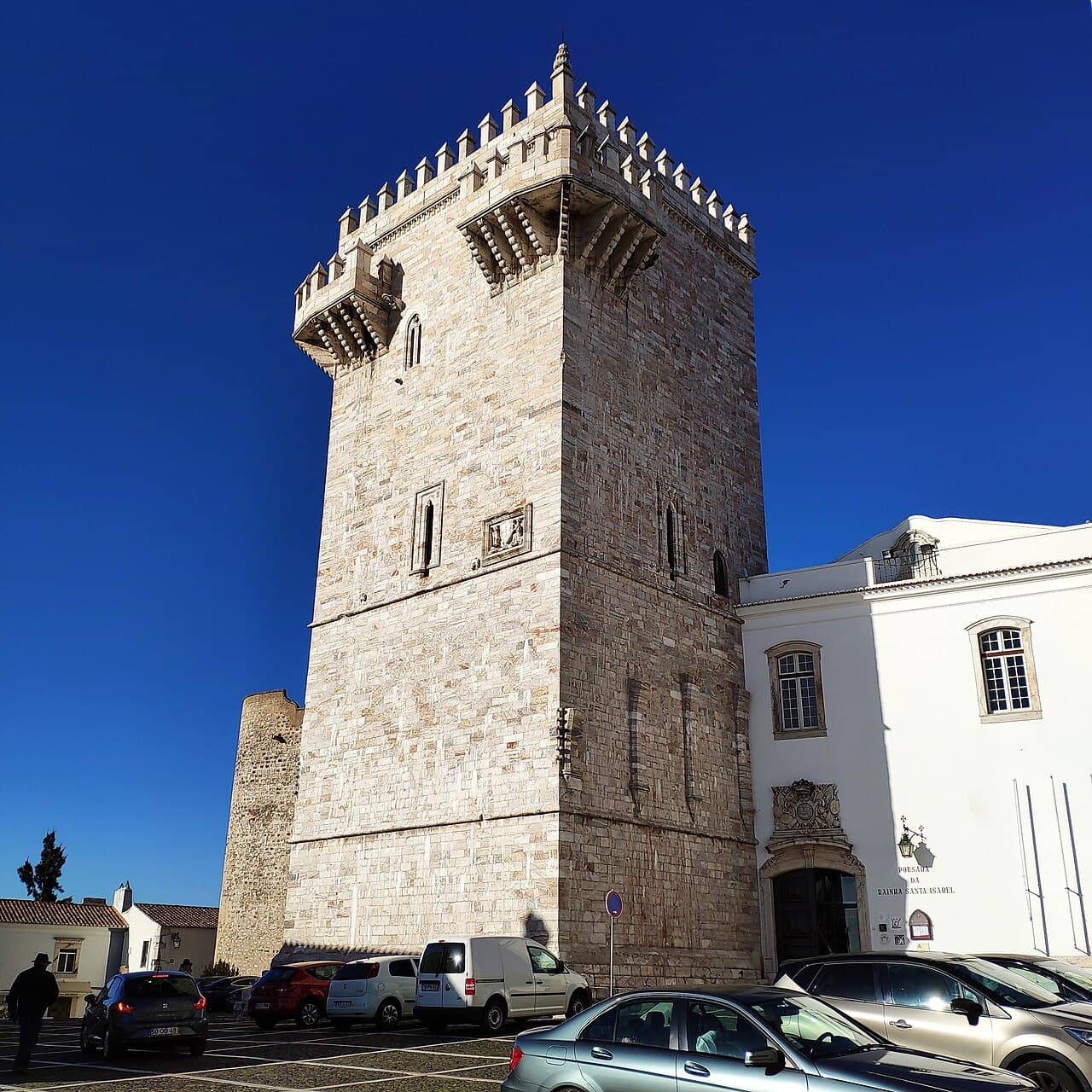
Estremoz Castle
Estremoz Castle, locally known as Castelo de Estremoz, stands prominently on a limestone hill overlooking the town of Estremoz in the Alentejo Central region of Portugal. This high medieval hill castle has a rich history spanning from the Roman era through the modern period, reflecting its strategic importance in border defense and royal residence. The castle’s commanding position and imposing architecture make it a significant cultural and historical landmark in Portugal.
Early history and strategic location
The site of Estremoz Castle was originally a settlement during the Roman conquest of the Iberian Peninsula, evidencing the long-standing strategic value of the limestone hill it occupies. Later, in the 12th century, Muslim settlers established a fortified position here, capitalizing on the natural elevation for defense in the volatile Alentejo border region.
During the Christian Reconquista, the castle was captured around 1165 and definitively came under Portuguese control by the mid-13th century under King Sancho II of Portugal. The Portuguese monarchs undertook substantial reconstruction and fortification efforts to secure the town and its castle, recognizing its vital role in border defense against Castilian incursions.
Medieval reconstruction and royal patronage
King Afonso III ordered the rebuilding of the castle and the construction of town walls in 1258, initiating a major phase of fortification. The castle’s keep tower, also known as the Tower of the Three Kings or Three Crowns Tower, began construction circa 1260 and was completed around 1370 during the reign of King Fernando I. This keep stands approximately 27 meters tall and features distinctive prismatic merlons, battlemented balconies, and machicolations for defense.
King Dinis I further enhanced the site by building a royal palace adjacent to the castle, which later gained religious significance as the death place of Queen Saint Isabel in 1336. The palace complex was an important symbol of royal authority and residence in the region.
Military role in dynastic conflicts and wars
The castle played a pivotal role during the 1383-1385 Portuguese interregnum, a dynastic crisis following the death of King Fernando I. Although the town’s mayor initially sided with Castile, the local population supported the Portuguese cause, expelling pro-Castilian forces. The renowned military leader Nuno Álvares Pereira established his headquarters at Estremoz Castle in 1384 before leading his troops to victory at the Battle of Atoleiros.
Nearly two centuries later, during the Portuguese succession crisis of 1580, the castle surrendered to Castilian troops under the Duke of Alba after a siege. This event marked a significant moment in the castle’s military history, reflecting the turbulent political landscape of the Iberian Peninsula.
In the 17th century, Estremoz Castle was a key military base during the Portuguese Restoration War (1640-1668). The fortress underwent extensive modernization to adapt to contemporary military technology, including the addition of bastions and ravelins. Military engineers such as João Pascácio Cosmander, Nicolau de Langres, and Pierre de Saint-Colombe contributed to these upgrades, transforming the castle into a bastioned fortress capable of withstanding artillery sieges.
During the War of the Oranges (1801), troops from Estremoz supported the defense of Elvas, and in 1808, the castle was briefly occupied by French forces during the Peninsular War. These events illustrate the castle’s continued military relevance into the modern era.
Architectural features and castle complex
The castle complex follows an irregular pentagonal plan shaped by the contours of the limestone hill. It is surrounded by a relatively low battlemented curtain wall with a broad chemin de ronde—an elevated walkway for guards. Four half-round turrets are positioned at strategic points along the walls, enhancing the defensive perimeter.
The southern side is dominated by the imposing keep tower, which reaches about 27 meters in height. Its three balconies with battlements and machicolations rest on strong corbels, designed to allow defenders to repel attackers by dropping projectiles or boiling substances. Inside, the tower is divided into three floors, with the second floor featuring a large octagonal chamber covered by a ribbed vault, a hallmark of Gothic architecture.
The town walls include several notable gates, such as the Porta de Santarém and Porta da Frandina, which controlled access to the fortified settlement. These gates were critical for defense and trade regulation.
Within the walls stands the Casa da Audiência (Audience House), distinguished by an ogival gallery with pairs of arches supported on white marble columns adorned with carved capitals. This building once housed the city’s coat of arms and served as a symbol of municipal authority.
From the reign of King Manuel I survive important structures such as the Common Granary, featuring a ribbed ogival vault similar to that of the keep tower, and the Clock Tower. These elements reflect the castle’s administrative and civic functions.
The former Royal Palace underwent significant transformation in the 18th century, being repurposed as military warehouses. Built between 1738 and 1742 in the Baroque style, the palace housed one of Europe’s most renowned arms collections. Its robust construction and expansive halls reveal its dual royal and military heritage.
Connected to the castle’s royal and religious history is the Chapel of Saint Isabel, developed from the rooms where the queen died. The chapel was enhanced during the Restoration period and further refurbished in the 18th century, blending medieval origins with later architectural refinements.
Modern history and preservation
In the late 19th century, urban development led to the demolition of a large section of the northern town wall to accommodate a railway station. Additionally, a catastrophic gunpowder explosion in 1898 severely damaged the castle and the historic town center, including the military warehouses.
Recognizing its cultural and historical significance, Estremoz Castle, along with the town walls, Torre das Couraças, and the Chapel of Saint Isabel, was declared a National Monument in 1910. Restoration efforts began in 1939 under Portugal’s Directorate-General for Buildings and National Monuments (DGEMN), including roof repairs in 1961.
Between 1967 and 1988, a major rehabilitation project converted the old military warehouses into a luxury hotel, now part of the Pousadas de Portugal chain. This adaptive reuse preserves the castle’s heritage while providing modern accommodations. The castle’s keep tower remains accessible to visitors during office hours, offering magnificent panoramic views of the surrounding landscape.
Estremoz Castle maintains intervisibility with Évora Monte Castle to the southwest, highlighting its strategic placement within the regional defensive network.
Cultural and historical significance
Estremoz Castle embodies centuries of Portuguese history, from its origins in the Roman and Muslim periods through the medieval monarchy and into modern times. Its architecture reflects evolving military technologies and styles, from Gothic ribbed vaults to Baroque military warehouses. The castle’s association with Queen Saint Isabel and its role in key historical conflicts such as the Portuguese Restoration War and the 1383-1385 interregnum make it a site of great national importance.
Today, Estremoz Castle stands as a well-preserved monument and a luxurious hotel, blending heritage tourism with historical education. Its panoramic views, architectural features, and layered history attract visitors interested in Portugal’s medieval fortifications and royal legacy.
Frequently asked questions (FAQ)
- How do I visit Estremoz Castle and its keep tower?
- Estremoz Castle operates as a luxury hotel, but the keep tower is open to the public during office hours for independent visits. Visitors can enjoy panoramic views from the top of the tower, though access inside the hotel requires a reservation.
- What is the historical significance of Estremoz Castle in Portuguese history?
- Estremoz Castle played a crucial role in the Portuguese Reconquista, the 1383-1385 interregnum, and the Portuguese Restoration War. It served as a royal residence, military fortress, and administrative center, reflecting its strategic importance through centuries.
- Can I see the architectural features of the castle's keep tower?
- Yes, the keep tower features distinctive Gothic elements such as ribbed vaults, machicolations, and battlemented balconies. Visitors can explore the tower’s three floors and appreciate its medieval defensive design and panoramic views.
- When was the castle last restored or renovated?
- Major restoration and rehabilitation took place from 1967 to 1988, converting the old military warehouses into a luxury hotel. Earlier roof repairs were done in 1961, and restoration efforts began as early as 1939 under Portugal’s Directorate-General for Buildings and National Monuments.
- Is Estremoz Castle accessible for visitors with limited mobility?
- Due to the castle’s medieval structure and hilltop location, accessibility may be limited. Visitors with mobility concerns should contact the hotel or local tourism offices in advance to inquire about accommodations and accessible areas.
- What nearby attractions can be visited along with Estremoz Castle?
- Nearby attractions include the town of Estremoz itself, known for its historic center and marble industry, as well as the Évora Monte Castle to the southwest, which shares historical intervisibility with Estremoz Castle.
Photo gallery

Information
Sources & official resources
Verify the information above using these authoritative references.
Loading map...
Visitor reviews
No reviews yet. Been here? Write the first review and help other travelers!
Write the first reviewVisited this castle? Share your experience
Your review helps other travelers and adds first-hand knowledge to our encyclopedia.



