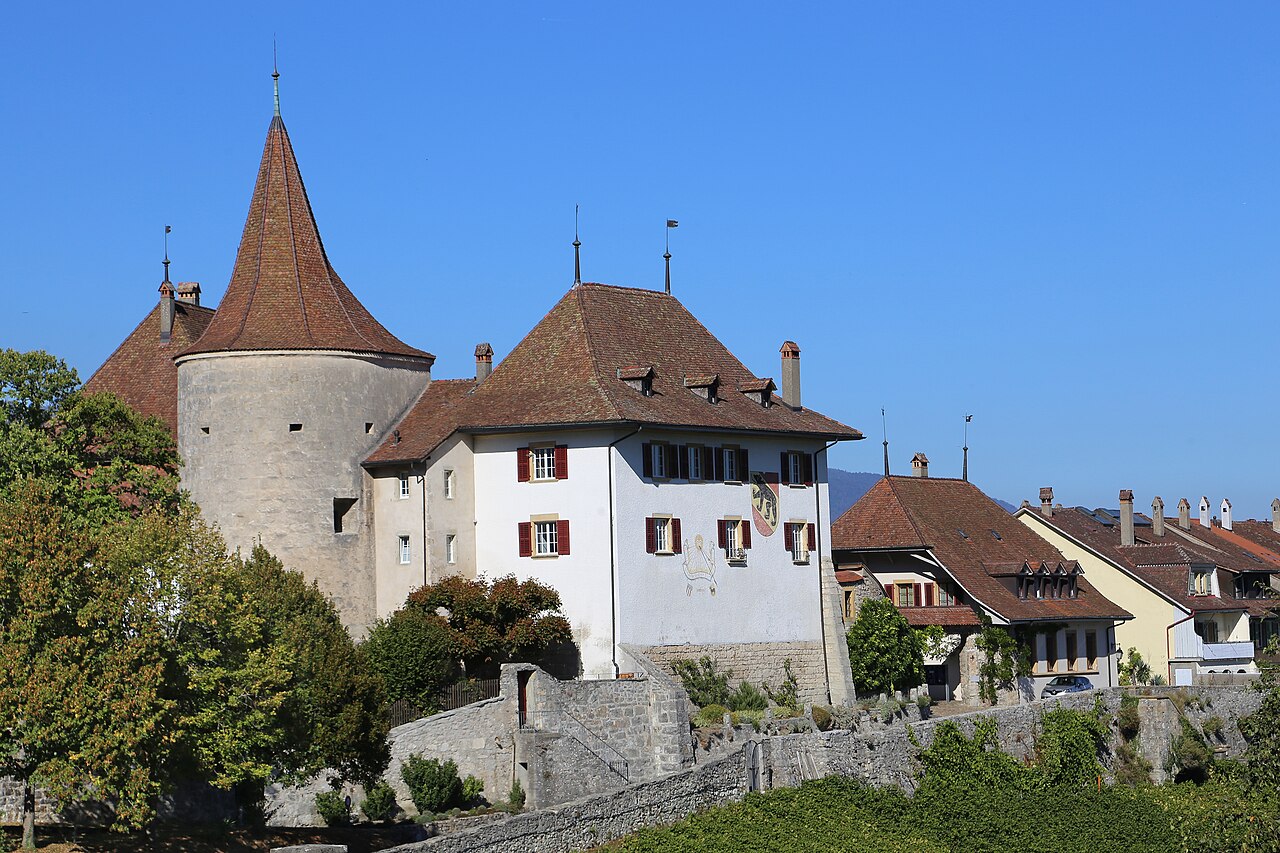
Erguel Castle
Erguel Castle stands as a remarkable example of a medieval hill castle strategically perched on a rocky ridge near Sonvilier in Switzerland. Established in the late 12th or early 13th century, this fortress was originally built by the noble d’Arguel family from the Franche-Comté region. Over centuries, it evolved from a vital administrative center and military stronghold into a prison and ultimately a ruin, reflecting the shifting political and military landscape of the region.
The castle’s earliest recorded mention dates to 1178, identifying Henricus de Arguel as a key figure associated with the site. By 1264, Otto von Erguel had transferred ownership to the Prince-Bishop of Basel, who appointed a bailiff to govern the territory from Biel. This transfer marked the beginning of the castle’s role as a fortified boundary post for the bishopric, particularly after the significant 1284 expansion under Bishop Heinrich of Isny, which included strengthening its defenses to guard the southern frontier.
Historical significance and political role
Throughout the High and Late Medieval periods, Erguel Castle functioned as an important administrative hub for the Saint-Imier valley. Its position at approximately 935 meters above sea level on a rocky ridge provided commanding views over the surrounding landscape, enabling effective control and surveillance. The castle’s role was both military and administrative, overseeing the bishopric’s southernmost boundary and serving as a residence for the bishop’s bailiff.
The castle endured significant conflict during the 14th century, notably in 1368 when it was besieged and captured by forces from Bern and Biel during a dispute involving Bishop Johann von Vienne. The siege resulted in partial destruction by fire, but the castle was quickly repaired. Records from 1417 indicate the presence of a castellan, underscoring its continued importance.
By the early 17th century, the castle’s military significance diminished. The bishop’s bailiff relocated to Courtelary in 1606, and the castle transitioned into a prison. Attempts to reinforce the castle, such as the 1617 proposal by Bishop Wilhelm Rinck von Baldenstein, were only partially realized, with limited repairs focusing mainly on the roof. The castle suffered further damage during the Thirty Years’ War, including occupation by Swedish troops in 1636.
Architectural features and layout
Erguel Castle exhibits a classic elongated layout oriented east to west, typical of hill castles designed to maximize natural defensive advantages. Constructed primarily from 13th-century limestone rubble, the castle integrates the rocky ridge into its fortifications.
Defensive structures
The eastern gatehouse was originally protected by an outer zwinger, an enclosed killing zone designed to trap and expose attackers. A defensive ditch further fortified the southern side, enhancing the natural steepness of the ridge. The castle’s most prominent defensive feature is the large round bergfried tower on the southern side. Built during the 1284 expansion, it once soared to approximately 30 meters with walls over 3.5 meters thick. Its entrance was uniquely positioned about seven meters above ground level, accessible only by a removable wooden ladder or stair, a design intended to deter attackers and protect the keep’s inhabitants.
Residential and administrative buildings
West of the courtyard lies the palas, the main residential and administrative building. The palas’s ground floor contained essential service rooms such as a cellar, stable, and kitchen. Above, the great hall measured approximately 18 by 7 meters and served as a representative space for gatherings and official functions. This hall featured biforium windows, elegant paired arched openings divided by a small column, reminiscent of those at the castle of Laupen. A chapel within the palas highlights the religious role the castle played alongside its military and administrative functions.
At the western end of the palas was another building of uncertain purpose, and historical plans from 1617 show a semi-circular tower at the far west end, which no longer survives.
Decline, abandonment, and preservation efforts
Following its abandonment as a noble residence in the early 1600s, Erguel Castle gradually fell into disuse and ruin. The partial collapse of the bergfried tower in 1754 marked a significant loss of its defensive architecture. Ownership passed between local municipalities, with the site’s stones often quarried by residents for other constructions.
Archaeological interest began in 1884 under architect Antoine Biétix, who initiated documentation and conservation efforts. Restoration projects took place in 1929–1931, 1964–1965, and more extensively in 1997–1998 following structural collapses. These efforts have stabilized the ruins and helped preserve the castle as a cultural landmark.
Today, Erguel Castle is recognized as a cultural property of regional importance in Switzerland. Its ruins offer visitors insight into medieval fortification techniques, noble residence layouts, and the historical role of the Prince-Bishopric of Basel in regional governance and defense.
Visitor experience and significance
Set on a scenic rocky ridge, visitors to Erguel Castle can explore its well-preserved ruins, including the imposing bergfried tower and the remains of the palas and gatehouse. The site’s elevated position provides panoramic views over the village of Sonvilier and the surrounding Jura landscape, enhancing its appeal as both a historical and natural attraction.
The castle’s architecture exemplifies key medieval defensive and residential features, making it a valuable destination for those interested in medieval military architecture, bishopric history, and Swiss cultural heritage. Interpretive signage and ongoing preservation ensure that Erguel Castle remains accessible and informative for visitors.
Frequently asked questions (FAQ)
- How do I get to Erguel Castle from Sonvilier?
- Erguel Castle is located on a rocky ridge near Sonvilier and can be reached by hiking trails starting from the village. The walk offers scenic views and takes approximately 30 to 45 minutes on foot.
- What is the best time to visit Erguel Castle?
- The best time to visit Erguel Castle is during the late spring to early autumn months when the weather is favorable for hiking and exploring the ruins. Summer offers the most pleasant conditions with longer daylight hours.
- Is Erguel Castle accessible for visitors with limited mobility?
- Due to its hilltop location and rugged terrain, Erguel Castle is not fully accessible to visitors with limited mobility. The site involves uneven paths and stairs, so appropriate footwear and physical ability are recommended.
- Are there guided tours available at Erguel Castle?
- Guided tours may be available seasonally through local tourism offices or heritage organizations. Visitors are advised to check in advance for tour schedules and availability.
- What architectural features make Erguel Castle unique?
- Erguel Castle features a distinctive large round bergfried tower with a high entrance about seven meters above ground, thick limestone walls, and biforium windows in the great hall, showcasing classic Gothic defensive and residential design.
Information
Sources & official resources
Verify the information above using these authoritative references.
Loading map...
Visitor reviews
No reviews yet. Been here? Write the first review and help other travelers!
Write the first reviewVisited this castle? Share your experience
Your review helps other travelers and adds first-hand knowledge to our encyclopedia.