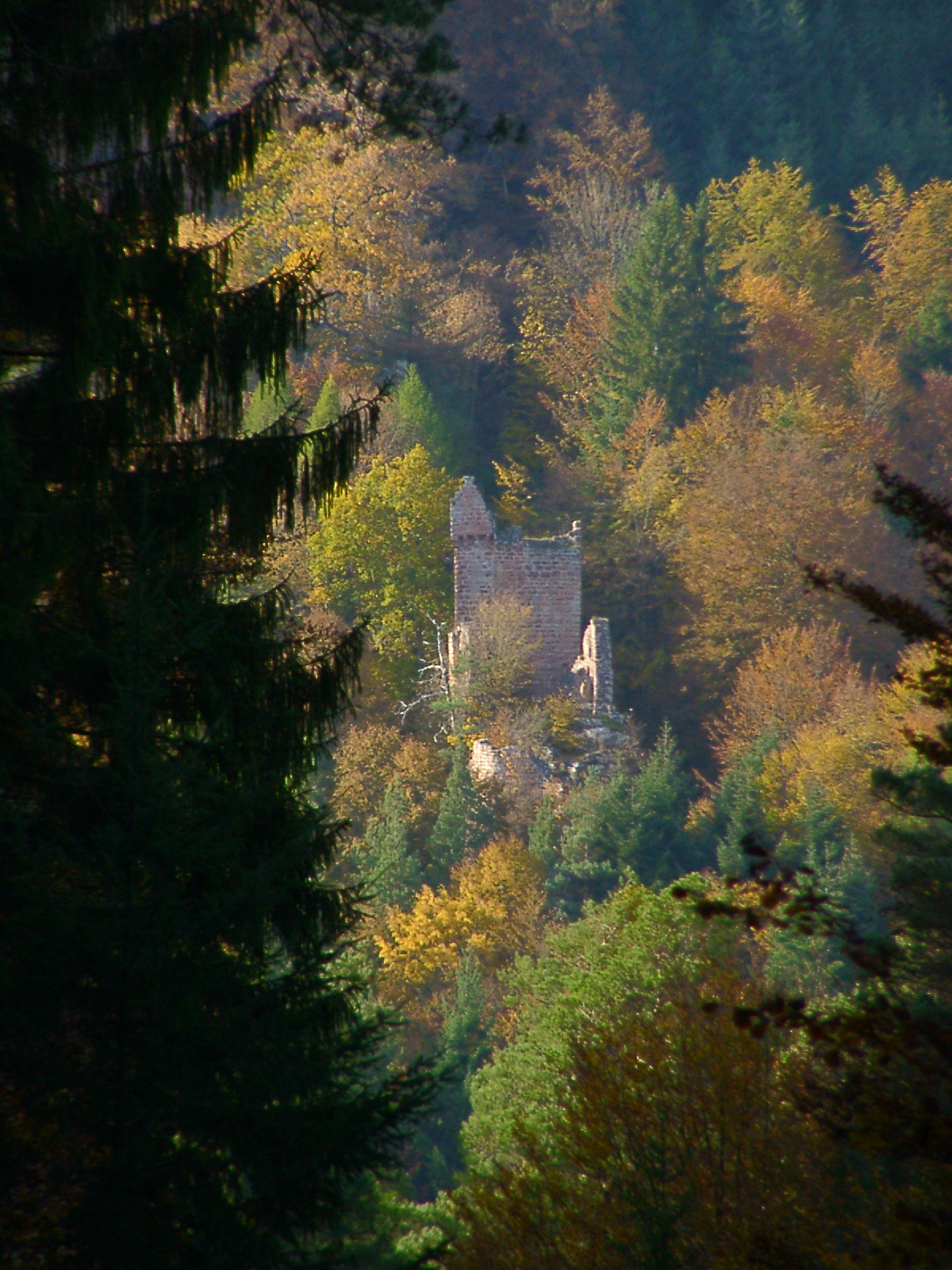
Elmstein Castle Ruins
Elmstein Castle, located in Lambrecht, Germany, is a significant example of a 12th-century High Medieval Palatine fortress. Constructed primarily to guard the strategic route through the valley, the castle played a critical role in regional defense and administration during the Middle Ages. The castle's origins trace back to the early 1100s when it was established as a seat for feoffees holding the aristocratic title of Schenk, a title originally denoting a cup bearer but later associated with noble responsibilities.
Historical background and ownership
Elmstein Castle was initially under the control of the Electorate of the Palatinate, a prominent territorial state within the Holy Roman Empire. Between 1220 and 1230, the castle saw the construction of its lower curtain wall, a key defensive feature designed to protect the inner bailey and residential quarters. The castle's ownership shifted through various noble hands over the centuries, reflecting the complex feudal relationships of the region.
Notably, Emperor Louis IV of Bavaria transferred the castle to his cousin, the Count Palatine, reinforcing its importance within the Palatine territories. From 1419 to 1437, the castle was occupied by Count John V of Sponheim, a period marked by relative stability. In 1466, Frederick I the Elector enfeoffed the castle to Erhard of Remchingen, further entrenching its feudal significance.
The castle changed hands again in 1513 when Henry of Pagk received it as a fief. However, the turbulent times of the German Peasants' War in 1525 inflicted damage on the structure, reflecting the widespread unrest that affected many castles and noble estates across the region.
Architectural features and layout
The remains of Elmstein Castle today include substantial sections of the original curtain walls, the palas (the main residential building), and the shield wall, which served as a formidable defensive barrier. The castle's design embodies typical High Medieval military architecture with thick stone walls and strategic positioning to oversee the valley route.
The curtain walls were constructed to enclose the castle's inner courtyard and protect the essential buildings within. The palas was the center of domestic life, housing the lord and his retinue, while the shield wall provided protection against direct assault, often facing the most vulnerable approach.
Conflicts and decline
Elmstein Castle's strategic location made it a target during several conflicts. It suffered damage during the German Peasants' War of 1525, a widespread revolt against feudal oppression. Later, the castle endured further damage during the Thirty Years' War, particularly in 1648, when many fortifications across the Holy Roman Empire were destroyed or weakened.
The final blow to the castle's military and residential function came during the War of the Palatine Succession in 1689. The castle was deliberately destroyed or abandoned, leading to its permanent state of disrepair. Since then, Elmstein Castle has remained a ruin, with only fragments of its former structure visible.
Current status and preservation
Today, Elmstein Castle stands as a well-preserved ruin under private ownership. Visitors can explore the surviving sections of the curtain walls, palas, and shield wall, which offer insight into medieval fortification techniques and noble life. The site provides a tangible connection to the region's High Medieval history and the shifting political landscape of the Palatinate.
The castle's ruins are accessible to the public, allowing for educational visits and cultural appreciation. Its enduring stone structures remain a testament to the architectural and historical legacy of the 12th century in this part of Germany.
Frequently asked questions (FAQ)
- How do I get to Elmstein Castle ruins in Lambrecht?
- Elmstein Castle ruins are located near the town of Lambrecht in Rhineland-Palatinate, Germany. Visitors can reach the site by car or local public transport, with walking paths leading from Lambrecht to the hilltop ruins.
- What is the historical significance of Elmstein Castle?
- Elmstein Castle was a strategic Palatine fortress built in the 12th century to guard a valley route. It played a role in regional defense and witnessed damage during the German Peasants' War and the Thirty Years' War.
- Can I explore the ruins of Elmstein Castle?
- Yes, the ruins of Elmstein Castle are accessible to the public. Visitors can see the remains of the curtain walls, palas, and shield wall, which illustrate medieval castle architecture and fortification.
- When was Elmstein Castle built?
- Elmstein Castle was constructed in the 12th century during the High Medieval period as a Palatine castle.
- Is there an entrance fee to visit Elmstein Castle ruins?
- There is typically no entrance fee to visit the ruins of Elmstein Castle, as it is privately owned and open to the public for exploration.
Information
Current owner
Private owner
Loading map...
Visitor reviews
No reviews yet. Been here? Write the first review and help other travelers!
Write the first reviewVisited this castle? Share your experience
Your review helps other travelers and adds first-hand knowledge to our encyclopedia.