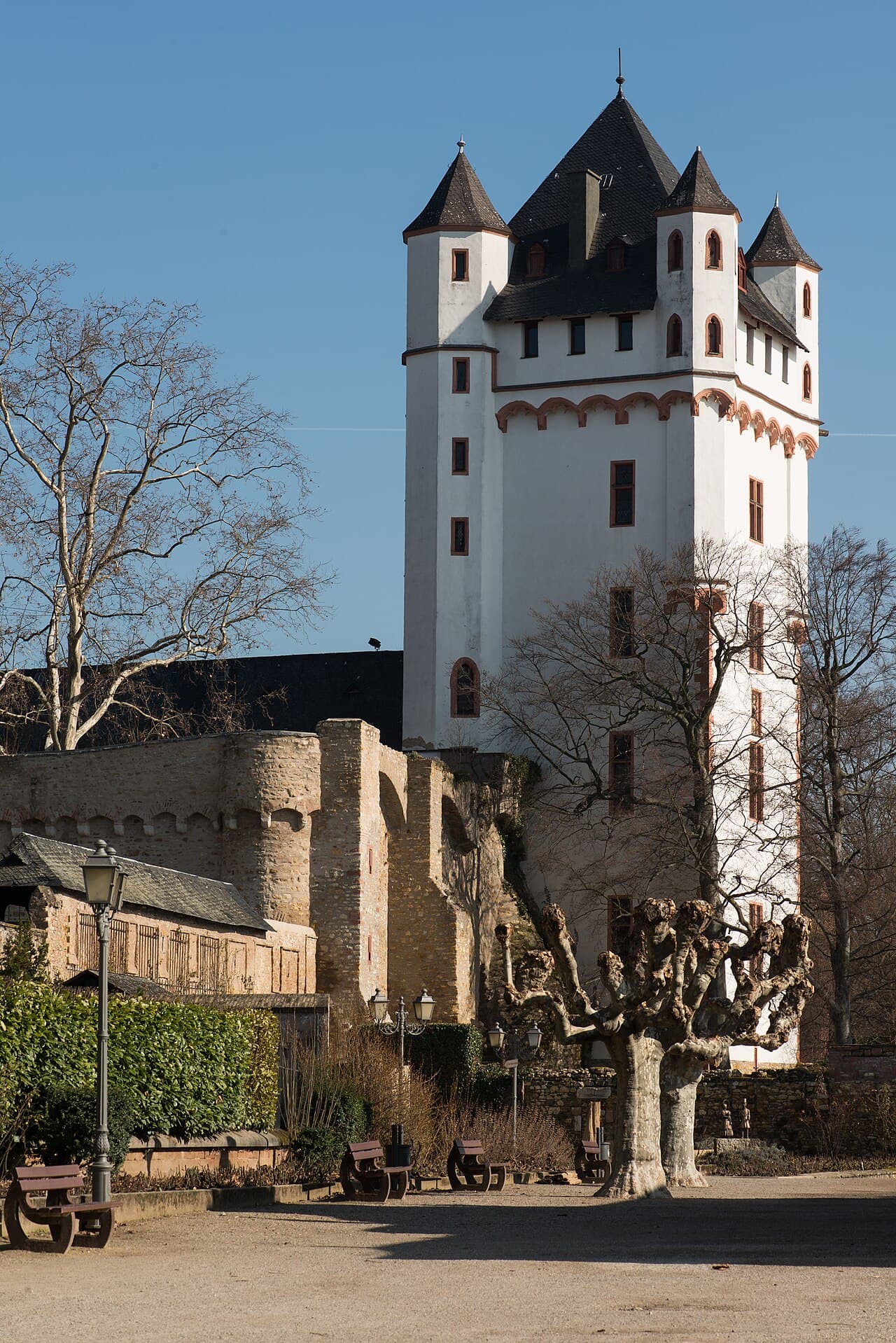
Electoral Castle
Electoral Castle in Eltville am Rhein, Germany, stands as a significant late medieval hill castle with a rich history spanning over seven centuries. Constructed beginning in 1330 by Balduin von Trier on the site of a former tower castle destroyed during the Toll Wars (Zollkriege), the castle was completed around 1350 by Heinrich von Virneburg. It served as the residence of the archbishops and electors of Mainz throughout the 14th and 15th centuries, playing a pivotal role in the political and religious landscape of the Holy Roman Empire.
Historical significance and political role
The castle's strategic location in Eltville, overlooking the Rhine River, made it a valuable fortification and administrative center. It was originally built to assert the authority of the Archbishop and Elector of Mainz, particularly after the contested election of Baldwin of Luxembourg as Archbishop in 1328. Baldwin chose Eltville as his residence due to opposition in Mainz, making the castle a seat of power and governance.
Throughout the late Middle Ages, Burg Eltville hosted important political events, including meetings of the prince-electors responsible for electing the Holy Roman Emperor. One of the castle's most notable moments was in 1465, when Archbishop Adolf of Nassau ennobled Johannes Gutenberg, the inventor of letterpress printing, marking the only time Gutenberg received official recognition during his lifetime.
Architectural features and layout
The castle exemplifies medieval fortress architecture with a blend of defensive and residential structures arranged around a moat and fortified walls. Access is gained via a bridge over the moat leading to the north gate. Adjacent to this gate is the east wing, housing the castle hall and the electoral hall, where imperial elections and official gatherings were historically held.
The dominant feature is the bergfried, a fortified residential tower rising 24 meters high, equipped with an adjoining staircase tower providing access to multiple floors. A spiral staircase descends to a dungeon in the basement, highlighting the castle's defensive and custodial functions. The tower's ground floor served as the servants’ lounge, while the first floor contained the count's chamber, richly decorated with ornate walls and a large fireplace, serving as a prestigious living and working space.
West of the bergfried lies the palas, a multi-story residential building from the castle's earlier phase, of which only parts of the external walls remain. Extending westward from the palas is a defensive wall walk leading to the south gate, which opens onto the moat and a well-maintained garden area.
The lower zwinger, or outer ward, faces the Rhine River and represents the southernmost part of the castle. This area was historically part of the layered defensive system and is accessible through a modern gate in the western wall.
Originally, the castle was enclosed by a ring-shaped battlement wall with multiple gates, including southern gates facing the Rhine that served as the main entrance in earlier configurations.
The fourth floor of the bergfried houses a defensive platform accessible by climbing 118 steps. Today, this platform functions as a viewing area offering panoramic views of the Rhine Valley, Eltville town, and surrounding vineyards, underscoring the castle's strategic vantage point.
Damage, restoration, and current use
In 1635, during the Thirty Years’ War, the castle was largely destroyed by Swedish troops, with only the residential tower surviving. Partial rebuilding of the tower occurred in 1682/83. The rest of the castle gradually fell into disuse and decay by the late 17th century.
Restoration efforts began in the 20th century, notably in 1938 and the 1980s, with a comprehensive preservation campaign starting in 2008. Today, the castle is legally protected as a cultural monument of national importance in Germany.
The castle grounds feature a courtyard, moat, and a beautiful rose garden, welcoming visitors year-round. The tower's ground floor hosts a tourist information office and a souvenir shop, while upper floors contain a memorial to Johannes Gutenberg and exhibits on the history of printing.
The east wing functions as the local registry office, and the castle hosts numerous festivals and cultural events throughout the year. The "gallery in the tower" offers space for art exhibitions and community gatherings. Additionally, the castle can be rented for private events such as weddings, family celebrations, business meetings, and seminars, making it a vibrant cultural hub.
Historical context and surrounding area
Located in the Rheingau region, known for its vineyards and scenic landscapes, Electoral Castle contributes significantly to the cultural heritage and tourism of Eltville am Rhein. Its proximity to the Rhine River historically enabled control over river traffic and toll collection, reflecting its role in regional power dynamics.
The castle's architecture and history are intertwined with the broader political and religious developments of the Holy Roman Empire, illustrating the complex relationship between ecclesiastical authorities and secular powers during the medieval and early modern periods.
The legacy of johannes gutenberg
The castle's connection to Johannes Gutenberg enhances its historical importance. The Gutenberg exhibition located in the tower honors the inventor of the movable-type printing press, who was ennobled here in 1465. This recognition underscores the castle’s role as a site of cultural and technological advancement in Europe.
Architectural style and influences
Electoral Castle primarily exhibits Gothic architectural elements typical of the late medieval period, including robust defensive features such as thick walls, battlements, and a bergfried tower. The castle's design balances military functionality with residential comfort, reflecting its dual role as a fortress and a noble residence.
Visitor experience and accessibility
Visitors to Electoral Castle can explore the courtyard, castle moat, and rose garden, enjoying the scenic views from the bergfried's viewing platform. The castle offers a rich historical narrative through its museum exhibits and the Gutenberg memorial.
The site is accessible via a bridge over the moat and includes facilities such as a tourist information center and souvenir shop. Regular cultural events and art exhibitions provide dynamic experiences for visitors throughout the year.
The castle's use as a venue for private and business events adds to its contemporary relevance, blending historical ambiance with modern functionality.
Frequently asked questions (FAQ)
- How do I get to Electoral Castle in Eltville?
- Electoral Castle is located in Eltville am Rhein, Hesse, Germany. It is accessible by car and public transport, with parking available nearby and local bus connections from the town center.
- What is the historical significance of Electoral Castle?
- Electoral Castle was the residence of the archbishops and electors of Mainz during the 14th and 15th centuries. It hosted important political events, including meetings of prince-electors and the ennoblement of Johannes Gutenberg.
- Can I visit the Gutenberg exhibition inside the castle?
- Yes, the castle tower houses a Gutenberg exhibition that honors the inventor of letterpress printing. Visitors can explore the exhibition along with other museum displays on the history of printing.
- Is the castle suitable for private events and weddings?
- Yes, Electoral Castle can be rented for private events such as weddings, family celebrations, business meetings, and seminars, offering a unique medieval setting.
- What are the opening hours and ticket prices for visiting Electoral Castle?
- The castle is open daily from 10:00 to 17:00. Admission costs €5 for adults and €3 for children, with discounts available for groups and families.
- Are there guided tours available at the castle?
- Guided tours are available upon request, providing detailed historical and architectural insights into the castle's significance and features.
Photo gallery

Information
Opening hours
10:00-17:00, daily
Ticket prices
€5 adult, €3 child
Current owner
Municipality
Website
Visit websiteSources & official resources
Verify the information above using these authoritative references.
Loading map...
Visitor reviews
No reviews yet. Been here? Write the first review and help other travelers!
Write the first reviewVisited this castle? Share your experience
Your review helps other travelers and adds first-hand knowledge to our encyclopedia.



