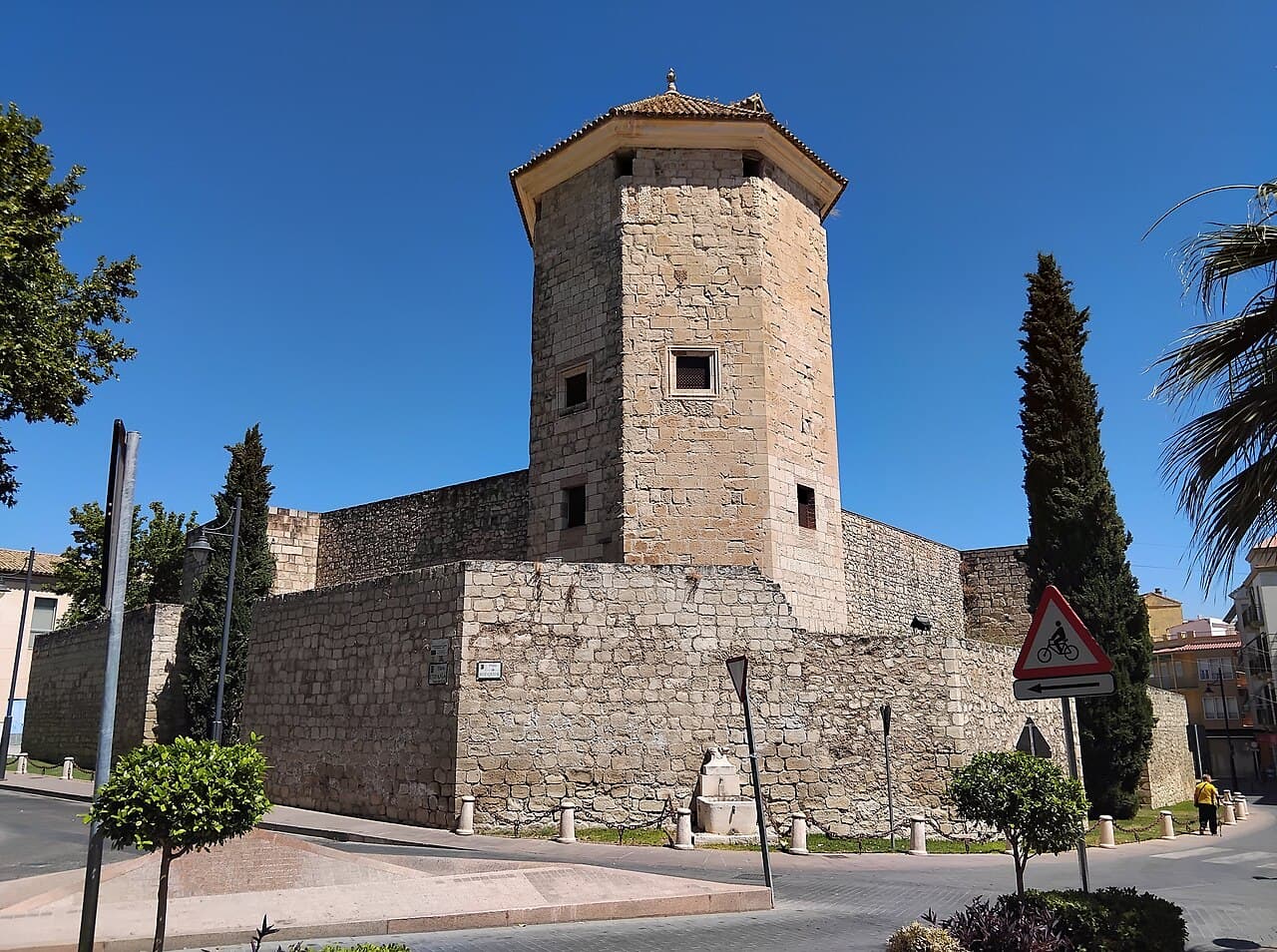
El Moral Castle
El Moral Castle stands as a monumental testament to the rich and layered history of Lucena, Spain. This hill castle, originally constructed in the 9th century during the Early Medieval period by the Moorish caliphate of Al-Andalus, occupies a strategic position in the heart of Lucena's historic town centre. Built atop the remains of earlier Roman and Visigothic settlements, the castle reflects a continuum of occupation and military significance spanning over a millennium. Its commanding location on elevated terrain approximately 490 meters above sea level provided a natural vantage point for surveillance and defense, overlooking the fertile agricultural fields and vital trade routes of the region.
The fortress is an outstanding example of Islamic military architecture adapted and transformed through successive periods of conflict and cultural change. It served multiple roles over the centuries: a defensive stronghold, a noble residence, a prison, and today, a cultural institution housing the Archaeological and Ethnological Museum of Lucena. The museum notably includes the Hall of Sima del Ángel, a site of profound paleoanthropological importance linked to the Lower Palaeolithic era, making El Moral a significant landmark not only for medieval history but also for the study of human origins in Spain.
The origins and early history of el moral castle
The initial construction of El Moral Castle dates back to the 9th century AD, during the era of the Moorish caliphate of Al-Andalus. This period was marked by the establishment of fortified sites to secure territorial control and protect trade routes. The castle was strategically positioned to oversee the cora of Cabra, an important administrative district, and to defend against incursions from Christian kingdoms advancing southward during the Reconquista.
Archaeological evidence confirms that the site had been occupied since Roman and Visigothic times, with remnants incorporated into the castle's foundations. The fortress was later rebuilt and expanded by the Almohad dynasty following their arrival in 1148, enhancing its defensive capabilities to meet the evolving military technologies and threats of the High Medieval period.
Transition to christian rule and medieval significance
In 1240, Fernando III of Castile captured El Moral Castle, marking a pivotal moment in its history as it transitioned from Muslim to Christian control. This conquest was part of a broader campaign that reshaped the political landscape of the Iberian Peninsula. Under Christian rule, the castle became a crucial frontier fortress, guarding the contested borderlands between Christian and Nasrid territories.
The castle's ownership changed hands multiple times in the subsequent decades. Initially managed by the Córdoba Cathedral chapter, it was soon entrusted to the Order of Santiago, a military and religious order instrumental in the Reconquista. By 1342, the fortress belonged to Leonor de Guzmán, the influential mistress of King Alfonso XI, until her death in 1351, after which it reverted to royal possession.
The castle under the fernández de córdoba family
In 1371, King Enrique II granted El Moral to Juan Martínez de Argote. Shortly thereafter, in 1375, it passed to María Alfonso de Argote, who married Martín Fernández de Córdoba. This union established the castle as a seat for the powerful Fernández de Córdoba family, who played a significant role in the military campaigns against the Nasrid Kingdom of Granada.
During this period, El Moral Castle gained further prominence as a military and political center. Its most famous historical episode is the imprisonment of Boabdil, the last Nasrid emir of Granada, captured at the Battle of Lucena in 1483. Boabdil was held in the castle's keep (Torre del Homenaje), symbolizing the shifting power dynamics that culminated in the eventual fall of Granada in 1492.
Architectural features and fortifications
El Moral Castle is characterized by its robust defensive walls that fully enclose the fortress, emphasizing its military purpose. The most striking architectural element is the octagonal Torre del Moral, originally topped with a flat, battlemented roof designed for defense and observation. In the 18th century, this roof was replaced by an eight-sided brick vault, altering the tower's silhouette but preserving its commanding presence.
Other significant towers include the Torre del Homenaje, the castle's keep, which served as a secure prison and royal residence. The fortress also contains two square-plan towers—the Torre de las Damas and the Torre del Coso—connected by an additional defensive wall. This secondary enclosure features an upper walkway, allowing defenders to patrol and repel attackers effectively.
The interior is organized around the Patio de Armas, a spacious courtyard that functioned as a gathering and assembly area for troops and equipment during military operations. The castle's layout reflects a blend of Islamic and Christian military architectural influences, adapted over centuries to meet changing defensive needs.
Modifications and restorations
Throughout its history, El Moral Castle underwent several modifications reflecting its changing roles. In the 17th century, gardens and stables were added, transforming parts of the fortress into a noble residence. These additions were removed in the 20th century to restore the castle's original military character.
Acquired by the municipality of Lucena in 1926 and declared a cultural heritage site in 1931, the castle has benefited from extensive restoration efforts. Post-war work beginning in 1946 focused on removing later alterations that obscured its medieval defensive design. Further structural repairs and modernization occurred between 1984 and 1997, including waterproofing masonry and upgrading lighting systems to enhance preservation.
Cultural significance and current use
Today, El Moral Castle serves as a vital cultural landmark in Lucena. It houses the Archaeological and Ethnological Museum of Lucena, which showcases artifacts from the region's extensive history, including the Sima del Ángel site, a key Lower Palaeolithic archaeological location. This museum enriches the castle's historical narrative by connecting visitors to the deep prehistoric past alongside its medieval heritage.
The castle's location near important urban landmarks such as the Church of San Mateo, Plaza de España, and the municipal market integrates it into the fabric of Lucena's historic centre. Visitors can enjoy panoramic views of the town and surrounding landscape from the castle's terraces and the Paseo de Ronda, enhancing its appeal as a tourist destination.
Recent conservation efforts have focused on maintaining the structural integrity and visual authenticity of the castle, including the removal of intrusive aerial wiring and the installation of modern utilities in a manner sensitive to the site's archaeological significance. These measures ensure that El Moral Castle remains a well-preserved monument that continues to educate and inspire.
Visiting el moral castle
Visitors to El Moral Castle can explore its extensive fortifications, towers, and the Patio de Armas, gaining insight into medieval military architecture and the castle's role in regional history. The Archaeological and Ethnological Museum offers a comprehensive display of artifacts from various periods, enriching the visitor experience with cultural and scientific knowledge.
The castle is accessible from the town centre, with nearby amenities and other historical sites to explore. Its position on a natural hill provides scenic views and a tangible connection to the landscape that shaped its strategic importance.
Frequently asked questions (FAQ)
- How do I visit El Moral Castle and what can I see inside?
- El Moral Castle is located in the historic centre of Lucena and is open to visitors who can explore its defensive walls, towers, and the Archaeological and Ethnological Museum. The museum features exhibits from the Lower Palaeolithic era and local history. Check local tourism websites for current opening hours and ticket prices.
- What is the historical significance of El Moral Castle?
- El Moral Castle was originally built by the Moors in the 9th century and later served as a frontier fortress during the Christian Reconquista. It was the prison of Boabdil, the last Nasrid emir of Granada, and later became a noble residence. It reflects the complex history of Andalusia and the transition from Muslim to Christian rule.
- Can I see panoramic views of Lucena from the castle?
- Yes, the castle's terraces and the Paseo de Ronda offer stunning panoramic views of Lucena and the surrounding countryside, making it a popular spot for photography and sightseeing.
- Is El Moral Castle accessible for people with mobility issues?
- Due to its medieval architecture and hilltop location, some areas of El Moral Castle may be challenging for visitors with mobility issues. However, the museum and some parts of the castle are accessible. It is advisable to contact the site in advance for specific accessibility information.
- When was El Moral Castle built and who built it?
- El Moral Castle was originally constructed in the 9th century by the Moorish caliphate of Al-Andalus, with significant rebuilding by the Almohad dynasty in the 12th century.
Photo gallery

Information
Sources & official resources
Verify the information above using these authoritative references.
Loading map...
Visitor reviews
No reviews yet. Been here? Write the first review and help other travelers!
Write the first reviewVisited this castle? Share your experience
Your review helps other travelers and adds first-hand knowledge to our encyclopedia.



