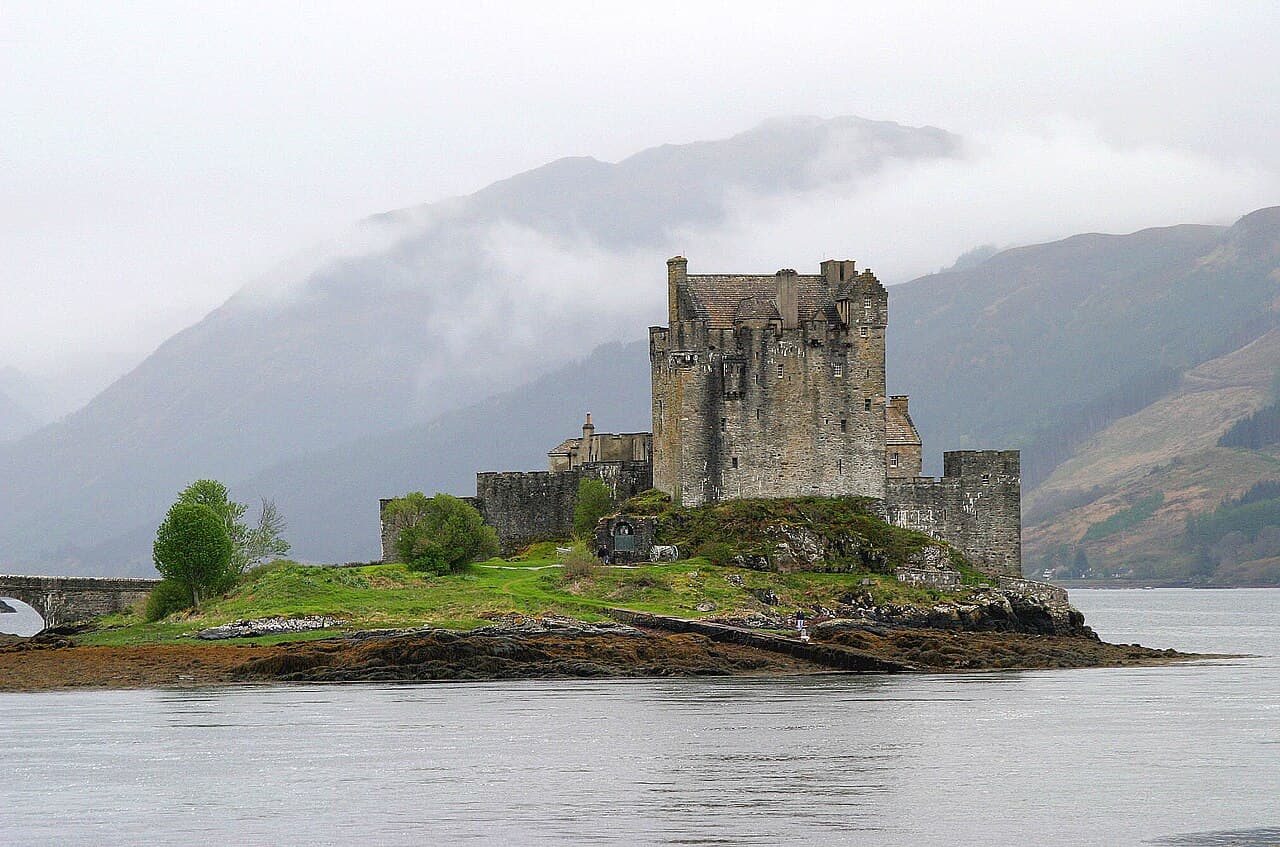
Eilean Donan Castle
Eilean Donan Castle stands as one of the most iconic and picturesque castles in Scotland, renowned worldwide for its stunning location and rich history. Situated on a small tidal island where three sea lochs—Loch Duich, Loch Long, and Loch Alsh—converge, the castle commands breathtaking views of the surrounding Highland landscape. This restored 13th-century fortress on the island of Eilean Donan has become a symbol of Scottish heritage and a popular destination for visitors seeking to explore the country’s medieval past.
The castle’s strategic position on an island connected to the mainland by a stone arched bridge, constructed during its 20th-century restoration, highlights its historical role as a defensive stronghold. Originally founded in the high medieval period, Eilean Donan was built to protect the western Highlands from Viking incursions and other threats. Over centuries, it evolved architecturally and militarily, reflecting the turbulent history of the Scottish clans and their struggles for power and survival.
Early history and foundation
The site of Eilean Donan Castle has been of significance since at least the 7th century when Saint Donnán of Eigg, a Celtic Christian martyr, is believed to have established a monastic presence on the island. This early religious foundation marked the island as a place of spiritual importance long before the construction of any fortifications.
The first fortified castle on the island was commissioned around 1220 by King Alexander II of Scotland. This initial stone castle was designed to serve as a defensive bastion against Viking raids and to assert royal control over the region of Kintail. The original structure likely encompassed the entire island with seven towers connected by a massive curtain wall, enclosing roughly 3,000 square meters. The central keep, measuring approximately 16.5 by 12.4 meters, featured thick walls up to three meters wide and a vaulted ground floor divided into two rooms.
Architectural evolution and features
Medieval fortifications and layout
Throughout the late medieval period, Eilean Donan Castle underwent multiple expansions and contractions. By the late 14th or early 15th century, the outer defensive perimeter was reduced to a smaller enclosure about 25 meters square, with an eastern approach. The castle’s defenses included a curtain wall, towers, and a deep well within an artillery bastion added in the late 16th century. This bastion was an irregular hexagonal hornwork connected to the main castle by a triangular courtyard, designed to accommodate artillery and improve defense capabilities.
Residential and military structures
The castle housed a variety of buildings including a modest house with a spiral staircase in the southeast corner, thought to be the constable’s residence, and an L-shaped building occupying the southwest corner partially inside and outside the curtain wall. The interior included vaulted halls, a dining room with a 15th-century style oak ceiling, and a heraldic fireplace, showcasing the blend of military and domestic functions within the fortress.
Historical significance and clan associations
Eilean Donan Castle was a principal seat of the Clan Mackenzie and their allies, the Clan Macrae, from at least the 13th century. The castle played a significant role during the Scottish Wars of Independence in the early 14th century, providing refuge to Robert the Bruce during the winter of 1306–1307 as he evaded English forces.
Over subsequent centuries, the castle was frequently involved in clan conflicts and regional power struggles, including a notable defense against an attack by Donald Gorm MacDonald of Sleat in 1539. Its military importance persisted into the 18th century during the Jacobite risings.
The 1719 jacobite uprising and destruction
In 1719, during the Jacobite rising, Eilean Donan was occupied by Jacobite leaders and a garrison of Spanish troops supporting the cause. The British Royal Navy responded by dispatching three frigates to bombard the castle. Despite walls up to five meters thick, the castle was overwhelmed after the discovery of 343 barrels of gunpowder inside, which were detonated, causing extensive destruction. The castle was left in ruins and remained abandoned for nearly two centuries.
20th-century restoration and modern use
Lieutenant Colonel John MacRae-Gilstrap purchased the ruined island in 1911 and embarked on an ambitious restoration project that lasted until 1932. The reconstruction respected the original medieval layout while incorporating some modern architectural elements. The restoration included rebuilding the curtain walls, towers, and residential quarters, as well as constructing the iconic stone arched bridge linking the island to the mainland.
The restored castle now serves as a cultural and historical attraction, featuring period furniture, Jacobean artifacts, weaponry displays, and fine art. Visitors can explore the vaulted halls, the dining room with its heraldic fireplace, and the battlements. The castle also hosts a visitors’ center with amenities such as a café, souvenir shop, and ticket office.
Visitor experience and accessibility
Eilean Donan Castle welcomes visitors year-round and offers ample free parking and facilities for large groups. While the castle itself is not fully accessible to wheelchair users due to its historic structure, a computerized virtual tour is available for those with mobility challenges, providing an inclusive way to experience the castle’s history and architecture.
The castle’s dramatic setting and well-preserved interiors make it a favorite among families and history enthusiasts alike. Children enjoy interactive elements such as handling replica weapons, exploring battlements, and learning about medieval defense mechanisms. The surrounding waters are rich in wildlife, including porpoises, dolphins, otters, and diverse bird species, enhancing the natural appeal of the site.
Cultural importance and commemorations
Adjacent to the castle stands a war memorial dedicated to members of Clan MacRae who died in World War I. This monument is adorned with verses from the poem "In Flanders Fields" and flanked by two grey field cannons from the conflict, honoring the clan’s military sacrifices. The castle’s Gaelic inscription above the main gate proudly declares, "So long as there is a MacRae inside, there will be no Fraser outside," reflecting the enduring clan loyalty and heritage.
Today, Eilean Donan Castle is not only a symbol of Scottish history and architecture but also a venue for special events, including weddings held in its beautiful Banqueting Hall, further cementing its role in contemporary cultural life.
Frequently asked questions (FAQ)
- How do I get to Eilean Donan Castle?
- Eilean Donan Castle is located on Eilean Donan island, accessible via a bridge from the mainland. The nearest major town is Kyle of Lochalsh, which is approximately 10 minutes away by car. Public transport options include buses that connect to Kyle of Lochalsh, with taxis also available for the final leg of the journey.
- What is the historical significance of Eilean Donan Castle?
- Eilean Donan Castle has a rich history dating back to the 13th century and is one of Scotland's most iconic castles. It served as a stronghold for the MacKenzies and the MacRaes and played a crucial role during the Jacobite risings. The castle has been restored and now symbolizes the romantic heritage of Scotland.
- When was Eilean Donan Castle built?
- Eilean Donan Castle was originally built in the 13th century, although the structure we see today was largely reconstructed in the early 20th century after being destroyed in 1719. The castle's picturesque setting and architectural beauty have made it a popular landmark and a favorite subject for photographers and filmmakers.
- Can I visit Eilean Donan Castle year-round?
- Yes, Eilean Donan Castle is open to visitors throughout the year, though opening hours may vary by season. Typically, the castle operates from 9:30 AM to 5:00 PM during the winter months and extends its hours in the summer. It’s advisable to check the official website for the most current information before planning your visit.
- Why is Eilean Donan Castle a popular tourist attraction?
- Eilean Donan Castle is renowned for its stunning architecture and scenic location, making it one of the most photographed castles in Scotland. Its historical significance and connection to Scottish heritage, combined with the breathtaking views of the surrounding landscape, attract thousands of visitors each year. The castle also features exhibitions that tell the story of its history and restoration.
- Is it possible to explore the interior of Eilean Donan Castle?
- Yes, visitors can explore the interior of Eilean Donan Castle, which includes various rooms furnished to reflect its historical significance. Guided tours are often available, providing insights into the castle's history and architecture. Interactive displays and exhibitions throughout the castle enhance the visitor experience.
- What are the ticket prices for Eilean Donan Castle?
- As of the latest information, adult tickets to Eilean Donan Castle are priced around £10, while concessions for students and seniors are typically available at a reduced rate. Children under the age of 5 can enter for free, and family tickets are also offered for those visiting with children. It's recommended to purchase tickets online in advance, especially during peak tourist seasons.
- What is the best time to visit Eilean Donan Castle?
- The best time to visit Eilean Donan Castle is during the spring and summer months, from May to September, when the weather is generally milder and the days are longer. This period attracts the highest number of visitors, so arriving early can help you avoid crowds. Autumn also offers beautiful foliage, while winter provides a unique charm with fewer tourists.
- Are there any nearby attractions to Eilean Donan Castle?
- Yes, there are several attractions near Eilean Donan Castle, including the stunning Loch Duich and the picturesque village of Dornie. Additionally, the nearby village of Plockton is known for its scenic beauty and traditional Scottish cottages. For those interested in hiking, the hills surrounding the area offer fantastic trails with breathtaking views.
Photo gallery

Information
Website
Visit websiteFeatured in
Articles on the Castlopedia blog that feature Eilean Donan Castle.
Sources & official resources
Verify the information above using these authoritative references.
Loading map...
Visitor reviews
No reviews yet. Been here? Write the first review and help other travelers!
Write the first reviewVisited this castle? Share your experience
Your review helps other travelers and adds first-hand knowledge to our encyclopedia.



