Fairburn Tower
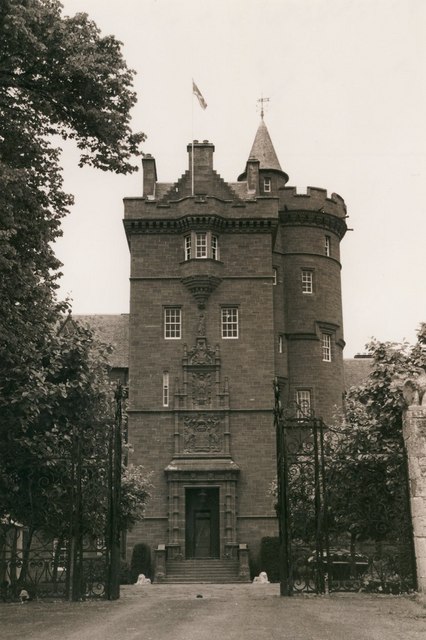
Fairburn Tower stands as a remarkable example of a 16th-century Scottish tower house, nestled near the village of Marybank in the Highland council area of Scotland. This historic structure embodies the architectural and cultural heritage of the Scottish Highlands during the turbulent mid-16th century. Constructed by the prominent Mackenzie family, the tower reflects the defensive needs and domestic aspirations of Scottish nobility of the era.
The origins of Fairburn Tower date back to the early 1540s when Murdo Mackenzie, a trusted courtier to James V of Scotland, was granted the lands of Fairburn in 1542. Murdo, who served as a groom of the bedchamber to the king from 1538, was tasked with establishing a fortified residence that included orchards and gardens, a sign of both status and self-sufficiency. This grant was later confirmed by Mary, Queen of Scots around 1548 or 1549, reinforcing the tower's official standing. Murdo Mackenzie founded a distinct branch of the Mackenzie clan associated with Fairburn, linking the site deeply to the clan's legacy. His death in 1590 and burial wish at Beauly Priory further connect the tower to significant Scottish historical sites.
Historical significance and folklore
In the late 16th century, Fairburn Tower became entwined with local legends through the prophecies of the Brahan Seer, Kenneth Ower (also known as Coinneach Odhar). The seer, who was executed for witchcraft in 1578, predicted the eventual ruin of the tower and the decline of the Mackenzie family residing there. This prophecy has become an enduring part of the tower's historical narrative, adding a mystical dimension to its story.
By the late 18th century, the tower was abandoned, around 1780, reflecting changes in residential preferences and the decline of fortified homes. The structure suffered significant damage in 1803 when a severe storm tore away its original oak-shingled roof, accelerating its decay. Prior to this, the Mackenzies had constructed a new residence nearby, known initially as Muirton House and later renamed Fairburn House, around 1800, marking a transition from medieval defensive architecture to more modern domestic living.
Architectural features and construction
Fairburn Tower is strategically situated on a hill overlooking the River Orrin, approximately two kilometers southwest of Marybank, positioned between the Orrin and Conon rivers. The tower's location provided natural defense advantages and commanding views of the surrounding landscape.
The tower's original design features a long rectangular footprint constructed from local fieldstone, coated with traditional Scottish harl plaster. This roughcast finish protected the masonry from harsh weather conditions, a common practice in Scottish castle construction.
The ground floor contains a vaulted chamber with a robust arched ceiling, typical of defensive Scottish homes of the period. This vault was accessible only from the first floor via an internal stair, a security feature that limited ground-level access. The main entrance was also located on the first floor, consistent with the defensive design of tower houses intended to deter attackers.
In the 17th century, a stair wing was added on the southern side, introducing a new ground-floor entrance that covered the original doorway. This addition included a chimney with a distinctive gable-ended design, enhancing both the tower's functionality and architectural character.
Defensive elements include several gun loops or shot-holes at ground level, allowing defenders to fire weapons while remaining protected. At the roofline, two bartizans, small projecting turrets, provided lookout and defensive positions, reinforcing the tower's military purpose.
Attached to the east side is a single-storey kitchen wing with a thatched roof, designed to keep cooking activities separate from living quarters. Although the original oak-shingled roof was lost in the early 19th century, the tower's roofs have since been restored with grey slate, preserving its historical silhouette.
Restoration and modern significance
Fairburn Tower's external walls retain their harled finish, preserving the traditional protective surface. The interior layout, including the vaulted ground floor, continues to reflect its original defensive purpose. Despite partial restoration, the tower maintains much of its historic fabric.
Recognized for its architectural and historical importance, Fairburn Tower was designated a Category A listed building in 1971, highlighting its national significance. The surrounding grounds were added to Scotland's Inventory of Gardens and Designed Landscapes in 1987, emphasizing the estate's designed natural environment.
From 2020 to 2022, the Landmark Trust undertook extensive restoration to convert the ruin into holiday accommodation. This sensitive restoration earned an award from the Royal Incorporation of Architects in Scotland in 2025 and was longlisted for the Best Building in Scotland Award the same year, underscoring the project's excellence in heritage conservation.
Location and landscape context
Fairburn Tower's hilltop position overlooking the River Orrin offers strategic views and natural defenses typical of hill castles in Scotland. Its proximity to the rivers Orrin and Conon situates it within a landscape rich in natural resources and historical routes, enhancing its significance as a fortified residence.
The tower's setting between these rivers also influenced the design and function of its gardens and orchards, originally established by Murdo Mackenzie as part of the estate's self-sustaining features. These elements contribute to the castle's inclusion in the Inventory of Gardens and Designed Landscapes.
Cultural heritage and visitor information
Today, Fairburn Tower stands as a testament to Scottish medieval architecture and clan history. Its restoration as holiday accommodation allows visitors to experience a unique blend of historical ambiance and modern comfort, providing insight into the life and defense strategies of 16th-century Scottish nobility.
The tower's association with the Mackenzie clan and the Brahan Seer legend enriches its cultural narrative, attracting history enthusiasts and those interested in Scottish folklore. Its Category A listing ensures ongoing preservation and recognition of its importance within Scotland's architectural heritage.
Visitors can explore the surrounding Highland landscape, including nearby rivers and designed gardens, which complement the tower's historical setting. The combination of natural beauty, historical depth, and architectural integrity makes Fairburn Tower a significant destination in Scotland's castle heritage.
Frequently asked questions (FAQ)
- How do I visit Fairburn Tower?
- Fairburn Tower is primarily available as holiday accommodation managed by the Landmark Trust. Visits are by arrangement through booking, offering a unique stay in a historic Scottish tower house.
- What is the historical significance of Fairburn Tower?
- Fairburn Tower was built in the mid-16th century by Murdo Mackenzie, a courtier to James V of Scotland, and is linked to the Mackenzie clan and the Brahan Seer prophecy, marking it as a site of rich Scottish heritage.
- What architectural features distinguish Fairburn Tower?
- The tower features a vaulted ground floor, defensive gun loops, bartizans at roof level, a 17th-century stair wing addition, and a separate thatched kitchen wing, showcasing typical Scottish tower house design.
- Is Fairburn Tower accessible to the public?
- Fairburn Tower is not a typical public tourist site but can be accessed by guests staying through the Landmark Trust. It is not generally open for casual visits.
- When was Fairburn Tower restored?
- Restoration work was carried out between 2020 and 2022 by the Landmark Trust, transforming the ruin into award-winning holiday accommodation while preserving its historical features.
Information
Opening hours
By arrangement, primarily for holiday accommodation
Ticket prices
Varies, typically by booking
Current owner
Landmark Trust
Website
Visit websiteSources & official resources
Verify the information above using these authoritative references.
Loading map...
Visitor reviews
No reviews yet. Been here? Write the first review and help other travelers!
Write the first reviewVisited this castle? Share your experience
Your review helps other travelers and adds first-hand knowledge to our encyclopedia.