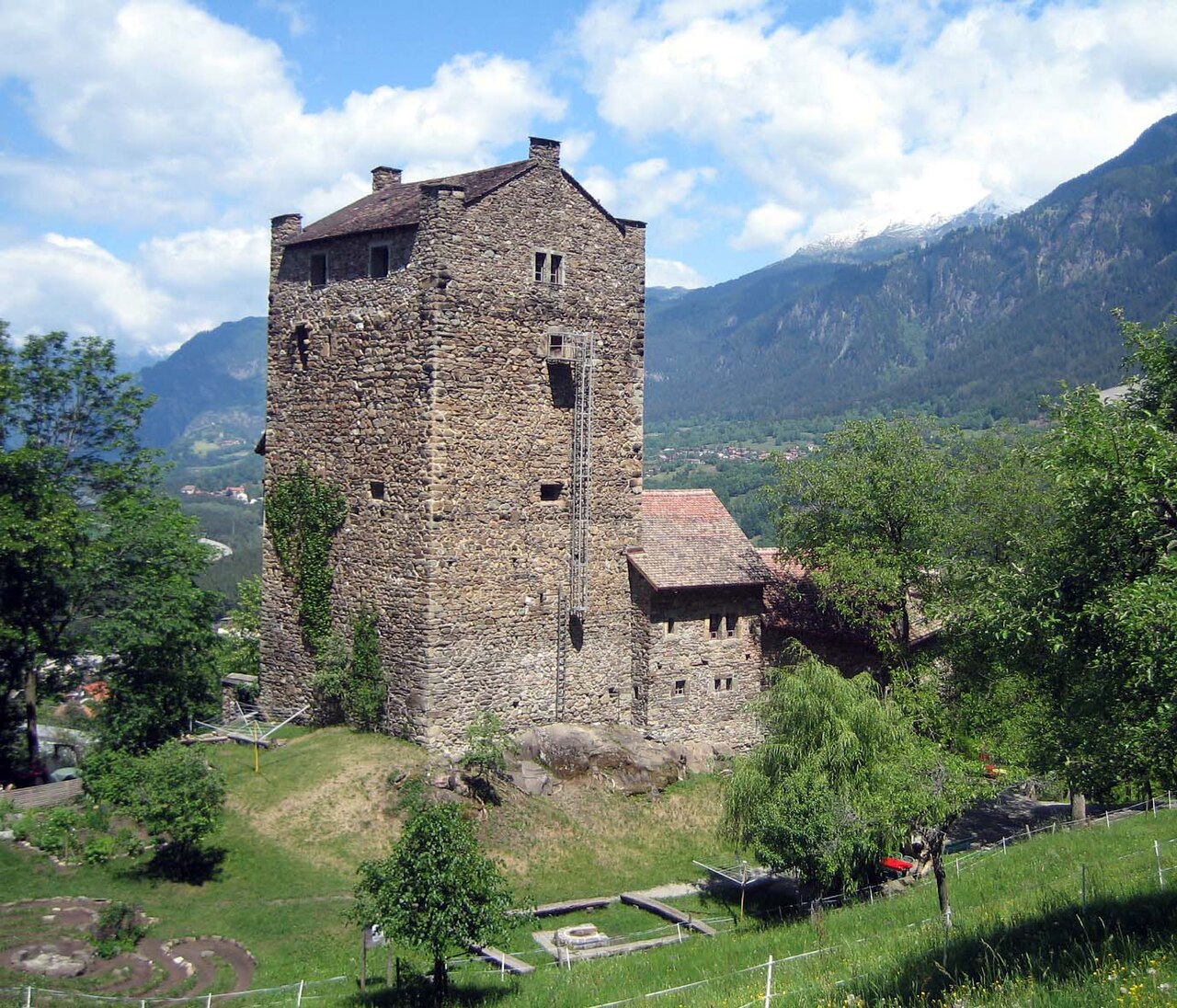
Campell Castle
Campell Castle stands as a significant example of high medieval hill castle architecture in the region of Sils im Domleschg, Switzerland. Constructed in the early 13th century for the noble von Campell family, the castle reflects the evolving defensive and residential needs of medieval Swiss nobility. The first recorded mention of the family dates to 1289 with Egeno de Campelle, indicating their prominence in the area during that period.
Early construction and medieval fortifications
The original structure of Campell Castle was a robust four-story bergfried, a type of tall tower typical in medieval fortifications, serving both as a last refuge and a symbol of lordly power. This central tower formed the heart of the castle complex. In the late 13th or early 14th century, the castle underwent significant expansions to enhance its defensive capabilities. A ring wall was added, enclosing the site with protective stone walls, complemented by a gatehouse that controlled access. Defensive features such as ditches and a drawbridge on the west side further secured the castle against potential attackers.
Alongside these fortifications, a residential wing was constructed on the east side, indicating a shift towards accommodating the domestic needs of its inhabitants alongside military functions. The castle's layout thus combined strong defensive elements with comfortable living quarters, a common evolution in medieval noble residences.
Ownership changes and architectural modifications in the 14th and 15th centuries
After the extinction of the von Campell family in the 14th century, the castle's ownership passed through several hands, reflecting the complex feudal relationships of the region. In 1389, the Bishopric of Chur transferred lands formerly held by the Campell family to Hans and Gottfried von Ehrenfels, although the castle itself was likely excluded at that time. It was not until 1418 that the castle was officially granted to Hermann von Schauenstein-Ehrenfels by the bishop.
During the 15th century, the castle saw further architectural enhancements. The west wall was raised and fitted with a roof, improving both defense and habitability. The original bergfried was extended by two additional stories and crowned with crenelations, the distinctive battlements that allowed defenders to shield themselves while firing upon attackers. A large cistern was excavated to the north of the tower, ensuring a secure water supply during sieges.
Ownership during this period shifted again, with the castle passing to the Ringg family around the mid-15th century, before returning to the Schauenstein family by 1500. The exact patrons of the renovations remain uncertain, but the modifications suggest a continued investment in the castle's defensive and residential functions.
Renaissance transformations and later history
The 16th century brought significant changes as Campell Castle transitioned from a primarily military fortress to a noble residence. The west wall and the zwinger—an enclosed killing zone between defensive walls—were roofed over to create a three-story palas, or great hall, reflecting the Renaissance emphasis on comfort and status. The original western gate was sealed, and a new entrance was constructed in the south wall, adapting the castle's layout to changing needs.
The west wall was also extended northward to protect the castle's flank, indicating ongoing concerns for defense despite the residential upgrades. In 1562, the castle was sold to Hans Faschau, and shortly thereafter, in 1567, it passed to Hercules von Salis, whose family maintained ownership for nearly a century.
During the tumultuous period of the Bündner Wirren—the conflicts in the Grisons region during the Thirty Years' War—the castle suffered fire damage. The west palas was rebuilt in 1635, while the east residential wing was abandoned and repurposed as a stable, marking a decline in the castle's residential use.
In 1647, the Salis family sold Campell Castle to the Freiherr von Schauenstein-Fürstenau. By the early 18th century, the castle was abandoned as a residence but remained structurally intact. However, by 1900, the castle had fallen into ruin, exacerbated by the construction of the Abula line of the Rhaetian Railway, which was built over the outer moat.
Modern preservation and current state
The Campell family reacquired the castle in 1932, initiating efforts to preserve the site. Between 1993 and 1998, extensive stabilization, repairs, and archaeological excavations were undertaken to protect the ruins and uncover historical details. The castle was opened to visitors in 2001, offering insight into medieval Swiss noble life and architecture.
Today, much of the castle remains standing. The original bergfried dominates the central complex, featuring an arched doorway leading to the eastern wing, both retaining their medieval character. The west palas, constructed after the castle ceased to function as a fortress, displays large windows characteristic of a noble residence designed for comfort rather than defense.
Architectural significance and features
The bergfried and defensive structures
The bergfried is a key architectural element, originally four stories tall and later extended. Its height and crenelated top provided a vantage point for surveillance and defense. The surrounding ring wall and gatehouse formed a formidable barrier, complemented by the moat and drawbridge systems that controlled access and hindered attackers.
Residential adaptations
The transformation of the zwinger and west wall into a palas illustrates the shift from military to residential priorities. Large windows and roofed-over sections created more habitable and light-filled spaces, aligning with Renaissance ideals of noble living. The eastern wing's preservation of medieval features offers a contrast, showcasing the castle's layered history.
Water management and logistics
The large cistern to the north of the tower highlights the importance of water storage in sustaining the castle during sieges. Its excavation demonstrates advanced planning for prolonged defense scenarios.
Frequently asked questions (FAQ)
- How do I get to Campell Castle?
- Campell Castle is located in Sils im Domleschg, Switzerland, easily accessible by car or public transportation. If traveling by train, the nearest station is in the town of Domleschg, from where you can take a short bus ride or a scenic walk to the castle.
- What is the historical significance of Campell Castle?
- Campell Castle dates back to the 12th century and is an important example of medieval Swiss architecture. It has served various purposes throughout its history, including as a defensive fortress and a noble residence, reflecting the region's rich cultural heritage.
- When was Campell Castle built?
- Construction of Campell Castle began in the early 12th century, making it one of the oldest castles in the area. Over the centuries, it has undergone several renovations, preserving its historical elements while adapting to the needs of its occupants.
- Can I visit Campell Castle year-round?
- Yes, Campell Castle is open to visitors throughout the year, although specific opening hours may vary by season. It’s best to check the official website for the most up-to-date visiting information before planning your trip.
- Why is the architecture of Campell Castle unique?
- The architecture of Campell Castle showcases a blend of Romanesque and Gothic styles, typical of medieval Swiss castles. Its imposing towers and fortified walls are not only visually striking but also illustrate the defensive strategies employed during the time of its construction.
- Is it possible to take guided tours of Campell Castle?
- Yes, guided tours are available at Campell Castle, providing visitors with deeper insights into its history and architecture. These tours are led by knowledgeable guides who can share fascinating stories about the castle and its significance in Swiss history.
- What are the ticket prices for visiting Campell Castle?
- Ticket prices for Campell Castle are generally affordable, with discounts available for students, seniors, and children. It’s advisable to purchase tickets in advance during peak tourist seasons to ensure availability.
- What are the opening hours for Campell Castle?
- Campell Castle typically opens to the public from 10 AM to 5 PM, with extended hours during the summer months. However, it's recommended to verify the current hours of operation on the official website before your visit.
- What are some nearby attractions to Campell Castle?
- In addition to Campell Castle, visitors can explore the picturesque village of Sils im Domleschg, which is known for its stunning landscapes and hiking trails. Nearby attractions also include other historical sites, museums, and the scenic Ruinaulta gorge, perfect for outdoor enthusiasts.
Loading map...
Visitor reviews
No reviews yet. Been here? Write the first review and help other travelers!
Write the first reviewVisited this castle? Share your experience
Your review helps other travelers and adds first-hand knowledge to our encyclopedia.