Eğirdir Castle — Turkey castle

Eğirdir Castle

Eğirdir Castle: historic hill castle in Isparta Province, Turkey

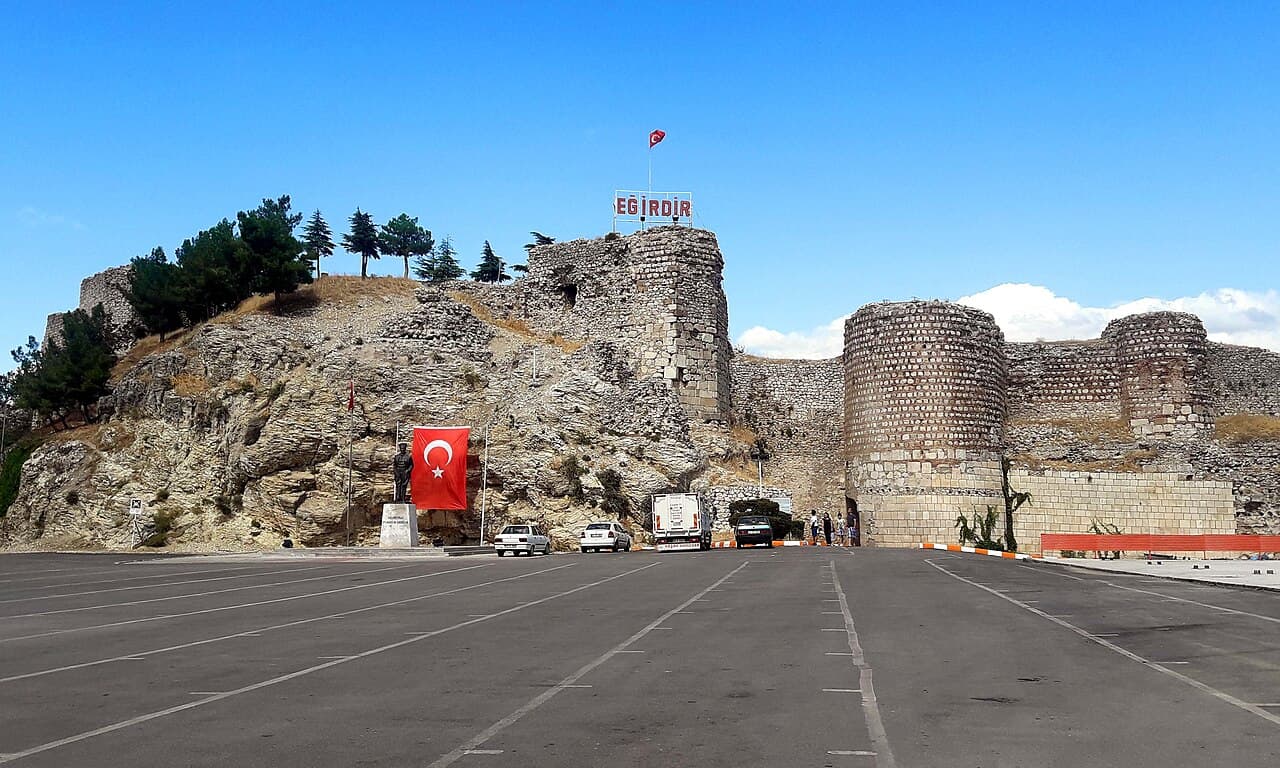
Eğirdir Castle is a significant hill castle located in the Eğirdir district of Isparta Province, Turkey. Positioned strategically on an isthmus of the Eğirdir Lake, the castle overlooks the water and the surrounding landscape, offering a commanding view that was essential for defense. The castle's placement on this narrow land bridge provided a natural defensive advantage against attacks from the lake side, a key factor in its design and historical use.

Historical background and origins

The exact date of Eğirdir Castle's construction remains uncertain due to the lack of written records. Local tradition suggests that the site may have origins as far back as the 6th to 7th centuries BC, potentially linked to the Lydian Kingdom. However, architectural analysis of the masonry indicates that the main construction or significant reconstruction likely took place during the Roman Empire or Byzantine Empire periods. This aligns with the common practice of reusing and reinforcing earlier fortifications during these eras.

In the early 14th century, Eğirdir served as the capital of the Anatolian beylik of Hamidids. The castle was restored in 1307 by Dündar of Hamidoğlu, as evidenced by an inscription found on the castle walls. This restoration was part of efforts to strengthen the region's defenses during a period of political fragmentation in Anatolia.

Later, during the 1402 campaign of Timur, the castle suffered partial destruction. Despite this damage, it remained in use during the Ottoman Empire era, functioning primarily as a small military post rather than a major fortress.

Architectural features and layout

The castle is relatively modest in height, standing about 15 metres (49 feet) tall, reflecting its primary defensive orientation against threats from the lake side. The original extent of the castle is difficult to determine due to the urban development that has taken place on its ruins over time. However, the inner castle area is estimated to cover approximately 4,500 square metres (48,000 square feet), indicating a substantial fortified space.

The masonry style suggests a blend of construction techniques from the Roman and Byzantine periods, characterized by robust stone walls designed to withstand sieges and natural wear. The castle likely included battlements, towers, and gates typical of hill castles of its era, although many of these features have been altered or lost due to later modifications and urban encroachment.

Defensive structures

Given its location on an isthmus, the castle's defenses were oriented to protect against attacks coming across the lake. The walls would have been reinforced on the lake-facing side to resist assaults and possible amphibious landings. The relatively low height of the walls suggests a design focused on controlling access rather than withstanding prolonged sieges from large armies.

Cultural and historical significance

Eğirdir Castle holds cultural importance as a symbol of the region's layered history, reflecting influences from the Lydian, Roman, Byzantine, Hamidid, and Ottoman periods. Its role as the capital fortress of the Hamidids in the early 14th century marks it as a key political and military site during a turbulent era in Anatolian history.

The castle's survival through multiple historical phases, including partial destruction during Timur's invasion and continued use in the Ottoman period, illustrates the strategic importance of Eğirdir as a crossroads of civilizations and military campaigns.

Current condition and preservation

Today, Eğirdir Castle is classified as partially preserved. The urban settlement built over parts of the ruins has obscured the full original layout, but significant portions of the inner castle remain visible. Preservation efforts focus on maintaining the remaining structures and highlighting the castle's historical value to visitors and scholars.

The castle is accessible to visitors interested in exploring the historical architecture and enjoying views of Eğirdir Lake and the surrounding landscape. Interpretive signage and local guides often provide context about the castle's diverse history and architectural evolution.

Visiting information

Visitors to Eğirdir Castle can explore the site throughout the year, although specific opening hours and ticketing details may vary locally. The castle's location within the town of Eğirdir makes it an accessible destination for those interested in Turkish history and medieval fortifications.

Frequently asked questions (FAQ)

What is the historical significance of Eğirdir Castle?
Eğirdir Castle, located in Turkey, dates back to ancient times and has played a crucial role in the region's defense against various invasions. It showcases a blend of Byzantine, Roman, and Ottoman architectural styles, reflecting its long and varied history.
When was Eğirdir Castle built?
The exact date of construction is unclear, but Eğirdir Castle is believed to have been established in the 4th century BC, with significant modifications made throughout the centuries. Its strategic location has made it a key fortification since its inception.
What are the opening hours for Eğirdir Castle?
Eğirdir Castle is typically open to visitors from 9 AM to 7 PM during the summer months and 9 AM to 5 PM in the winter. It's advisable to check local listings for any changes in hours, especially during holidays.
Can I access Eğirdir Castle with a wheelchair?
Eğirdir Castle features some uneven terrain and stairs, which may pose challenges for wheelchair users. However, efforts are being made to improve accessibility to certain areas within the castle grounds.
Is it possible to take guided tours at Eğirdir Castle?
Yes, guided tours are available at Eğirdir Castle, offering visitors insightful information about its history and architecture. It's recommended to book in advance, especially during peak tourist seasons.
What is the best time to visit Eğirdir Castle?
The best time to visit Eğirdir Castle is during the spring (April to June) and fall (September to October) when the weather is mild and pleasant. These seasons also provide stunning views of the surrounding landscape.
What are the ticket prices for Eğirdir Castle?
Entry to Eğirdir Castle is generally affordable, with ticket prices around 20 Turkish Lira for adults and discounted rates for students and children. Be sure to check for any special promotions or group rates available during your visit.
Are there any nearby attractions to visit while at Eğirdir Castle?
Yes, nearby attractions include the picturesque Eğirdir Lake and the charming town of Eğirdir itself, known for its local cuisine and beautiful scenery. The region is also home to several hiking trails and natural parks, perfect for outdoor enthusiasts.

Photo gallery

Eğirdir Castle
Click to view

Photo by Nedim Ardoğa•CC BY-SA 4.0

1 photo • Click any image to view in full screen

Information

Hill Castle

Loading map...

Visitor reviews

No reviews yet. Been here? Write the first review and help other travelers!

Write the first review

Visited this castle? Share your experience

Your review helps other travelers and adds first-hand knowledge to our encyclopedia.
Write a review

(5/5)

0/2000 characters

Your review will be visible after admin approval

Nearby castles

101.9 km
Afyonkarahisar Castle — Turkey castle

Afyonkarahisar Castle

Kale Mah., Turkey

Afyonkarahisar Castle, also known locally as Afyonkarahisar Kalesi, is a prominent historic fortress located in the city of Afyonkarahisar in western Turkey. Towering atop a volcanic rock approximately 220 meters (740 feet) high, this castle has a rich and complex history spanning over three millennia. It stands as a testament to the strategic importance of this site through various civilizations and empires, from the ancient Hittites to the Ottoman Empire. Early history and strategic significance The castle's origins trace back to around 1350 BC, when the Hittites first fortified the volcanic rock. This early fortification is believed to have been commissioned by the Hittite king Mursili II to protect the town then known as Hapanuwa. The location's natural elevation and volcanic rock made it an ideal defensive position, commanding views over the surrounding plains and trade routes. Following the Hittites, the site was successively occupied by the Phrygians, Lydians, and the Achaemenid Persian Empire. Each of these cultures contributed to the site's development and fortification, adapting the castle to their defensive needs. Classical and Byzantine periods In 333 BC, the area was conquered by Alexander the Great, who renamed the town Akroinon or Akronium. The name persisted through the rule of the Seleucid Empire, the kingdom of Pergamon, and the Roman Empire. The castle and town remained strategically important throughout these periods, serving as a military and administrative center. The Byzantine Empire inherited the fortress and the surrounding city, which gained renewed significance after the Battle of Akroinon in 740 AD. This battle marked a decisive Byzantine victory over an invading Umayyad Arab army. In honor of this victory, the city was renamed Nicopolis, meaning "city of victory" in Greek. The Byzantine fortifications were strengthened during this time, reflecting the ongoing military threats in the region. Seljuk and Ottoman periods The castle entered a new phase in 1071 when the Seljuks conquered the region. They renamed the fortress Kara Hisar, meaning "Black Fortress" in Turkish, a name that highlighted the dark volcanic rock on which the castle stands. The Seljuk period saw further modifications to the castle's defenses, adapting it to the changing warfare technologies of the medieval period. During the Crusades, the castle was a contested stronghold due to its strategic location. It was finally conquered by the Ottoman Empire in 1392. However, the castle was briefly lost after the invasion of Timur Lenk (Tamerlane) in 1402, only to be recaptured by the Ottomans in 1428–1429. Under Ottoman rule, the fortress continued to serve as a military bastion and administrative center. The town itself became known as Afyon, Turkish for "opium," reflecting the region's status as a major producer of raw opium until the late 1960s. The official name was changed to Afyonkarahisar in 2004, combining the words for "opium" and "black fortress," acknowledging both the agricultural heritage and the iconic castle. Architectural features and layout Afyonkarahisar Castle is classified as a bastioned fortress due to its defensive structures adapted over centuries. The castle's plan is notably irregular, as its curtain walls follow the natural contours of the volcanic rock on which it stands. This irregularity is a direct response to the topography, maximizing defensive capabilities by integrating the natural landscape. The fortress includes several cisterns carved into the rock, which provided essential water storage for the garrison during sieges. There are also rock-cut stairs that connect different levels of the castle, facilitating movement within the complex despite the steep terrain. Additionally, rock-cut graves have been found within the castle precincts, indicating the site's long-term habitation and cultural significance. Recent archaeological excavations, particularly in the western corner of the castle, have uncovered foundations of various buildings. These findings suggest that the castle complex included residential, administrative, and military structures that evolved over time. Visiting Afyonkarahisar Castle today The castle is freely accessible to visitors, although reaching the summit requires climbing a strenuous set of stairs located on the south side of the rock. The climb rewards visitors with panoramic views over the city of Afyonkarahisar and the surrounding landscape. Today, the castle remains a significant cultural and historical landmark in Turkey. It is primarily of Byzantine and Ottoman origin, with modern repairs preserving its structure. Visitors can explore the ruins, including the defensive walls, cisterns, and archaeological sites, gaining insight into the castle's layered history and architectural evolution. Historical significance and cultural heritage Afyonkarahisar Castle stands as a symbol of the region's turbulent history and strategic importance. Its continuous occupation and adaptation by various civilizations reflect the broader historical currents of Anatolia and the eastern Mediterranean. The castle's prominent position and enduring presence have made it a cultural icon, representing both the ancient heritage and the Ottoman legacy of the city. Its name, combining "Afyon" (opium) and "karahisar" (black fortress), encapsulates the intertwined agricultural and military history of the area. Preservation and ongoing research Archaeological work continues at the site, uncovering new insights into the castle's construction phases and the daily lives of its inhabitants. Preservation efforts aim to maintain the castle as a well-preserved monument, highlighting its architectural and historical significance for future generations.

Details
115.4 km

Karaköy Castle

Southwest of Karaköy, Turkey

Karaköy Castle, also known locally as Karaköy Kalesi, Ilgın Kalesi, or Çetmi'nin Kalesi, is situated southwest of the village of Karaköy in the Konya Province of Turkey. This site represents a complex archaeological and architectural heritage spanning several historic periods, prominently featuring remains from the Hellenistic era and earlier Iron Age fortifications. Historical context and location The castle occupies a strategic position on a hillside, overlooking the surrounding landscape. It is one of two fortifications on this hill, with Karaköy Castle itself located on the slope of a higher hill. Above it once stood an even older fortification, often referred to as the Karaköy Upper Castle, which dates back to the Iron Age. This upper fortification is believed to have had a circular plan fortified with 26 semicircular towers, a design that suggests significant defensive capabilities. Although no visible remains of this upper castle survive today, archaeological evidence indicates it may have been linked to the Hittite civilization, especially given the proximity of the Yalburt Hittite Water Monument, a religious site located approximately 17 kilometers north. Dating and architectural phases The present ruins of Karaköy Castle are thought to date primarily from the Hellenistic period, approximately between the 3rd century BC and 50 BC. This dating aligns with the architectural style and masonry techniques observed in the remaining structures. Despite its designation as a castle, the site’s exact function remains debated. Its position below the higher Iron Age fortification raises questions about its defensive logic, as having an elevated vantage point behind a fortification would be disadvantageous in military terms. Architectural features and site layout The surviving remains of Karaköy Castle reveal characteristic masonry work typical of the Hellenistic era. The castle’s walls and foundations display stone construction with a focus on durability. However, the absence of significant defensive features such as extensive battlements or a moat suggests that the site may have served purposes beyond pure military defense. Possible religious or ceremonial functions Given the presence of a reliable water source beneath the castle, adjacent to a nearby road, some scholars have proposed that Karaköy Castle may have functioned at least partly as a religious or ceremonial site. This theory is supported by the proximity of the Hittite religious pool, which hints at the area’s longstanding spiritual significance. Archaeological significance and current condition While Karaköy Castle does not present as a grand fortress typical of medieval military architecture, it remains an important archaeological site that sheds light on the region’s complex history. Its layered history from the Iron Age through the Hellenistic period illustrates the continuity of settlement and strategic use of the hill. Today, Karaköy Castle is freely accessible to visitors. Although it may not offer the dramatic ruins or extensive fortifications seen at other castles, it provides a unique glimpse into ancient construction techniques and the historical landscape of Konya Province. The site’s relatively modest remains and quiet setting contribute to its character as a somewhat forgotten archaeological location. Visitor information and accessibility Visitors to Karaköy Castle can explore the ruins without restrictions, making it an appealing destination for those interested in early medieval and ancient sites off the beaten path. Its location near Karaköy village allows for easy access, though facilities and interpretive signage may be limited. The site is best visited in good weather, when the surrounding countryside is visible from the castle’s elevated position.

Early Medieval (5th–10th c.)
Details
152.1 km
Alara Castle — Turkey castle

Alara Castle

Turkey, Turkey

Alara Castle stands as a remarkable example of medieval military architecture in Anatolia, Turkey. Constructed originally in the 11th century during the Byzantine Empire, this hill castle occupies a commanding position on a steep rock formation overlooking the Alara River valley. Its strategic location made it a vital defensive stronghold controlling inland routes leading to the Mediterranean coast. Initially built to serve Byzantine interests, the castle later became a crucial frontier fortress for the Armenian Kingdom of Cilicia from 1080 to 1375. During this period, it played a key role in protecting caravans traveling along the Silk Road, which was a major trade artery connecting Asia and Europe. The castle's proximity to the caravanserai known as Alarahan provided a secure resting point for merchants and travelers before they continued their journey toward the coast. Alara Castle's natural defenses are enhanced by its location atop a steep hill rising between 200 and 500 meters above sea level and situated approximately 7 kilometers inland from the Mediterranean Sea. The castle is divided into two principal sections: the outer fortress and the inner citadel. Access to the inner citadel is gained through a distinctive square-shaped tower adorned with heraldic emblems painted in a rare fresco style, reflecting the artistic influences of the era. Architectural features and layout The castle's entrance is notable for a dark staircase carved directly into the bedrock, containing between 120 and 180 steps. This stairway was designed to be defensible and difficult for attackers to ascend. Partway up the staircase lies a cistern connected to a natural cave, which historically served as a vital water storage facility, ensuring the castle's sustainability during sieges. Within the inner citadel, visitors can find the remains of a small palace attributed to the Seljuk period, along with residential quarters for the castle's personnel. The inclusion of a mosque and a bathhouse within the castle complex illustrates the multifunctional nature of the site, combining military, administrative, and domestic uses. The Seljuk bathhouse and frescoes The bathhouse is architecturally significant, comprising two vaulted chambers: a heated room featuring a small hearth and a cold room with two windows, one overlooking a scenic valley. This bathhouse is distinguished by its rare fresco-style decorations, including figurative images such as a legendary beast above the hearth window and a human figure painted on a now heavily damaged wall. These artworks are unique examples of Anatolian Turkish ornamental style within medieval architecture, highlighting the cultural synthesis present in the region during the Seljuk era. Historical context and strategic importance Alara Castle's history reflects the turbulent dynamics of medieval Anatolia. After its initial Byzantine construction, the castle was taken over by the Armenian Kingdom of Cilicia, which used it as a defensive outpost on its western frontier. Its role in safeguarding the Silk Road caravans made it a key asset for controlling trade and regional security. In the early 13th century, the castle changed hands when its lord surrendered it around 1231 or 1232 following the Seljuk Sultan Alaeddin Keykubad I's conquest of nearby Alanya. The Seljuks incorporated Alara Castle into their expanding territory, adapting its structures and functions to suit their administrative and military needs. Construction techniques and natural integration Much of Alara Castle's interior, including tunnels, chambers, and stairways, was carved directly from the natural bedrock, demonstrating advanced craftsmanship in utilizing the landscape for defensive advantage. This integration of architecture with the natural environment not only enhanced the castle's defensibility but also conserved resources by adapting existing geological features. The castle's position provides commanding views over the surrounding valley and the Mediterranean coast, including a harbor approximately three kilometers away at Qaraburun promontory. This vantage point allowed its occupants to monitor land and sea routes effectively. Current condition and cultural significance Today, Alara Castle remains a partially preserved ruin, with many of its structures exposed to the elements and overgrowth. Despite this, the site continues to offer valuable insights into the medieval military architecture of Anatolia and the cultural interactions between Byzantine, Armenian, and Seljuk civilizations. The castle is an important cultural heritage site in Turkey, attracting historians, archaeologists, and tourists interested in exploring its complex history and architectural features. Its unique frescoes and bathhouse remain highlights for visitors, showcasing the artistic and functional sophistication achieved by its builders. Efforts to preserve and study Alara Castle contribute to a broader understanding of the region's medieval history and the strategic importance of Anatolian fortresses along historic trade routes.

High Medieval (11th–13th c.)
Details