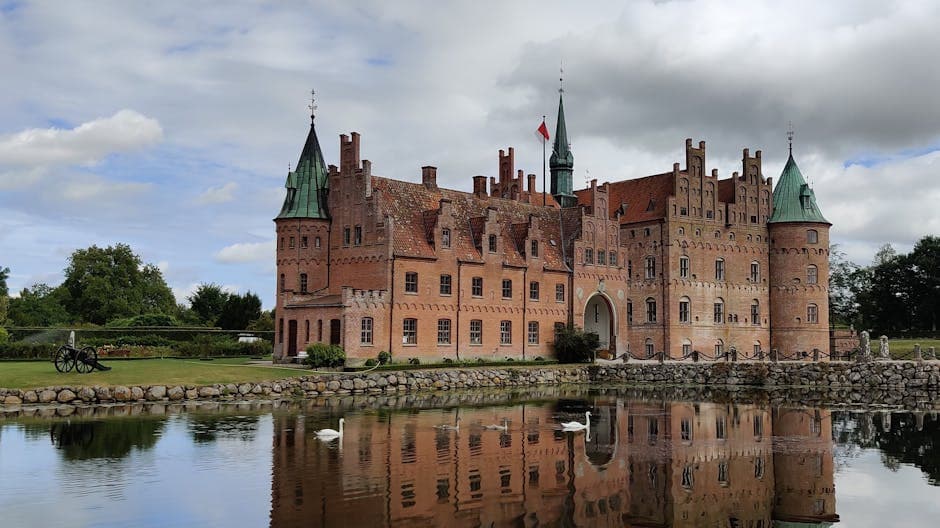
Egeskov Castle
Egeskov Castle stands as one of Europe's best preserved Renaissance water castles, located on the island of Funen, Denmark. Built in 1554 by the Danish warlord Frands Brockenhuus, the castle is renowned for its unique construction on thousands of oak piles driven into a shallow lake, creating a natural moat that enhanced its defensive capabilities during a turbulent period marked by the Count's Feud and the Protestant Reformation. This Renaissance fortress exemplifies the transition from medieval fortifications to more modern residential castles while maintaining formidable defensive features.
Historical origins and early ownership
The site of Egeskov Castle originally hosted a large farm as early as the 1400s. Historical records from 1405 reveal that the farm, known as Egeskovgaard, belonged to Skinkel Ludeke, a member of an old Holstein noble family. Ludeke's early life was marked by piracy, but by the late 1380s, he had made peace with both Queen Margrethe and the Hanseatic League towns. The farm remained in the Skinkel family until 1545, when it passed to the Brockenhuus family through marriage.
In 1545, Frands Brockenhuus married Anne Tinhuus (Skinkel), inheriting the Egeskov estate through her. That same year, Frands was appointed sheriff of Nyborg, a role that influenced the castle's design. Architectural similarities between Nyborg Castle and Egeskov suggest that the royal builder Morten Bussert was involved in Egeskov's construction. Bussert died in 1553, before the castle's completion in 1554, so another builder finished the work.
Architectural design and defensive features
Egeskov Castle was constructed as an impregnable fortress amid a lake, reflecting the unsettled times of mid-16th century Denmark. Its foundation rests on thousands of oak piles submerged in water up to five meters deep, giving the castle its name, which means "oak forest." The castle consists of two long buildings connected by a thick double wall over one meter wide, containing secret staircases and a water well accessible from the servants' kitchen, allowing defenders to sustain a siege.
The castle's defensive architecture includes round corner towers from which defenders could attack enemy flanks, artillery ports, arrow slits, and machicolations (scalding holes) for dropping boiling substances on attackers. The walls are built of oversized medieval "monk bricks" and feature conical towers constructed in separate panels. Windows exhibit both depressed and round arches, with decorative blank arcading on the gables and a distinctive double string course separating the cellar from the ground floor.
Inside, the castle has 66 rooms illuminated by 200 windows containing over 2,000 glass panes. Early examples of indoor plumbing are present, with vertical shafts designed for waste disposal. Large rooms feature massive parallel exposed beams, some with carved ends, showcasing Renaissance craftsmanship. Among the furnishings is a massive iron chest dating back to the 16th century, originally from Hvedholm Castle, and numerous oil paintings, including a prominent portrait of Niels Juel, the naval hero who defeated the Swedish fleet at the Battle of Køge Bay in 1677.
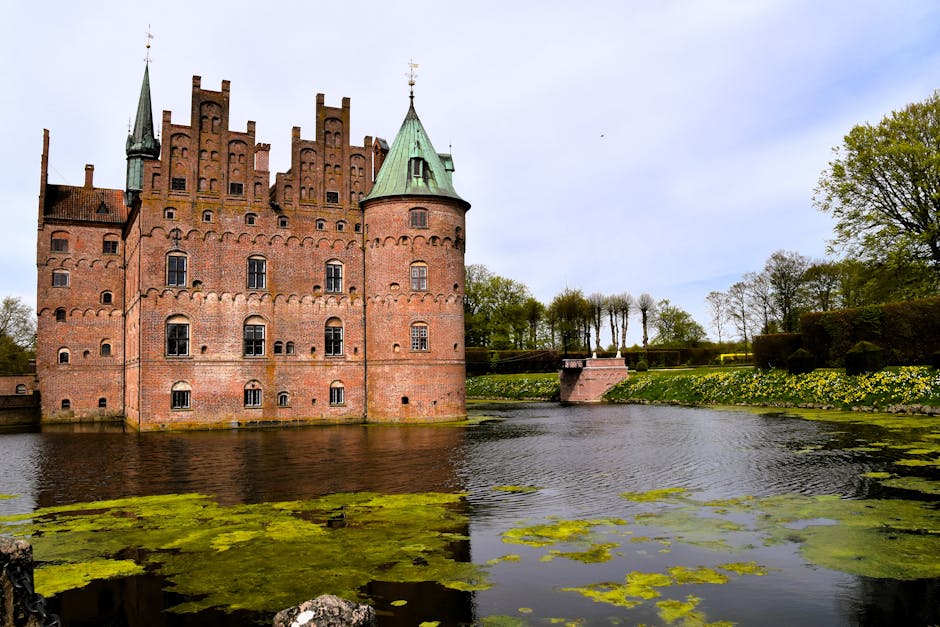
Photo by Waldemar Brandt
Notable historical figures and family saga
Frands Brockenhuus was a highly valued Danish nobleman, serving as a member of the War Council and commander of infantry during the war against Sweden. He was appointed riksmarsk (marshal) in 1567 but died from a leg wound sustained during the siege of Varberg in 1569. His wife, Anne, managed the estate until her death in 1565.
Their son, Laurids Brockenhuus, inherited Egeskov as a minor and was known for a turbulent youth marked by violent conflicts. Laurids married Karen Skram in 1571, and they had nine children, five daughters reaching adulthood. One daughter, Rigborg Brockenhuus, became embroiled in a scandalous affair with Frederik Rosenkrantz, resulting in her imprisonment within the castle for five years. Their son, Holger Rosenkrantz, later became a distinguished officer and progenitor of the Norwegian Rosenkrantz dynasty.
The Rosenkrantz name is famously associated with Shakespeare's "Hamlet," and it is believed that Frederik Rosenkrantz's trip to London inspired the playwright's use of the names Rosencrantz and Guildenstern.
In 1616, Jacob Ulfeldt became owner of Egeskov. He relocated family coffins to the nearby Kværndrup Church and commissioned a mausoleum. His son, Corfitz Ulfeldt, married King Christian IV's daughter, Leonora Christina, further elevating the family's status. Throughout the 17th century, ownership changed hands several times until the estate was acquired by the Bille-Brahe family in 1784, who still own it today.
Gardens and parkland
The castle is surrounded by an extensive park exceeding 20 hectares, featuring a variety of themed gardens. The Renaissance garden includes fountains, gravel paths, and topiary figures. The fuchsia garden is one of the largest in Europe, boasting over 100 species. Other gardens include an English garden, water garden, herb garden, vegetable garden, and a traditional peasant's garden (bondehave).
Four hedge mazes are found on the grounds, including a centuries-old beech maze, a bamboo maze (the world's largest), a larch maze, and a yew maze. The bamboo maze features a Chinese tower at its center, with a bridge leading to the exit. The park also contains a three-meter-tall sundial designed by the Danish poet and mathematician Piet Hein.
Modern use and museums
Today, Egeskov Castle serves as a museum complex with several exhibition halls that house collections of vintage automobiles, motorcycles, aircraft, and emergency vehicles. The castle's knight's hall has been restored and is open to visitors, showcasing the grandeur of Renaissance banquets.
The estate includes the Ladegården, a thatched half-timbered building now used as a museum space for agricultural exhibits and horse-drawn carriages. Other museums on site feature dollhouses, including the famous Titania's Palace, a highly detailed miniature castle constructed over 15 years.
While most of the castle and grounds are open to the public from late April to late September, some private areas remain reserved for the current owners, the Ahlefeldt-Laurvig-Bille family.
Legends and cultural significance
A local legend surrounds a wooden doll hidden in the castle's attic. The story warns that if the doll is moved from its cushion, the castle will sink into its moat on Christmas Eve. This tale adds a layer of mystique to the castle's rich history and continues to fascinate visitors.
In 1986, a full-scale replica of Egeskov Castle was constructed in Hokkaidō, Japan, serving as an aquarium and symbolizing the international recognition of Egeskov's architectural and cultural importance.
Egeskov Castle remains a remarkable example of Renaissance architecture blending defensive military features with residential elegance. Its preservation, extensive gardens, and diverse museums make it a significant cultural landmark in Denmark and Europe.
Frequently asked questions (FAQ)
- How do I get to Egeskov Castle?
- Egeskov Castle is located in Kværndrup, Denmark, easily accessible by car or public transportation. If traveling by car, you can find ample parking on-site. Public transport options include buses that connect to nearby towns, making it convenient for visitors.
- What is the historical significance of Egeskov Castle?
- Egeskov Castle, built in 1554, is one of the best-preserved Renaissance water castles in Europe. It was constructed by the noble family of the Frijs and has played a significant role in Danish history, serving as a symbol of wealth and power through the centuries.
- When was Egeskov Castle built?
- Egeskov Castle was built in the year 1554. The castle is renowned for its unique architecture and beautiful gardens, making it a popular tourist attraction today.
- Can I visit the gardens at Egeskov Castle?
- Yes, visitors are welcome to explore the stunning gardens surrounding Egeskov Castle. The gardens feature a variety of themed areas, including a rose garden and a topiary garden, providing a picturesque setting for a leisurely stroll.
- Is it possible to tour the interior of Egeskov Castle?
- Yes, guided tours of the interior of Egeskov Castle are available, allowing visitors to learn about its rich history and architecture. The tours typically cover several rooms filled with fascinating artifacts and decor from different historical periods.
- What are the opening hours for Egeskov Castle?
- Egeskov Castle is generally open from April to October, with specific hours varying by season. During peak summer months, the castle opens earlier and closes later, providing ample opportunity for visitors to explore.
- What are the ticket prices for Egeskov Castle?
- Ticket prices for Egeskov Castle vary depending on age and group size, with discounts often available for children and families. It’s advisable to check the official website for the most current pricing and any special offers before your visit.
- When is the best time to visit Egeskov Castle?
- The best time to visit Egeskov Castle is during the summer months when the gardens are in full bloom and the weather is pleasant. Additionally, special events and exhibitions are often held during this time, enhancing the visitor experience.
- Are there any nearby attractions to Egeskov Castle?
- Yes, there are several nearby attractions including the Funen Village and the Odense Zoo, making it easy to plan a full day of exploration in the region. Visitors can also enjoy the scenic countryside and other historical sites nearby.
Photo gallery

Photo by Andreas Helveg Rudolph


Information
Website
Visit websiteSources & official resources
Verify the information above using these authoritative references.
Loading map...
Visitor reviews
No reviews yet. Been here? Write the first review and help other travelers!
Write the first reviewVisited this castle? Share your experience
Your review helps other travelers and adds first-hand knowledge to our encyclopedia.



