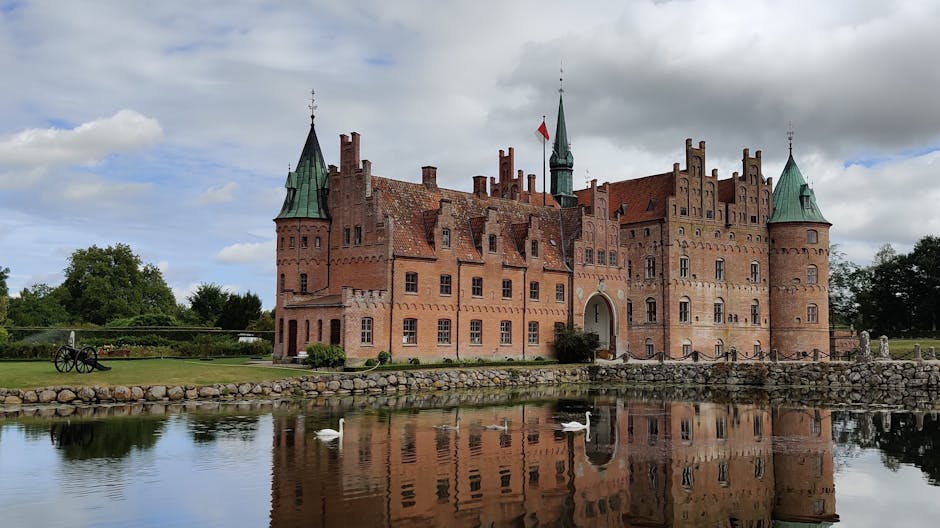
Brahetrolleborg Castle
Brahetrolleborg Castle in Faaborg, Denmark, stands on the site of the former Cistercian Holme Abbey, a religious institution founded in 1172 as a daughter house of the Cistercian Herrevad Abbey in Scania (now part of Sweden). The abbey was established during the High Medieval period, reflecting the expansion of the Cistercian order in Northern Europe. Its original design followed the strict architectural plan inspired by Saint Bernard of Clairvaux, emphasizing simplicity and austerity, typical of Cistercian monastic architecture.
From abbey to noble estate: historical transitions
Following the Reformation in Denmark, around 1536, the abbey was secularised as part of the widespread dissolution of monastic institutions. The property passed to the Danish Crown and was subsequently released into private ownership. In 1568, it became the possession of Heinrich Rantzau, a notable figure of the time, and was briefly known as Rantzausholm.
After reverting to the Crown in 1661, the estate was granted by King Frederick III of Denmark in 1664 to the German merchant and politician Christoffer Gabel. Gabel exchanged the estate three years later with Birgitte Nielsdatter of the Trolle family, who was married into the Brahe family. This exchange gave rise to the name Brahetrolleborg, combining the two noble family names. The estate was elevated to a barony under this name.
In 1722, the estate was sold to Christian Detlev von Reventlow, the Oberpräsident of Altona, whose family has retained ownership to the present day. The property's long history reflects its transformation from a religious center to a noble estate, with layers of architectural and cultural significance.
Architectural features and modifications
The former Cistercian church and chapel
The former Cistercian church at Brahetrolleborg is a key surviving feature of the original abbey. It was constructed following the Cistercian emphasis on functional and austere design, laid out according to the plan of Saint Bernard. The church has a notable west front tower, which was characteristic of some Cistercian churches although towers were generally rare in the order's architecture.
Inside the chapel, there is a significant crucifix by Claus Berg, dating from around 1500. Claus Berg was a renowned sculptor and artist of the late Gothic period in Denmark, and his work adds considerable artistic value to the chapel. The preservation of this crucifix highlights the chapel's historical and religious importance.
Conversion of conventual buildings into a castle
After the abbey's secularisation, the conventual buildings, originally designed for monastic life, were adapted for residential and defensive purposes. These buildings were converted into a castle structure, reflecting the changing needs and functions of the estate.
In about 1870, Brahetrolleborg underwent a comprehensive overhaul, transforming it into the castle seen today. This renovation likely included updates to the living quarters, fortifications, and aesthetic elements to suit the tastes and requirements of the noble owners of the period.
Legacy and current status
Brahetrolleborg remains a significant cultural and historical site in Denmark, illustrating the evolution of a medieval monastic complex into a noble estate. The castle is still owned by the Reventlow family, maintaining a continuous link to its historical past.
The site offers insights into High Medieval monastic architecture, the impact of the Reformation on ecclesiastical properties, and the architectural adaptations that reflect changing social and political circumstances over centuries.
Visitors to Brahetrolleborg can explore the chapel with its preserved Gothic art and appreciate the castle's layered history, from its monastic origins to its present-day status as a noble estate.
Frequently asked questions (FAQ)
- When was Brahetrolleborg Castle originally founded?
- Brahetrolleborg Castle was originally founded in 1172 as the Cistercian Holme Abbey, a daughter house of Herrevad Abbey in Scania.
- What architectural style characterizes the original abbey church?
- The original abbey church was built following the Cistercian plan inspired by Saint Bernard, emphasizing simplicity and austerity typical of High Medieval monastic architecture.
- How did Brahetrolleborg transition from an abbey to a castle?
- After the Reformation, the abbey was secularised and the conventual buildings were converted into a castle, with major renovations occurring around 1870 to adapt it for noble residence.
- Who currently owns Brahetrolleborg Castle?
- The castle has been owned by the Reventlow family since 1722 and remains in their possession today.
- Is the Claus Berg crucifix still present at Brahetrolleborg?
- Yes, the chapel of Brahetrolleborg houses a crucifix by Claus Berg dating from around 1500, reflecting its Gothic artistic heritage.
Information
Current owner
Reventlow family
Loading map...
Visitor reviews
No reviews yet. Been here? Write the first review and help other travelers!
Write the first reviewVisited this castle? Share your experience
Your review helps other travelers and adds first-hand knowledge to our encyclopedia.