Edzell Castle
Edzell Castle stands as a remarkable example of Scottish Renaissance architecture combined with medieval fortification elements. Located near the village of Edzell in Scotland, this 16th-century castle is renowned not only for its historic tower house but also for its adjacent early-17th-century Renaissance walled garden, one of the most distinctive and well-preserved of its kind in Scotland. The castle and garden together reflect the evolution of noble residences from defensive strongholds to country houses emphasizing comfort and aesthetic appeal.
The site’s origins trace back to the 12th century when the Abbott family constructed a timber motte and bailey fortress known as Castlehillock. This early fortification was strategically positioned to guard the mouth of Glenesk, a critical pass leading north into the Scottish Highlands. The motte, a large artificial mound, remains visible about 300 meters southwest of the present castle, serving as a physical reminder of the site's medieval defensive importance. By the mid-14th century, the estate had changed hands through several noble families before coming into the possession of the Lindsay family in 1358 through marriage.
Development of the castle and its architecture
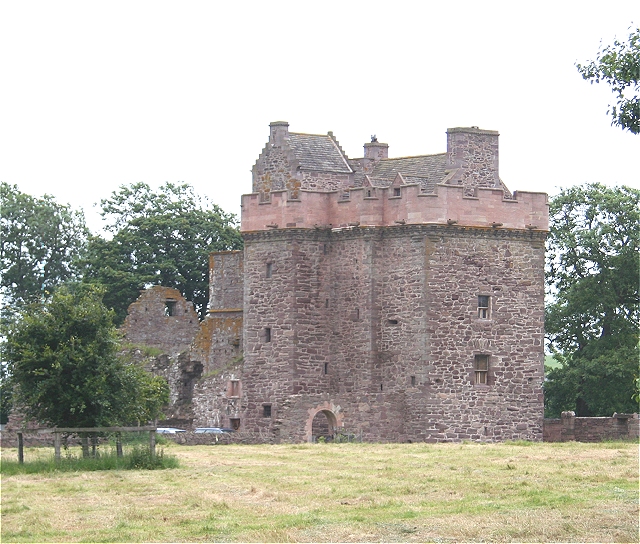
Around 1520, David Lindsay, the 9th Earl of Crawford, initiated the construction of the current castle, opting to build a new stone tower house and courtyard in a more sheltered location than the original motte. This decision marked a shift from purely defensive architecture to a residence that balanced security with domestic comfort and status. The castle's red sandstone tower house, known as Stirling Tower, is a four-storey structure approximately 13 by 10 meters at its base and about 16 meters tall. Its thick walls, tapering from over two meters at the basement to about one and a half meters at upper levels, were originally coated with protective harling. Defensive features include inverted keyhole-shaped gun holes and a drawbar slot at the entrance, along with bartizans—small turrets projecting from the corners and wall midpoints—that provided vantage points for surveillance and defense.
By the mid-16th century, the castle was expanded with a western wing that introduced a new main entrance and a great hall, reflecting the growing emphasis on social functions and noble hospitality. This wing contained a kitchen on the lower floor and reception rooms above, featuring larger windows with iron grilles and small gunholes for protection. Later, Sir David Lindsay, Lord Edzell and son of the 9th Earl, further extended the castle with a northern range intended to be three storeys tall, including private chambers and kitchen facilities. This northern wing remained unfinished due to Sir David's death in 1610.
Interior and defensive features
The interior of Stirling Tower includes vaulted cellars beneath the main hall on the first floor, which was the primary reception and living space. Evidence of a gallery for minstrels and a timber screen concealing service areas points to the castle's role as a comfortable noble residence. A spiral staircase provides access to private chambers and a rooftop cap-house, which leads to a parapet walk with a distinctive chequered corbel pattern supporting the battlements. The castle's defensive architecture is subtle, reflecting its function more as a status symbol and residence than a fortress designed for prolonged military engagement.
Historical significance and noble connections
Edzell Castle holds a notable place in Scottish history, having hosted prominent figures such as Mary, Queen of Scots in 1562 and her son, King James VI, who visited twice in the late 16th century. These visits underscore the castle’s importance within the Scottish nobility and its connection to the royal court. The Lindsay family, particularly Sir David Lindsay, Lord Edzell, was instrumental in enhancing the castle and its grounds, blending Renaissance cultural influences with local traditions.
The castle saw limited military action but was briefly occupied by English troops during Oliver Cromwell’s invasion of Scotland in 1651. Later, it served a religious role after 1689 when it became a site for Episcopal worship during local church disputes. The Lindsay family's decline began after the Jacobite rising of 1715, leading to the sale of the estate and subsequent ownership changes, including the York Buildings Company and eventually the Earls of Dalhousie. The castle suffered neglect and partial dismantling in the 18th century but was preserved as a ruin and heritage site in the 20th century.
Renaissance walled garden: design and symbolism
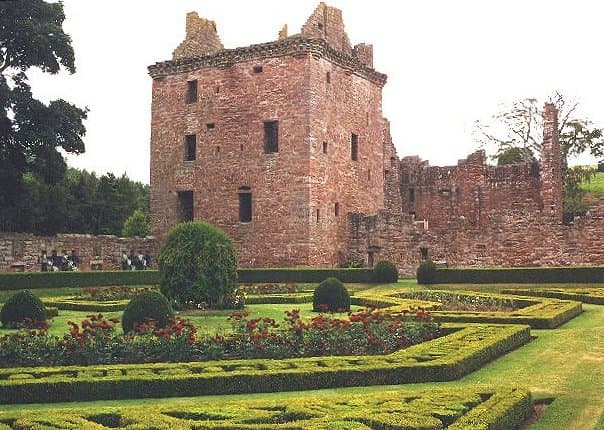
One of the most exceptional features of Edzell Castle is its Renaissance walled garden, known as the Pleasaunce, laid out in 1604 under Sir David Lindsay’s direction. This garden is a rare example of early 17th-century garden design in Scotland, combining horticultural function with rich symbolic decoration. The garden is enclosed by walls approximately 3.6 meters high, featuring intricate relief carvings and niches intended to hold statues.
The garden walls are divided into compartments separated by pilasters, with the east wall adorned by curved pediments carved with scroll motifs and the four national emblems—the thistle, fleur-de-lis, shamrock, and rose—symbolizing the Union of the Crowns in 1603. The south wall sports square pediments, while the west wall remains undecorated, suggesting the decorative program was incomplete.
Below the niches are three series of seven carved stone panels illustrating the seven Cardinal Virtues, the seven Liberal Arts, and the seven Planetary Deities. These panels draw inspiration from contemporary European engravings by artists such as Georg Pencz, Marten de Vos, Jan Sadeler, and Crispijn de Passe, reflecting the Renaissance humanist interests of the castle’s owners. The garden also displays the coats of arms of the Lindsay and Stirling families, carved into heraldic recesses that may have served as bird nesting places.
Garden structures and restoration
At the garden’s corners stand two significant structures: the ruins of a bath house, discovered in the 19th century, and a two-storey summer house featuring groin-vaulted ceilings and the castle’s only surviving carved oak wall paneling. The summer house includes elaborately decorated gun holes attributed to Thomas Leiper, a local stonemason. In the 1930s, the garden’s planting was restored to reflect its original symbolism, with clipped hedges representing the four national emblems and inscribed family mottos such as “Dum Spiro Spero” and “Endure Forte.”
Preservation and public access
Today, Edzell Castle and its Renaissance garden are protected as Scheduled Ancient Monuments and managed by Historic Environment Scotland. The castle is a popular visitor attraction, open year-round with an entrance fee. The site includes the castle ruins, garden, and a caretaker’s cottage built in the early 20th century, which is itself a listed building. These preserved features provide valuable insights into Scottish noble life from the medieval period through the Renaissance, emphasizing the blend of military architecture and cultural refinement.
The castle’s well-preserved architectural elements, combined with the garden’s unique artistic program, make Edzell Castle a significant cultural and historical landmark. Its story illustrates the transition of Scottish castles from fortified strongholds to elegant residences reflecting Renaissance ideals and the social aspirations of their owners.
Frequently asked questions (FAQ)
- What is the historical significance of Edzell Castle?
- Edzell Castle is a remarkable example of Renaissance architecture in Scotland, built in the 16th century. It was the seat of the Lindsays, a powerful family in the region, and showcases intricate design and beautiful gardens that reflect the era's artistic achievements.
- When was Edzell Castle built?
- Edzell Castle was constructed in the early 16th century, with its earliest parts believed to date back to around 1553. The castle underwent various modifications over the years, enhancing its architectural features and gardens.
- What are the opening hours for Edzell Castle?
- Edzell Castle is typically open to visitors from April to September, with specific hours varying by season. It is advisable to check the official website or contact them directly for the most current opening times before planning your visit.
- Can I access Edzell Castle with mobility difficulties?
- Yes, Edzell Castle offers some accessibility options for visitors with mobility challenges. However, certain areas may be restricted due to the historical nature of the site, so it's recommended to inquire about specific accessibility features upon arrival.
- What is the best time to visit Edzell Castle?
- The best time to visit Edzell Castle is during the spring and summer months when the gardens are in full bloom and the weather is generally pleasant. This time also allows visitors to fully appreciate the outdoor spaces and participate in any seasonal events.
- Are there any nearby attractions to visit while at Edzell Castle?
- Yes, there are several nearby attractions, including the picturesque village of Edzell and the stunning Angus countryside. Visitors can also explore other historical sites such as Glamis Castle and the Cairngorms National Park, which are within a short drive.
- How much are the ticket prices for Edzell Castle?
- Ticket prices for Edzell Castle vary based on age and concession types, with discounts available for families and groups. It is best to check the official site for detailed pricing and any special offers that may be available during your visit.
Photo gallery

Information
Website
Visit websiteSources & official resources
Verify the information above using these authoritative references.
Loading map...
Visitor reviews
No reviews yet. Been here? Write the first review and help other travelers!
Write the first reviewVisited this castle? Share your experience
Your review helps other travelers and adds first-hand knowledge to our encyclopedia.