Edole
Ēdole Castle stands as a remarkable example of a 14th-century bastioned fortress in Latvia, embodying centuries of historical transformation from a medieval stronghold to a noble residence. Located in the municipality of Kuldīga, the castle's origins trace back to the early 1300s when it was constructed under the authority of the bishops of Courland. This strategic location on a small hill by the Vanka River allowed the castle to be naturally defended by a moat and mill pond created by damming the nearby stream.
The castle's initial design featured a roughly square plan measuring approximately 31.5 by 34.5 meters, enclosed by defensive walls and surrounded on three sides by water-filled moats. The earliest surviving structure is the northern wing, which originally contained vaulted cellars with barrel and star-shaped vaults, a testament to the medieval architectural techniques employed during its construction. The castle's gate was positioned on the eastern wall within a tower that projected outward, designed as a defensive stronghold with a characteristic four-sided roof.
Medieval origins and ecclesiastical ownership
The lands encompassing Ēdole Castle came under the control of the bishops of Courland in the mid-13th century, following the conquest of Courland by the Livonian Order. Although some sources suggest construction may have begun as early as 1275, most evidence supports an early 14th-century date for the castle's initial build. Ēdole, originally known as Edwahlen, served as a pivotal episcopal seat and fortress within the bishopric of Piltene.
Throughout the Late Medieval period, the castle was fortified and expanded to meet the demands of regional conflicts, including the Livonian War and subsequent Polish-Swedish wars. Despite sustaining damage from sieges and fires, the castle was repeatedly repaired, maintaining its role as a stronghold and residence for the bishops.
Transition to noble residence and architectural evolution
Following the dissolution of the Livonian Confederation in 1561, ownership of Ēdole Castle transitioned from ecclesiastical hands to secular nobility. The von Behr family acquired the castle, establishing it as their ancestral seat for several centuries. This period marked a gradual shift from purely defensive architecture to a more comfortable noble residence.
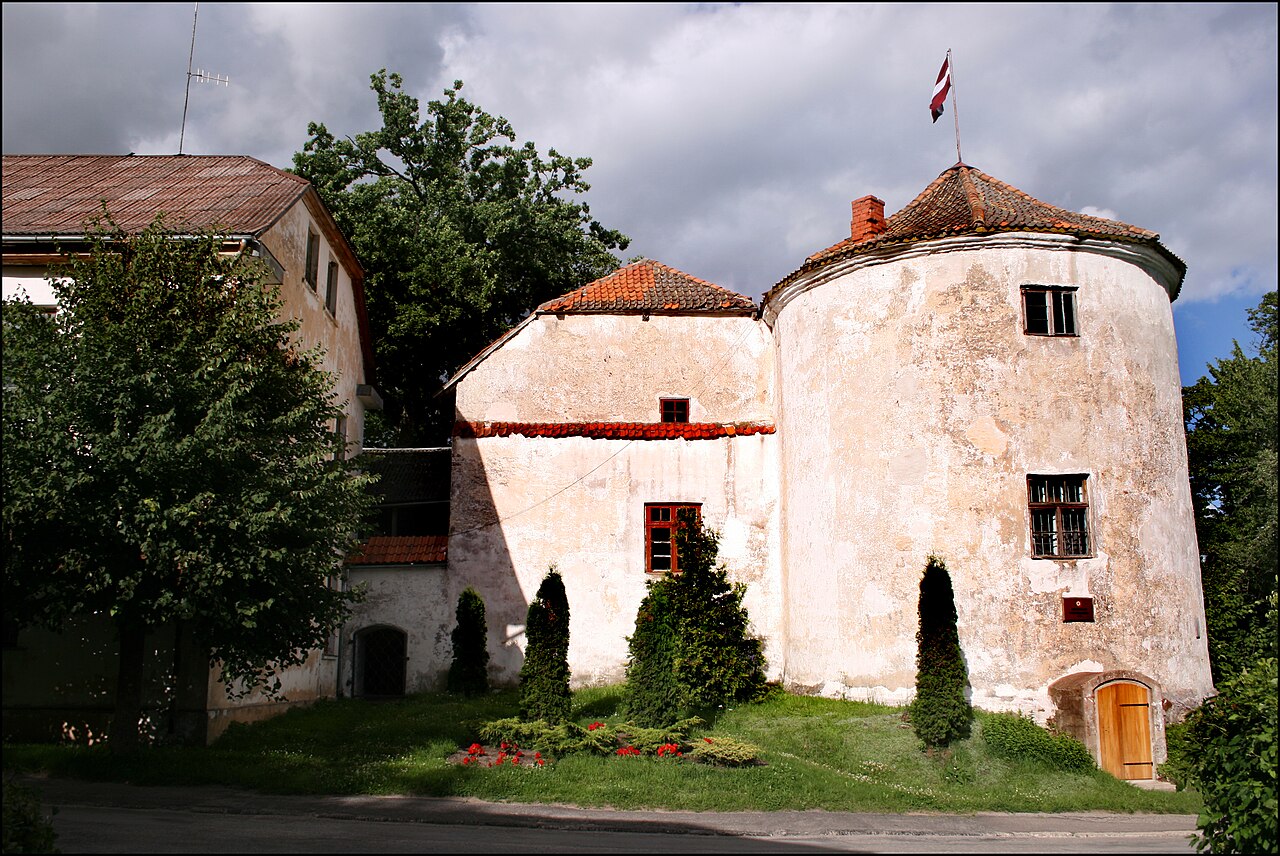
The 16th century saw the addition of a massive round tower in the southwestern corner, originally designed for defense with cannon openings on each floor. Over time, these gun ports were bricked up and converted into residential windows, reflecting the castle's changing function. The tower's vaulted interiors, including a distinctive star-shaped vault on the second floor, remain an architectural highlight.
In the 18th and 19th centuries, the castle complex was further expanded with new service buildings and a secondary courtyard, enhancing its residential character. The principal gate tower was modified after a fire in 1905, changing its roof from conical to an octagonal shape during restoration.
Neo-gothic transformation and 20th-century history
Between 1835 and 1841, Baron Adolf Werner von Behr undertook a major reconstruction of Ēdole Castle, embracing the Neo-Gothic architectural style that was then fashionable across Europe. This renovation involved the removal of many older additions, the elevation of the gate tower, and the redesign of facades to emphasize Gothic forms. The interiors were lavishly redecorated, with the main entrance hall becoming a showcase of aristocratic luxury featuring intricately carved oak balustrades and other ornamental details.
The castle grounds were complemented by a landscaped park, enhancing the estate's grandeur. However, the castle suffered significant damage during the 1905 Russian Revolution when it was set ablaze. Restoration efforts quickly followed, altering some Neo-Gothic elements and modifying the gate tower's appearance.
In the aftermath of World War II, Ēdole Castle was repurposed as a care home for disabled persons, leading to a period of neglect. Later, it served as a facility for the Academy of Fine Arts until the late 20th century. Since 1991, the castle has been owned by the municipality of Edole and has undergone extensive restoration to preserve its historical and architectural heritage.
Architectural features and archaeological significance
Ēdole Castle is notable for its combination of medieval defensive features and later residential adaptations. The moat and mill pond remain defining elements of its water castle character. The castle's masonry includes fieldstones and baked bricks, with many surfaces plastered during various renovations.
The courtyard formed by the castle's wings and the southwestern round tower was once surrounded by a wooden gallery supported by stone arcades, providing sheltered passageways and access to different levels. Archaeological excavations have revealed foundations of a former foreburg with circular walls and towers, highlighting the castle's extensive defensive system.
Additional historical structures, such as a warehouse-like water gate accessible by boat, have been documented, though some were demolished in the 19th century. The castle's elevated position overlooking the river and the surrounding landscape park contribute to its picturesque setting and historical ambiance.
Cultural legacy and visitor experience
Today, Ēdole Castle stands as one of Latvia's finest examples of a noble residence with deep medieval roots. Its well-preserved interiors display a rich collection of original details from various periods, offering visitors insight into the lifestyle of Baltic-German aristocracy. The castle is open to the public, with the older sections accessible for tours and the newer wings functioning as a hotel and event venue.
The castle is also steeped in local legends, including tales of fratricide and supernatural guardians believed to protect hidden treasures within its cellars. Its historical atmosphere has made it a favored location for film productions and cultural events, further cementing its status as a heritage landmark.
Visitors can explore the castle's architectural evolution from a medieval fortress to a Neo-Gothic mansion, appreciating the blend of defensive and residential elements that define its unique character. The surrounding parkland offers a tranquil setting for leisurely walks, enhancing the overall experience of this historic site.
Frequently asked questions (FAQ)
- How do I get to Ēdole Castle?
- Ēdole Castle is located in the municipality of Kuldīga, Latvia. It is accessible by road, with parking available nearby for visitors traveling by car.
- What are the opening hours for visiting Ēdole Castle?
- The castle is generally open for visitors during the day, with specific hours varying seasonally. It is recommended to check the official website or contact the local tourist office for current visiting times.
- Can I stay overnight at Ēdole Castle?
- Yes, part of the castle complex operates as a hotel, offering guests the opportunity to experience the historic atmosphere overnight with modern amenities.
- What architectural styles are represented in Ēdole Castle?
- Ēdole Castle showcases a blend of medieval defensive architecture and 19th-century Neo-Gothic renovations, reflecting its evolution from fortress to noble residence.
- Is Ēdole Castle suitable for families and children?
- The castle and its grounds are family-friendly, with spacious courtyards and parkland for exploration. However, some areas may have uneven surfaces, so supervision is advised for young children.
- Why is Ēdole Castle historically significant?
- Ēdole Castle is significant as one of the oldest fortified residences in Courland, with a history spanning from the 14th century, reflecting regional political and architectural developments.
Information
Sources & official resources
Verify the information above using these authoritative references.
Loading map...
Visitor reviews
No reviews yet. Been here? Write the first review and help other travelers!
Write the first reviewVisited this castle? Share your experience
Your review helps other travelers and adds first-hand knowledge to our encyclopedia.