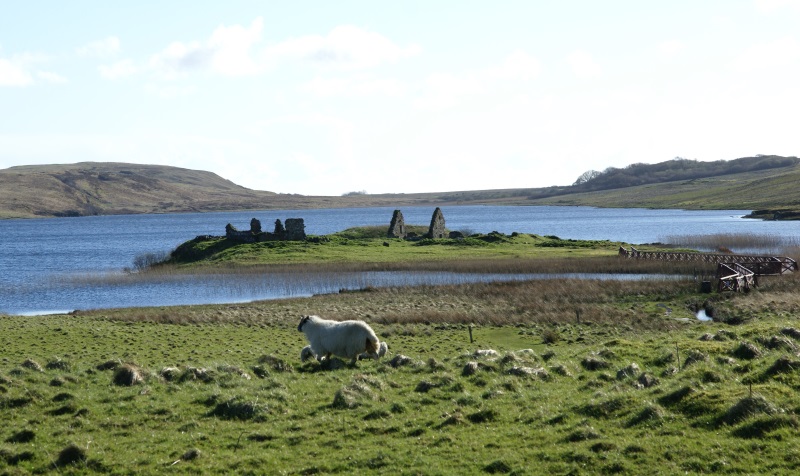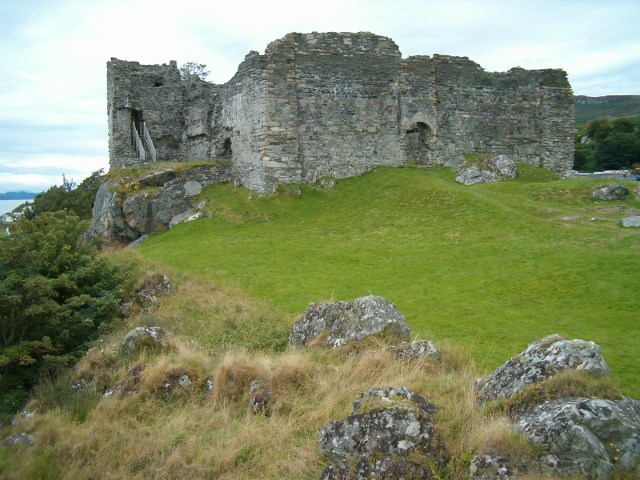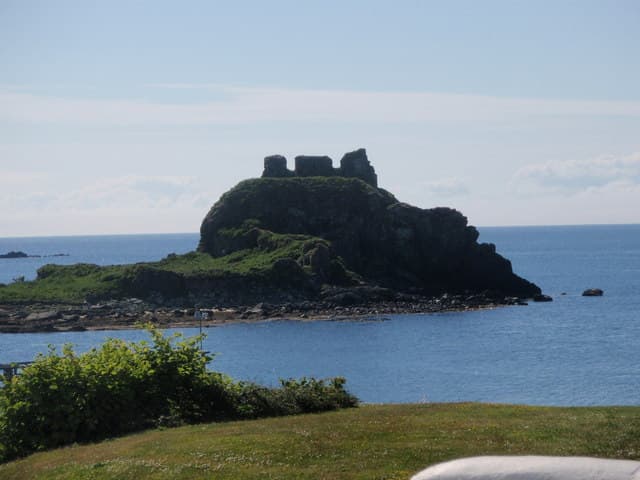
Dunyvaig Castle
Dunyvaig Castle stands as a significant historic monument on the southern coast of the Scottish island of Islay. This hill castle occupies a commanding rocky promontory overlooking Lagavulin Bay, a strategic position that controlled vital maritime routes between Kintyre and Northern Ireland. While the existing ruins primarily date to the 16th century, historical evidence confirms that the castle's origins trace back to the 12th century, when it was initially constructed atop an ancient fortification, possibly an Iron Age dun.
The castle's location and architecture reflect its dual purpose as a naval stronghold and defensive fortress. It served as a pivotal base for the Lords of the Isles, particularly the powerful Clan Donald, who dominated the western Scottish seaboard during the High Medieval period. Over the centuries, Dunyvaig witnessed numerous sieges, ownership changes, and military actions, emblematic of the turbulent clan rivalries and shifting political landscapes of the Scottish Highlands and Islands.
Early origins and medieval significance
The site of Dunyvaig Castle was originally occupied by an ancient fortification, likely dating back to the Iron Age. The castle itself was established in the 12th century by Somerled, King of the Isles, a Norse-Gaelic ruler who consolidated power across the Hebrides and western Scotland. This early construction marked the beginning of Dunyvaig's role as a key maritime fortress.
Throughout the 13th and 14th centuries, Dunyvaig functioned as the principal naval base for the Lords of the Isles, who used the bay as a sheltered anchorage for their fleet of galleys. The castle's strategic position allowed the MacDonald clan to exert control over sea routes and maintain their influence across the western seaboard. The castle was integral to the political and military power of the Lordship of the Isles until its forfeiture in 1493.
Clan conflicts and changing ownership
Following the collapse of the Lordship of the Isles, Dunyvaig Castle passed to the MacIans of Ardnamurchan. The 16th century was marked by a series of transfers between the MacDonalds and the Campbells, reflecting the intense clan rivalries characteristic of the period. In 1545, the castle was leased back to the MacDonalds, but control fluctuated repeatedly.
The early 17th century saw continued conflict over Dunyvaig. In 1608, the castle was surrendered to royal forces led by Andrew Stuart and Andrew Knox. Between 1614 and 1615, it was contested between Coll Ciotach, a prominent MacDonald leader, and Sir John Campbell of Calder. The castle's strategic importance made it a focal point for military engagements during this era.
Sieges and decline in the 17th century
In 1647, Covenanter forces under David Leslie laid siege to Dunyvaig amidst the wider conflicts of the Scottish Civil War period. Following this, the castle came under the possession of the Campbells of Cawdor, who maintained control until 1677. That year, Sir Hugh Campbell demolished the fortress and relocated to the nearby Islay House, signaling the end of Dunyvaig’s active military use.
Architectural features and surviving ruins
The remaining structures of Dunyvaig Castle predominantly date from the 16th century, though they incorporate earlier elements such as a 15th-century keep and a 13th-century courtyard. The castle complex is arranged on a rocky promontory with commanding views over Lagavulin Bay, emphasizing its role in maritime defense.
Layout and defensive structures
The castle's layout includes a tower house situated atop the rock, surrounded by an inner courtyard and a larger outer courtyard. The outer courtyard is enclosed by thick curtain walls, approximately two to three meters in thickness, although much of these walls are now partially buried or ruined. The main entrance was located on the northern side of the outer enclosure.
Within the inner courtyard, architectural features such as an arched doorway and remnants of a rib-vaulted ceiling survive. These vaulted ceilings, formed by intersecting stone arches, provided both structural strength and an imposing interior space. The outer courtyard contained four small buildings, likely used as kitchens and storage facilities, essential for sustaining the castle’s occupants during sieges and daily life.
Sea access and defensive adaptations
A notable feature was the castle’s access to the sea. A large sea gate on the southwestern wall allowed boats to enter directly from Lagavulin Bay, facilitating naval operations and resupply. A smaller gate on the western side, now blocked, once provided access down to the coastline.
From the southern wall, a vaulted passage descends into a small triangular inner courtyard, which was defended by a drawbridge spanning a ravine. This added a layer of defense against attackers approaching from the landward side. Remnants of a staircase provided access from this courtyard to the donjon or keep, the castle’s strongest defensive tower.
The keep and structural details
The keep is reinforced on its southeast corner with substantial masonry, adapted to the uneven rock foundation. Portions of the keep’s walls on the southeast, southwest, and northeast sides still stand to a height of two stories, offering insight into the castle’s original vertical scale and defensive capabilities. The keep would have served as the last refuge in case of attack and as a residence for the lord.
Cultural and heritage significance
Today, Dunyvaig Castle is a protected scheduled monument, recognized for its historical and architectural importance. The ruins provide a tangible link to the complex history of the Hebrides, clan warfare, and maritime power in medieval and early modern Scotland. The castle’s dramatic setting and evocative remains continue to attract visitors and scholars interested in Scottish history and castle architecture.
Its story encapsulates the turbulent history of the Scottish Isles, marked by Norse-Gaelic rule, clan rivalries, and shifting allegiances. The castle’s location on Islay, an island renowned for its cultural heritage and whisky production, adds to its appeal as a site of both historical and touristic interest.
Visiting dunyvaig castle
Visitors to Dunyvaig Castle can explore the ruins and enjoy panoramic views of Lagavulin Bay and the surrounding landscape. The site’s rugged coastal setting offers a unique glimpse into the strategic considerations of medieval castle builders. While the ruins are exposed and weathered, they remain accessible to the public, providing an evocative experience of Scotland’s rich past.
Nearby attractions on Islay include historic distilleries, other archaeological sites, and natural reserves, making the island a compelling destination for those interested in history, culture, and nature.
Frequently asked questions (FAQ)
- How do I get to Dunyvaig Castle on Islay?
- Dunyvaig Castle is located on the southern coast of Islay, accessible by local roads. Visitors typically reach Islay by ferry from the Scottish mainland or by air, then travel by car or bus to the castle site near Lagavulin Bay.
- What is the historical significance of Dunyvaig Castle?
- Dunyvaig Castle was a strategic naval base for the Lords of the Isles and Clan Donald, playing a key role in controlling maritime routes and clan conflicts in western Scotland from the 12th to 17th centuries.
- Can I explore the ruins of Dunyvaig Castle?
- Yes, the ruins of Dunyvaig Castle are accessible to the public. Visitors can walk around the site to view the remains of the tower house, courtyards, curtain walls, and sea gate, all set in a dramatic coastal landscape.
- When is the best time to visit Dunyvaig Castle?
- The best time to visit Dunyvaig Castle is during the late spring to early autumn months when the weather is milder and the coastal views are clearer, enhancing the experience of the ruins and surrounding scenery.
- Is there an entry fee to visit Dunyvaig Castle?
- There is no entry fee to visit the ruins of Dunyvaig Castle, making it an accessible historical site for all visitors interested in Scottish heritage.
Photo gallery

Information
Website
Visit websiteSources & official resources
Verify the information above using these authoritative references.
Loading map...
Visitor reviews
No reviews yet. Been here? Write the first review and help other travelers!
Write the first reviewVisited this castle? Share your experience
Your review helps other travelers and adds first-hand knowledge to our encyclopedia.