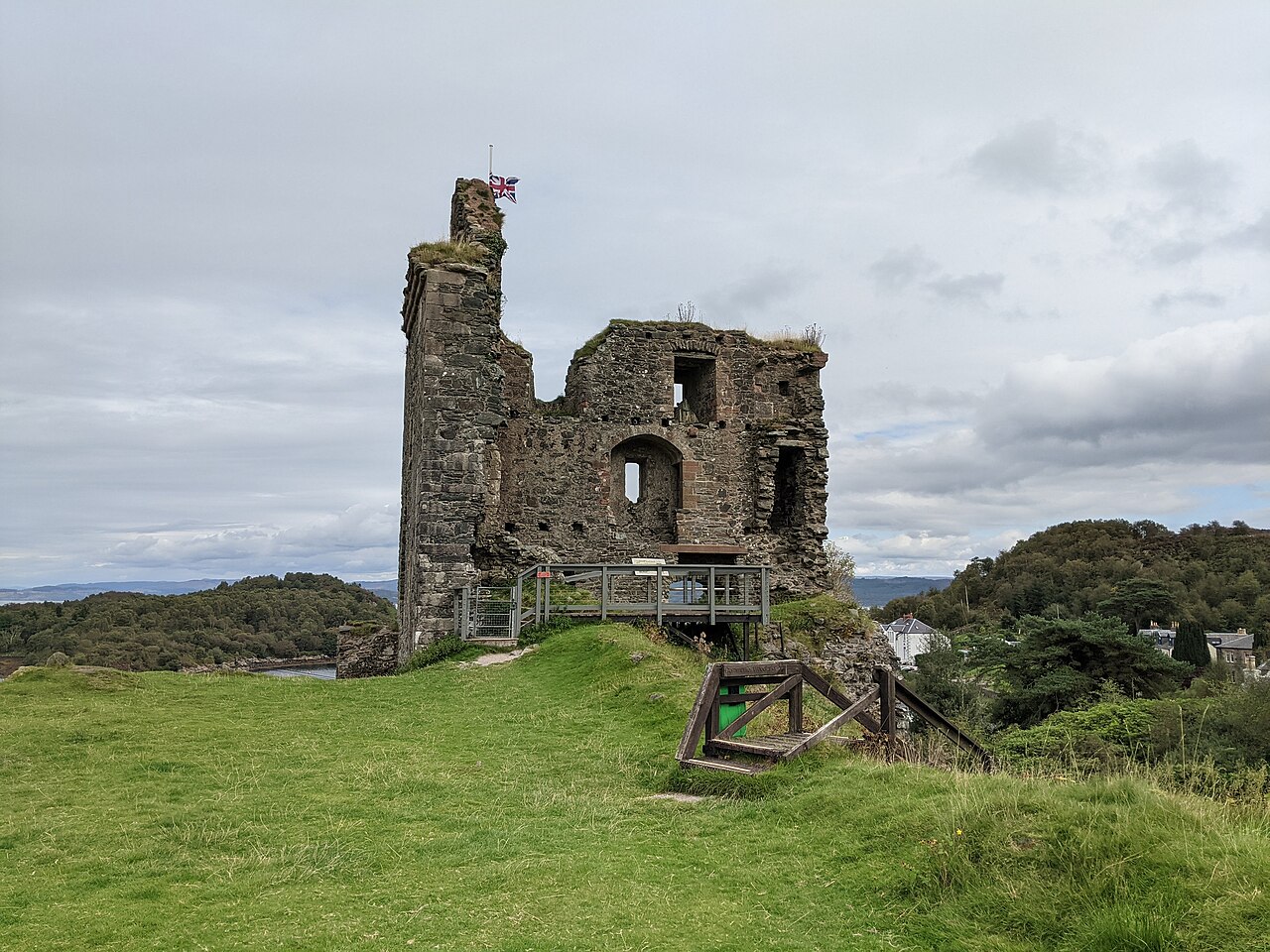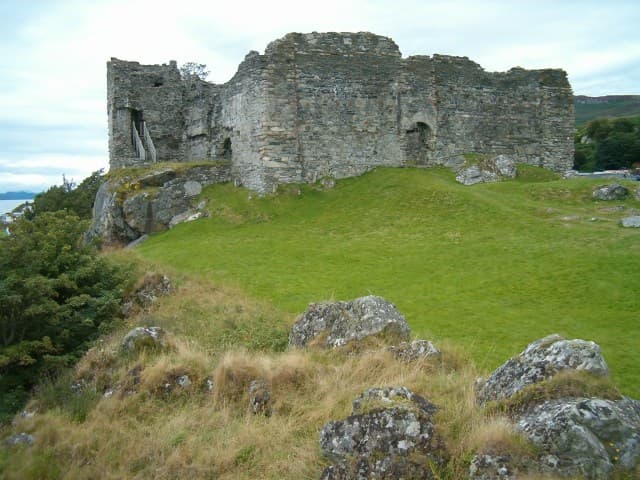
Castle Sween
Castle Sween stands as one of the earliest stone castles constructed in Scotland, dating back to the late 12th century. Located on the eastern shore of Loch Sween in Argyll and Bute, this hill castle is a remarkable example of early medieval Scottish fortification, reflecting the turbulent history of the region and the shifting power dynamics of Gaelic clans and Scottish nobility. The castle's origins are closely linked to the Gaelic Clan MacSween, descendants of Suibhne (Sween), an Irish nobleman whose lineage traces back to Hugh the Splendid O'Neill, who died in 1047.
Originally, the site likely featured wooden structures which were later replaced or supplemented by stone towers and walls, a transition characteristic of castle development during the High Medieval period. The surviving stone fabric includes thick defensive walls, buttresses, and a gatehouse, which collectively illustrate the castle's strategic importance in controlling the surrounding lands of Knapdale and beyond.
Historical context and clan heritage
The castle was named after its founder, Suibhne, whose Gaelic name was Anglicised as 'Sween'. The MacSween clan held significant territories extending north to Loch Awe and south to Skipness Castle on Loch Fyne during the 12th and 13th centuries. This period was marked by fluctuating allegiances and territorial disputes among Scottish clans and emerging noble families.
In the latter half of the 13th century, the MacSween lands, including Castle Sween, passed into the hands of the Stewart Earls of Menteith. During the Wars of Scottish Independence, the MacSweens allied with King Edward I of England in an attempt to reclaim their ancestral lands from the Stewarts. However, the rise of Robert the Bruce led to the displacement of the MacSweens. After Bruce's victory over the MacDougalls in 1308, he besieged Castle Sween, held by Alasdair Og MacDonald, who surrendered and was subsequently disinherited. The castle and surrounding lands were then granted to Angus Og MacDonald, Bruce's loyal supporter and Alasdair's younger brother.
Conflicts and ownership changes in the 14th century
By 1310, Edward II of England granted the MacSween brothers their ancestral lands, though Castle Sween itself remained under the control of Sir John Menteith. This period saw ongoing conflicts, including a notable campaign by John MacSween to retake Castle Sween, possibly commemorated in the Gaelic poem "Dál chabhlaigh ar Chaistéal Suibhne" (The assembling of a fleet against Castle Sween).
Following Sir John Menteith's death in 1323, the lordship of Arran and Knapdale remained with his descendants. In 1376, Robert II of Scotland granted half of Knapdale, including Castle Sween, to his son-in-law John I, Lord of the Isles, marking the beginning of the castle's association with the powerful MacDonald Lords of the Isles. The MacDonalds managed the castle through clans such as the MacNeils and MacMillans, who made significant architectural contributions during their tenure.
Architectural evolution and features
Castle Sween occupies a roughly square site fortified by thick stone walls approximately three meters wide. The castle's defensive design includes prominent buttresses that reinforce the walls, a strategically placed gatehouse on the southern face serving as the main entrance, and a latrine tower on the southeast corner for waste disposal.
Archaeological evidence indicates the castle was never fully roofed, with a combination of stone and wooden buildings within the courtyard. A well in the northeast corner provided fresh water, an essential feature for sustaining inhabitants during sieges.
Additions and modifications through centuries
In the early 13th century, a rectangular wing was added on the west side, later rebuilt around 1300 as a three-story tower enhancing the castle's residential and defensive capabilities. A round tower with a latrine was also added at the northwest corner during the late 13th or early 14th century, demonstrating continuous adaptation to the needs of its occupants.
The 15th century introduced MacMillan's Tower on the outside of the northeast corner. This three-story structure housed kitchens on the ground floor and private chambers above for the lord and lady of the castle. The tower reflects the architectural influence of the MacMillans, who managed the castle during this era. MacMillan's Cross, erected in memory of Alexander MacMillan, originally stood near the castle but was relocated to Kilmory Knap Chapel in the 20th century.
Decline and preservation efforts
The castle's strategic importance declined after it passed to the Campbell family in 1490 when King James IV granted it to Colin Campbell, 1st Earl of Argyll. The castle remained in Campbell hands until it was attacked and burnt in 1647 by Alasdair MacColla and his Irish Confederate allies during the Wars of the Three Kingdoms. Since then, Castle Sween has stood as a ruin, its stone walls weathered but still evocative of its medieval past.
In 1933, the castle came under the care of the Historic Building and Monuments Directorate and is now protected by Historic Environment Scotland. Archaeological excavations in the 1980s and 1990s have shed light on the castle's construction phases and historical significance. Recent studies have raised concerns about the site's vulnerability to coastal erosion exacerbated by climate change, prompting ongoing preservation efforts.
Cultural significance and visitor experience
Castle Sween offers a tangible connection to Scotland's early stone castle architecture and the complex history of Gaelic clans and Scottish nobility. Its ruins provide insight into medieval defensive strategies, clan politics, and architectural evolution from wooden fortifications to stone strongholds.
Visitors to the site can explore the remains of the castle's walls, towers, and courtyard, appreciating the blend of architectural styles and historical layers. The location on Loch Sween also offers scenic views and a sense of the castle's strategic position controlling maritime routes and local lands.
Preservation efforts continue to ensure that Castle Sween remains accessible for future generations, highlighting its importance as a cultural heritage site and a symbol of Scotland's medieval past.
Frequently asked questions (FAQ)
- When was Castle Sween built and by whom?
- Castle Sween was built in the late 12th century by Suibhne (Sween), a Gaelic nobleman and ancestor of the MacSween clan.
- What is the historical significance of Castle Sween?
- Castle Sween is one of Scotland's earliest stone castles and played a key role in medieval clan conflicts and the Wars of Scottish Independence.
- Can visitors explore the ruins of Castle Sween today?
- Yes, Castle Sween is open to visitors who can explore its ruins and learn about its history, although facilities and access may be limited due to its remote location.
- Who currently manages Castle Sween?
- Castle Sween is managed and protected by Historic Environment Scotland, which oversees its preservation and archaeological research.
- Why is Castle Sween at risk from coastal erosion?
- The castle is located on the shore of Loch Sween and is vulnerable to coastal erosion, a problem worsened by climate change, threatening the stability of the ruins.
Photo gallery

Information
Sources & official resources
Verify the information above using these authoritative references.
Loading map...
Visitor reviews
No reviews yet. Been here? Write the first review and help other travelers!
Write the first reviewVisited this castle? Share your experience
Your review helps other travelers and adds first-hand knowledge to our encyclopedia.