Dunscaith Castle Ruins
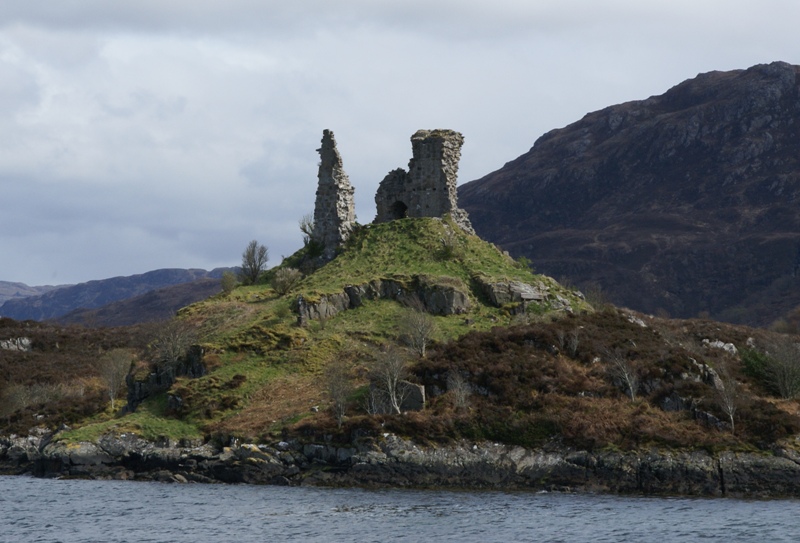
Dunscaith Castle is a striking medieval fortress located on the rugged coast of the Isle of Skye in Scotland, United Kingdom. Perched atop an offshore rock separated from the mainland by a narrow natural gap, the castle is steeped in both historical significance and mythological lore. It is famously associated with the legendary warrior maiden Scáthach, a figure from Irish mythology who is said to have trained the hero Cú Chulainn in martial arts. This legendary connection enriches the cultural heritage of Dunscaith, making it a site of fascination beyond its architectural and historical importance.
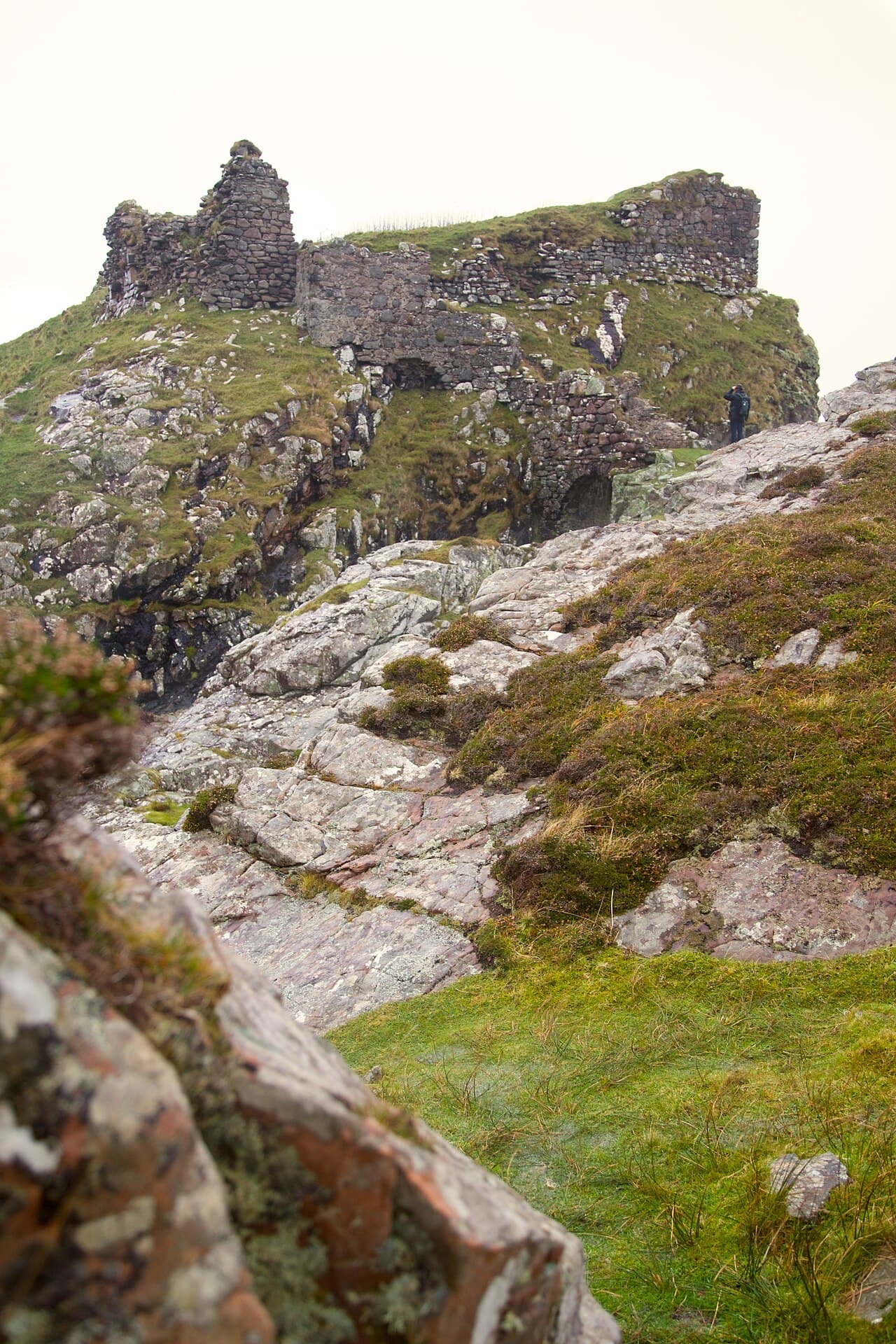
The castle’s strategic position on a rocky promontory rising about 12 to 15 meters above sea level provided natural defense advantages. Access was originally controlled via a stone-walled bridge spanning the gap between the mainland and the rock, followed by a drawbridge whose pivot holes remain visible today. This defensive approach led to a flight of stairs flanked by protective walls, ascending to the main enclosure. The surviving elements of the castle include parts of the curtain wall along the cliff edge, remnants of a well within the courtyard, and the foundations of a stairway that once led to a now-vanished tower or keep.
Historical background and clan conflicts
The origins of Dunscaith Castle trace back to the late medieval period, with construction dating primarily to the 14th century. The site was initially occupied by Norse settlers, reflecting the Viking influence in the region during the early Middle Ages. A notable early figure linked to the castle was Gilbert MacAskill, a descendant of the Norse explorer Ascall Mar Ragsnaill, emphasizing the Norse-Gaelic cultural blend prevalent in the Hebrides.
By the 14th century, control of Dunscaith had passed to the powerful Clan MacDonald of Sleat, a branch of the Clan Donald. The castle became a key stronghold in the clan’s territorial network. However, this control was contested during the century, as the Clan MacLeod seized the castle for a time, with their allies, the MacAskills, holding it briefly. The MacDonalds regained possession in the following century, reaffirming their dominance in the region.
The castle’s strategic importance drew the attention of the Scottish crown as well. In the early 15th century, specifically around 1430, King James I of Scotland captured Dunscaith during his campaign to subdue the Lord of the Isles, the chief of Clan Donald. Despite this royal intervention, the MacDonalds were eventually permitted to retain the castle, highlighting the complex political dynamics between the crown and the powerful Highland clans.
In the early 17th century, the castle was abandoned by the MacDonalds, marking the end of its active use as a fortress. Over time, it fell into ruin, with much of the inner buildings disappearing, leaving primarily the robust curtain walls and foundational remains visible today.
Architectural features and defensive design
Dunscaith Castle exemplifies late medieval military architecture adapted to a challenging coastal environment. The castle’s location on a steep rocky outcrop necessitated innovative defensive measures. The original stone-walled bridge crossing the gap to the mainland was constructed with a series of arches spaced approximately six feet apart, providing a formidable barrier to attackers.
The drawbridge beyond the stone bridge was a critical defensive feature, controlling access to the castle’s entrance. The pivot holes of this drawbridge remain visible, offering rare physical evidence of its mechanism. After passing the drawbridge, visitors would encounter a doorway leading to a staircase flanked by two protective walls, ascending to the main courtyard.
The curtain wall that remains along the cliff edge was constructed from irregularly shaped stones bonded with an early form of lime mortar, measuring approximately 1.5 to 2 meters (5 to 6.5 feet) thick. This robust wall provided substantial protection against siege weaponry and natural erosion.
Within the courtyard, a well ensured a water supply during sieges, while the remains of a stairway suggest the presence of a tower or keep that once dominated the enclosure. The foundations of this tower are now visible as grass-covered mounds, hinting at the castle’s former vertical complexity.
Layout and strategic considerations
The castle’s layout emphasizes layered defense, with a fortified approach requiring attackers to cross multiple barriers: the stone bridge, the drawbridge, and then ascend a protected staircase before reaching the central enclosure. This design maximized the natural defensive advantages of the site while incorporating man-made fortifications to deter and delay assailants.
Mythological significance and cultural heritage
Dunscaith Castle holds a unique place in Celtic mythology, particularly within the Ulster Cycle of Irish legend. It is traditionally identified as the home and training ground of Scáthach, a formidable warrior woman who tutored the hero Cú Chulainn in the arts of combat. This legendary association has imbued the castle with a mystical aura that attracts visitors interested in both history and myth.
The castle’s Gaelic name, sometimes rendered as Dun Sgathaich or Tokavaig, translates roughly to "the fortress of shadows," reflecting its dark and dramatic setting and its connection to the enigmatic figure of Scáthach. This blend of tangible historical remains and intangible mythological significance enhances Dunscaith’s appeal as a cultural landmark.
Preservation and visitor experience
Today, Dunscaith Castle is recognized as a scheduled monument, protected by heritage conservation laws in Scotland. Although the castle remains are largely in ruin, the surviving curtain walls, drawbridge pivot holes, and other architectural fragments provide valuable insights into medieval fortification techniques and clan history.
Visitors to the site can explore the rugged terrain and imagine the castle’s former grandeur amid the striking coastal landscape of the Isle of Skye. The castle’s remote location and fragmented remains offer a poignant glimpse into Scotland’s turbulent medieval past and the enduring legacy of its clans and legends.
Access to Dunscaith Castle requires a moderate hike over uneven ground, and visitors should exercise caution near the cliff edges. The site is open year-round, with no formal visitor facilities, making it ideal for those interested in history, archaeology, and mythology who appreciate a more natural and solitary experience.
Frequently asked questions (FAQ)
- How do I get to Dunscaith Castle on the Isle of Skye?
- Dunscaith Castle is located on the southeastern coast of the Isle of Skye. Visitors typically reach it by car or local transport to the nearby village of Tokavaig, followed by a moderate walk over uneven terrain to the castle site.
- What is the historical significance of Dunscaith Castle?
- Dunscaith Castle was a strategic stronghold for Clan MacDonald of Sleat and played a role in the clan conflicts and Scottish crown campaigns during the late medieval period. It is also linked to the legendary warrior maiden Scáthach from Irish mythology.
- Can I explore the ruins of Dunscaith Castle?
- Yes, visitors can explore the ruins, including the curtain walls, drawbridge pivot holes, and courtyard remains. However, the site is rugged and partially overgrown, so caution is advised, especially near cliff edges.
- When is the best time to visit Dunscaith Castle?
- The best time to visit is during late spring to early autumn when weather conditions on the Isle of Skye are milder and the terrain is easier to navigate.
- Is there an entrance fee to visit Dunscaith Castle?
- There is no entrance fee to visit Dunscaith Castle, as it is an open historic site with no formal visitor center or ticketing.
Photo gallery

Information
Loading map...
Visitor reviews
No reviews yet. Been here? Write the first review and help other travelers!
Write the first reviewVisited this castle? Share your experience
Your review helps other travelers and adds first-hand knowledge to our encyclopedia.