Dunraven Castle
Dunraven Castle was a distinctive castellated mansion located on the South Wales coast near Southerndown, within the municipality of Bridgend. This site holds a rich historical lineage, evolving from medieval fortifications to a refined Victorian residence before its demolition in the mid-20th century. The castle’s layered history reflects the architectural and social transformations that occurred in Wales over several centuries.
Medieval origins and early history
The earliest known fortifications on the Dunraven site date back to the mid-12th century, attributed to Arnold le Boteler (Butler). This initial structure formed part of the defensive landscape shaped by Norman influences in Wales during the medieval period. The castle’s location on a hill overlooking the coastline provided strategic advantages, typical of hill castles designed for surveillance and defense.
By the 16th century, the site had transitioned from a military fortification to a manor house owned by the Vaughan family. This manor was significant enough to be documented by John Leland, an English antiquary who conducted extensive surveys of Welsh estates during the Tudor era. The manor house symbolized the continuity of noble residence and local authority in the region.
The wyndham family and early 19th-century transformation
In 1642, ownership of the estate passed to the Wyndham family. A pivotal figure was Thomas Wyndham, who served as a Member of Parliament for Glamorgan from 1789 until his death in 1814. Between 1802 and 1806, Thomas Wyndham undertook a significant rebuilding project, transforming the manor house into a castellated hunting lodge. This design reflected the Gothic Revival trend of the time, combining medieval castle motifs with the comforts of a country house.
The design of the hunting lodge is credited in part to Thomas Wyndham’s wife, who likely drew inspiration from Clearwell Castle, a noted example of castellated Gothic Revival architecture. This remodeling introduced battlements, towers, and other castle-like features that enhanced the estate’s romantic and picturesque qualities.
Mid-19th-century remodeling and expansion
The estate passed to their daughter Caroline Wyndham, who married Windham Henry Quin, the future 2nd Earl of Dunraven, in 1810. Caroline initiated further remodeling in 1858, commissioning architect Egbert Moxham to enlarge the north and south wings of the castle. During this period, the original central tower was removed and replaced by a conservatory, reflecting Victorian tastes for light-filled, elegant garden rooms.
These expansions balanced the romantic Gothic elements with modern amenities, demonstrating the evolving architectural ambitions of the Victorian aristocracy. The castle thus became a hybrid structure, merging defensive stylistic cues with the comforts expected in a prestigious country estate.
20th-century use and eventual demolition
Dunraven Castle remained in the hands of the Wyndham-Quin family into the 20th century. During World War II, the castle was repurposed as a military hospital, serving the war effort by providing medical care to wounded soldiers. This adaptive reuse reflected the broader trend of country houses being converted for wartime purposes.
Following the war, the castle was no longer inhabited and fell into disuse. Despite its historical and architectural significance, the main building was demolished in 1963. This loss marked the end of the castle as a residential structure but did not erase its historical footprint.
Remaining structures and heritage significance
Though the main mansion no longer stands, several important elements of the estate survive. The walled garden remains a key feature, enclosed by sturdy walls that created a protected microclimate for horticulture and leisure. The gatehouse also endures, marking the formal entrance to the property with an imposing façade designed to control access.
These surviving structures are recognized for their architectural and historical value, designated as Grade II listed buildings. The gardens and parkland are registered with Cadw and ICOMOS, underscoring their importance within Welsh cultural heritage and international conservation efforts.
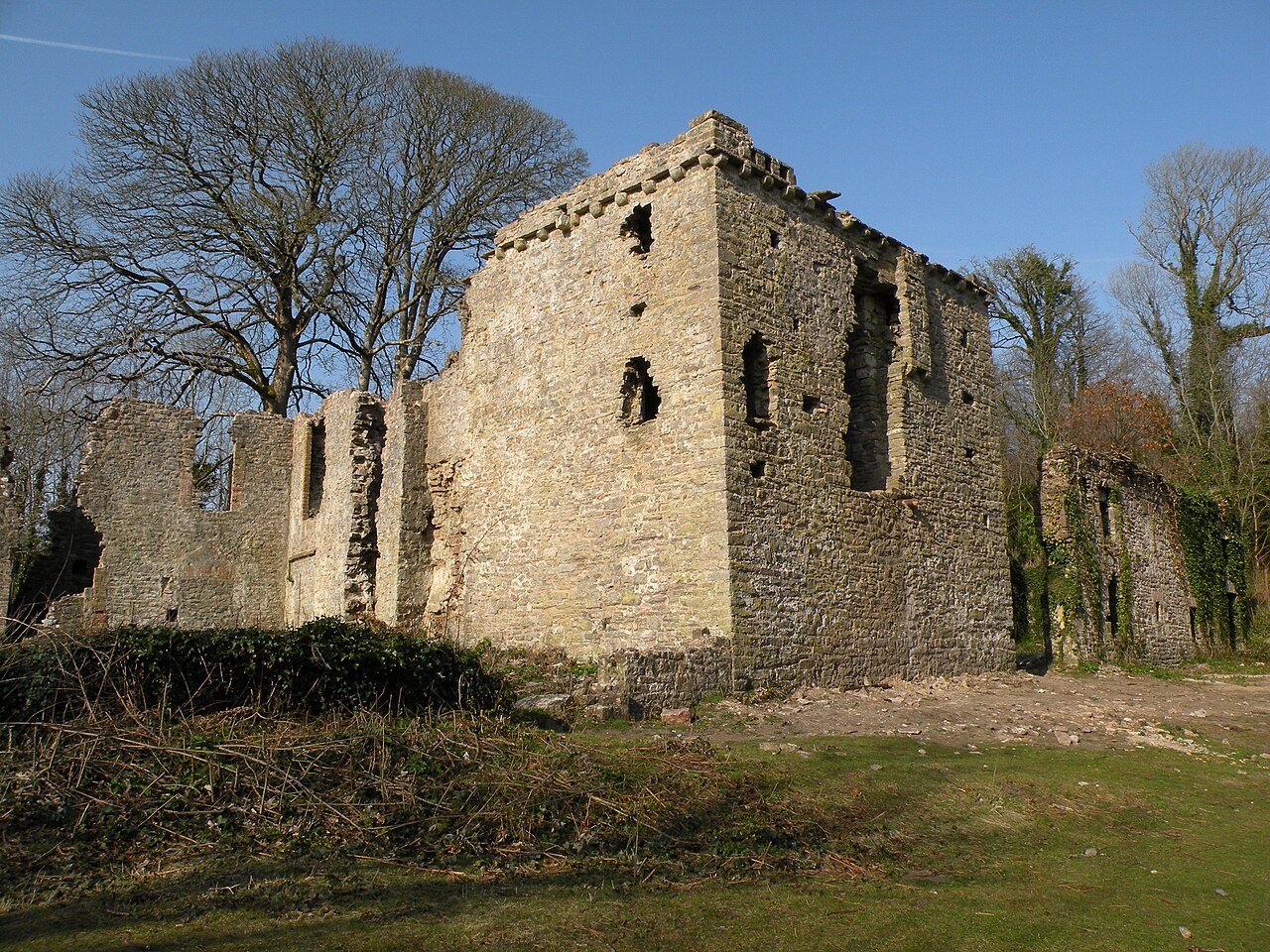
Today, the remnants of Dunraven Castle offer a tangible connection to the past, illustrating the evolution from a medieval fortification to a romantic Gothic Revival country house. The site is part of the Glamorgan Heritage Coast, attracting visitors interested in history, architecture, and natural beauty.
Architectural features of the hunting lodge
The 19th-century rebuilding of Dunraven Castle introduced characteristic elements of the Gothic Revival style, including battlements, crenellated parapets, and pointed arch windows. The castle’s layout was expanded with the addition of north and south wings, creating a symmetrical plan that balanced aesthetic appeal with functional living spaces.
The replacement of the central tower with a conservatory was a notable Victorian adaptation, providing a light-filled space that connected the interior with the surrounding gardens. This feature highlighted the era’s interest in integrating architecture with nature.
Historical context and regional importance
Dunraven Castle’s history reflects broader trends in Welsh and British aristocratic life. Its transformation from a medieval fortification to a Gothic Revival mansion mirrors the changing needs and tastes of the landed gentry. The castle’s location on the South Wales coast also situates it within a landscape rich in cultural and historical significance, contributing to the heritage of the Glamorgan region.
The estate’s role during World War II as a military hospital adds a layer of 20th-century historical importance, connecting the site to national wartime narratives. The subsequent demolition of the main house is emblematic of the decline of many British country houses in the postwar period.
Visiting and preservation today
While the main castle building no longer exists, the surviving structures and gardens are accessible to the public as part of the Glamorgan Heritage Coast. Visitors can explore the walled garden and gatehouse, appreciating their architectural details and the scenic coastal setting.
The site is managed to preserve its historical and environmental significance, offering educational opportunities about Welsh history, architecture, and conservation. The combination of natural beauty and cultural heritage makes Dunraven Castle an important destination for heritage tourism in South Wales.
Frequently asked questions (FAQ)
- How do I get to Dunraven Castle?
- Dunraven Castle is located in Bridgend, Wales, and can be accessed by car, bus, or train. The nearest train station is Bridgend, from where you can take a taxi or a local bus to reach the castle grounds.
- What is the historical significance of Dunraven Castle?
- Dunraven Castle has a rich history dating back to the 12th century, originally built as a fortified manor. It played a crucial role in the local area during the medieval period and has since become a symbol of the region's architectural heritage.
- When was Dunraven Castle built?
- The construction of Dunraven Castle began in the 19th century, specifically in 1830, and it was completed in the 1850s. The castle exhibits a blend of Gothic Revival and Tudor architectural styles, making it a fascinating study for visitors interested in historical architecture.
- Can I visit Dunraven Castle year-round?
- Dunraven Castle is generally open to visitors from April to October, with specific opening hours that may vary by season. It is recommended to check the official website for the most current visiting information and any seasonal events.
- Why is Dunraven Castle a popular tourist attraction?
- Dunraven Castle is popular due to its stunning coastal views and picturesque ruins, which provide excellent photo opportunities. Additionally, its rich history and architectural beauty attract both history enthusiasts and casual visitors alike.
- Is it possible to access the castle grounds with a wheelchair?
- While Dunraven Castle's grounds are partially accessible, some areas may be challenging for wheelchair users due to uneven terrain and steps. It is advisable to check with the site management for specific accessibility options and assistance before your visit.
- What are the ticket prices for visiting Dunraven Castle?
- Ticket prices for Dunraven Castle may vary depending on the time of year and any special events. Generally, adult tickets are affordably priced, with discounts available for children, seniors, and families, making it accessible for all visitors.
- What are the opening hours for Dunraven Castle?
- Dunraven Castle typically opens from 10 AM to 5 PM during the peak season, with reduced hours in the off-season. It is advisable to verify the opening hours ahead of your visit to ensure you have ample time to explore the castle and its grounds.
- What are some nearby attractions to Dunraven Castle?
- Nearby attractions include the stunning Vale of Glamorgan coastline and the picturesque town of Llantwit Major, known for its historic buildings and beautiful beaches. Visitors can also explore the surrounding nature reserves and walking trails that offer breathtaking views of the Welsh landscape.
Information
Loading map...
Visitor reviews
No reviews yet. Been here? Write the first review and help other travelers!
Write the first reviewVisited this castle? Share your experience
Your review helps other travelers and adds first-hand knowledge to our encyclopedia.