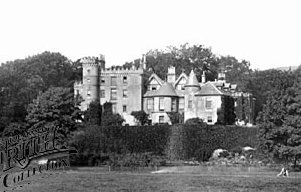
Dunoon Castle
Dunoon Castle stands as a significant medieval fortress located in the town of Dunoon on the Cowal peninsula in Scotland. Constructed originally by the Scottish Stewarts, this hill castle occupies a commanding volcanic cone-shaped hill approximately 80 feet (24 meters) above the surrounding landscape, offering strategic views over the nearby River Clyde and access routes. The castle first appears in historical records in the 13th century, marking its importance in the shifting power dynamics of medieval Scotland.
Early history and strategic importance
The castle's early history is closely intertwined with the rise of the Stewart family, who sought to extend their influence over the Cowal peninsula. Its elevated position made it a formidable defensive site, typical of hill castles designed to control territory and monitor movement in the region. Dunoon Castle's location near vital waterways and trade routes underscored its military and administrative significance during the high medieval period.
Medieval conflicts and ownership
Siege by Edward Balliol and English control
In 1333, Dunoon Castle became a focal point during the Wars of Scottish Independence when Edward Balliol laid siege to the fortress. After successfully capturing it, Balliol handed the castle over to Edward III of England, marking a brief period of English control. However, this occupation was short-lived as Robert the Steward, later crowned King Robert II, reclaimed Dunoon Castle with the assistance of Colin Campbell of Lochow.
The campbell family's stewardship
The castle's association with the powerful Campbell clan began in the 14th century and lasted for several centuries. By the 15th century, the Campbells were established as hereditary custodians, solidified by royal endorsement when King James III compensated Colin Campbell, the first Earl of Argyll, for restoration works in 1468 and formally appointed him keeper of the castle in 1472. This royal patronage reinforced the Campbells' authority in Argyll and the surrounding regions.
16th-century sieges and royal connections
Dunoon Castle witnessed renewed military activity during the turbulent Scottish-English conflicts of the 16th century. In 1544, Matthew Stewart, 4th Earl of Lennox, supported by Henry VIII of England, launched a siege with a fleet of eighteen ships and 800 soldiers. This assault successfully captured Dunoon and Rothesay Castles, temporarily displacing Archibald Campbell, 4th Earl of Argyll, from his ancestral seat.
Mary, queen of scots' residence and political role
The castle also played a role during the reign of Mary, Queen of Scots. In 1563, she stayed at Dunoon Castle while visiting her half-sister, Jean Stewart, Countess of Argyll. During her stay, Mary issued several official charters from the castle, highlighting its administrative importance. The castle also served as a strategic meeting place for her supporters during the Chaseabout Raid, a rebellion against her rule.
Later history and decline
The surrounding region experienced the tragic Dunoon massacre in 1646, when members of the Campbell clan killed members of the neighboring Clan Lamont, an event reflecting the clan rivalries of the era. Following the restoration of episcopal governance under King Charles II, Dunoon Castle was adapted for use as a residence for the bishops of Argyll, demonstrating its evolving role beyond military functions.
By the late 17th century, the castle had fallen into disuse and became dilapidated. Despite this, the site regained military significance in the 20th century when defensive structures were installed during both World War I and World War II to protect the nearby River Clyde and its vital shipbuilding industry.
Architectural features and remains
Dunoon Castle was originally built atop a distinctive volcanic hill, a natural defensive feature typical of hill castles. The elevated position provided commanding views and strategic advantage. Unfortunately, only minimal ruins survive today, limiting detailed understanding of the castle's original layout or architectural details.
The remaining structures are insufficient to reveal the full scope of the castle's fortifications, but the site’s prominence and historical significance remain clear. Nearby, Castle House, built in 1822 just a few yards north of the castle ruins, indicates continued occupation or use of the area long after the medieval fortress fell into ruin.
Heritage status and preservation
Today, Dunoon Castle and its surrounding area are designated as a scheduled monument, ensuring legal protection and conservation of the site. This status preserves the archaeological integrity of the castle hill and its environs, allowing ongoing study and public appreciation of its role in Scotland's rich history.
The castle’s layered history—from a medieval stronghold of the Stewarts and Campbells, through sieges and royal visits, to its later religious and military adaptations—makes Dunoon Castle a notable landmark in Scottish heritage. Its enduring presence atop the volcanic hill continues to symbolize the complex historical narratives of the Cowal peninsula and the wider Argyll region.
Frequently asked questions (FAQ)
- How do I get to Dunoon Castle?
- Dunoon Castle is located in the town of Dunoon, Scotland, accessible by road and ferry connections from nearby cities such as Glasgow. The castle hill is within walking distance from the town center.
- What is the historical significance of Dunoon Castle?
- Dunoon Castle played a key role in medieval Scottish history, serving as a strategic fortress for the Stewarts and later the Campbell clan. It was involved in notable sieges and royal visits, reflecting its military and political importance.
- Can I visit the ruins of Dunoon Castle?
- Yes, the castle ruins are accessible to the public as part of a scheduled monument site. Visitors can explore the hilltop and enjoy panoramic views, though only minimal remains of the original structure survive.
- When was Dunoon Castle built?
- The castle was first recorded in the 13th century, built by the medieval Scottish Stewarts to control the Cowal peninsula.
- Is there an entry fee to visit Dunoon Castle?
- There is no entry fee to visit the Dunoon Castle site, as it is an open historic area protected as a scheduled monument.
Information
Website
Visit websiteSources & official resources
Verify the information above using these authoritative references.
Loading map...
Visitor reviews
No reviews yet. Been here? Write the first review and help other travelers!
Write the first reviewVisited this castle? Share your experience
Your review helps other travelers and adds first-hand knowledge to our encyclopedia.