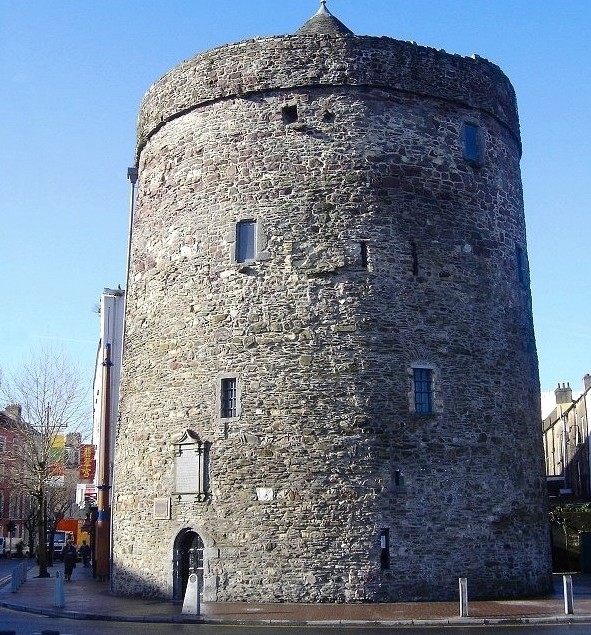
Dunhill Castle
Dunhill Castle, also known as Woodstown Castle, is a notable medieval fortress located just south of the village of Dunhill in County Waterford, Ireland. Perched on a rocky outcrop overlooking the valley of the winding River Anne, the castle commands extensive views of the surrounding landscape, including vistas towards the nearby ocean. Its strategic position reflects its original defensive purpose during the turbulent centuries following the Anglo-Norman invasion of Ireland.
Early history and construction
The site of Dunhill Castle likely has origins predating the medieval period, with evidence suggesting it was initially occupied by a Celtic fortification. The present castle was constructed in the early 13th century, attributed to the Anglo-Norman La Poer (Power) family, who established themselves in Ireland following their arrival during the 1170s invasion. This family became prominent landowners in the region, and Dunhill served as one of their key strongholds.
The original structure was typical of early medieval fortifications, built primarily for defense and control over the surrounding territory. Its elevated position on a rocky promontory provided natural protection and a commanding view to monitor movement along the river valley.
Architectural evolution: 15th-century tower house addition
During the 15th century, a significant architectural development occurred with the addition of a tower house to the existing castle complex. Tower houses were a common feature of Irish medieval castles in this period, combining residential and defensive functions in a vertical stone structure. This addition reflects changing military and domestic needs, providing improved living quarters while maintaining strong defensive capabilities.
The tower house at Dunhill would have included thick stone walls, narrow windows for archery defense, and multiple floors connected by internal staircases. These features were designed to withstand sieges and provide refuge during attacks.
The Cromwellian siege and decline
Dunhill Castle remained under the control of the Power family until 1649, when it became a target during the Cromwellian conquest of Ireland. The castle was besieged and eventually captured by the forces of Oliver Cromwell. According to local legend, the castle was defended by Lady Gyles, who managed the defense in the absence of her husband, Lord John Power.
The story recounts that during the siege, a gunner in Lady Gyles's garrison requested food and drink for the soldiers. Lady Gyles famously offered buttermilk instead of beer, which displeased the gunner. This act led the gunner and his comrades to surrender by laying down their arms and opening the gates to Cromwell's forces. Despite the victory, Cromwell reportedly considered the gunner a traitor and had him executed.
Following the siege, the castle and its lands were confiscated and granted to Sir John Cole. However, neither he nor his descendants took up residence at Dunhill, and the castle quickly fell into disuse.
Ruination and preservation
By the early 18th century, around 1700, Dunhill Castle had deteriorated into a ruin due to neglect. The structure suffered further damage in 1912 when a storm caused part of the already fragile ruins to collapse.
Today, Dunhill Castle stands as a ruined medieval fortress, accessible to the public without charge. Visitors can explore the remains of the castle and enjoy the scenic views of the River Anne valley and the nearby coastline. The site offers insights into the architectural and historical developments of Anglo-Norman castles in Ireland, particularly the evolution from early fortifications to tower houses.
Architectural features and layout
The castle's original 13th-century construction features robust stone walls integrated with the natural rock outcrop, enhancing its defensive strength. The later tower house addition exhibits typical characteristics such as battlements, narrow slit windows for defense, and a vertical emphasis in design.
Though much of the castle is in ruins, key elements remain visible, including portions of the curtain walls, the tower house's lower floors, and remnants of defensive structures like battlements and arrow loops. The castle's position on a rocky promontory provided natural fortification on multiple sides, reducing the need for extensive artificial defenses.
Historical significance and cultural context
Dunhill Castle represents an important example of the Anglo-Norman influence on Irish medieval architecture and settlement patterns. The La Poer family played a significant role in the region's history, and their castle reflects the military and social dynamics of medieval Ireland.
The castle's endurance through the centuries, including its role in the Cromwellian wars, adds to its historical resonance. The legend of Lady Gyles contributes a human dimension to the site's story, illustrating the challenges faced by castle defenders during periods of conflict.
Visiting Dunhill Castle
Visitors to Dunhill Castle can freely access the site, which is open year-round. The castle's ruins provide a tangible connection to Ireland's medieval past and offer picturesque views of the surrounding countryside and ocean horizon.
While the castle is in a ruined state, care should be taken when exploring due to uneven terrain and unstable masonry. The site is a valuable destination for those interested in medieval history, castle architecture, and Irish heritage.
Frequently asked questions (FAQ)
- How do I get to Dunhill Castle?
- Dunhill Castle is located south of the village of Dunhill in County Waterford, Ireland. It can be accessed via the L8002 road. Visitors typically travel by car or local transport to reach the site.
- What is the historical significance of Dunhill Castle?
- Dunhill Castle was built in the early 13th century by the Anglo-Norman La Poer family and later played a role in the Cromwellian conquest of Ireland. Its architecture reflects the transition from early medieval fortifications to 15th-century tower houses.
- Can I visit Dunhill Castle for free?
- Yes, Dunhill Castle is freely accessible to the public year-round. There is no admission fee to explore the ruins and enjoy the surrounding views.
- What architectural features remain at Dunhill Castle?
- Visitors can see parts of the curtain walls, the 15th-century tower house lower floors, battlements, and defensive arrow loops. The castle's position on a rocky promontory adds to its natural defenses.
- Is Dunhill Castle suitable for children and families?
- While the site is open to all visitors, the uneven terrain and ruins require caution, especially for young children. Families should supervise children closely when exploring the castle remains.
Information
Address
L8002 Dunhill, United Kingdom of Great Britain and Northern Ireland
Loading map...
Visitor reviews
No reviews yet. Been here? Write the first review and help other travelers!
Write the first reviewVisited this castle? Share your experience
Your review helps other travelers and adds first-hand knowledge to our encyclopedia.