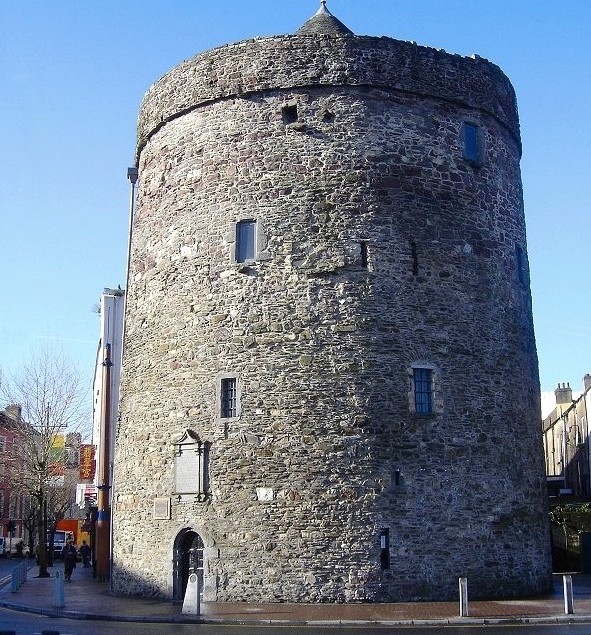
Cullen Castle

Cullen Castle in County Waterford, Ireland
Cullencastle, United Kingdom
Renaissance (15th–17th c.)
Partially Preserved

Cullen Castle is located in the townland of Cullencastle within County Waterford, Ireland. This castle is notable for its association with the Anglo-Norman La Poer (Power) family, who were prominent landowners in the region during the medieval and early modern periods. The castle later came under the possession of the Bryver family during the 17th century.

The historical context of Cullen Castle

The castle's history is intertwined with the complex socio-political landscape of Ireland during the Renaissance period. The La Poer family, originally of Norman descent, established several strongholds across Ireland following the Norman invasion. Cullen Castle was one such possession, serving as a local seat of power and administration. The transition of ownership to the Bryver family in the 17th century reflects the shifting dynamics of landholding and influence during this turbulent era, marked by conflicts such as the Irish Confederate Wars.

Architectural features and construction

While detailed architectural records of Cullen Castle are scarce, it is classified as a Renaissance period structure built in the 17th century. Castles of this period often incorporated elements of both defensive military architecture and residential comfort, reflecting the evolving needs of their owners. Typical features might have included thick stone walls, fortified towers, and possibly a bawn or courtyard enclosed by defensive walls.

The castle's exact layout and design remain largely undocumented, and the structure is now situated on private farmland, limiting access and detailed study. From the public road, observers can view the remnants or outline of the castle, though the site is not developed as a tourist attraction.

Current condition and accessibility

Cullen Castle is located on private property, which restricts public access. Visitors can only view the castle from nearby public roads, as the site is not open for tours or exploration. The castle is described as "not very interesting" by some sources, likely due to its limited visible remains and lack of visitor facilities.

The preservation state of the castle is unclear, but given its private ownership and limited public engagement, it may be in a partially preserved or ruined condition. The castle does not currently serve as a museum or heritage site.

The significance of Cullen Castle in Irish heritage

Despite its modest profile today, Cullen Castle represents an example of the many lesser-known castles that illustrate the spread of Norman influence in Ireland and the subsequent changes in land ownership through the Renaissance and early modern periods. It contributes to the historical tapestry of County Waterford, a region rich in medieval and post-medieval architecture.

Its association with notable families such as the La Poer and Bryver families adds genealogical and historical interest, reflecting the shifting allegiances and power structures in Ireland during the 17th century.

Frequently asked questions (FAQ)

Can I visit Cullen Castle?
Cullen Castle is located on private farmland and is not open to the public. Visitors can view the castle only from the nearby public road.
What is the historical significance of Cullen Castle?
Cullen Castle was a possession of the Anglo-Norman La Poer family and later held by the Bryver family in the 17th century, reflecting the regional power shifts in Ireland during the Renaissance.
What architectural style is Cullen Castle?
Cullen Castle dates from the 17th century and is classified as a Renaissance-period castle, though detailed architectural features are not well documented.
Is Cullen Castle well preserved?
The castle is believed to be partially preserved or in ruins, as it is on private land with limited public access and no formal conservation efforts.
Where is Cullen Castle located?
Cullen Castle is situated in the townland of Cullencastle in County Waterford, Ireland, visible from public roads but on private property.

Information

Lowland Castle

Current owner

Private owner

Loading map...

Visitor reviews

No reviews yet. Been here? Write the first review and help other travelers!

Write the first review

Visited this castle? Share your experience

Your review helps other travelers and adds first-hand knowledge to our encyclopedia.

Write a review

(5/5)

0/2000 characters

Your review will be visible after admin approval

Nearby castles

7 km

Dunhill Castle

L8002 Dunhill, United Kingdom

Dunhill Castle, also known as Woodstown Castle, is a notable medieval fortress located just south of the village of Dunhill in County Waterford, Ireland. Perched on a rocky outcrop overlooking the valley of the winding River Anne, the castle commands extensive views of the surrounding landscape, including vistas towards the nearby ocean. Its strategic position reflects its original defensive purpose during the turbulent centuries following the Anglo-Norman invasion of Ireland. Early history and construction The site of Dunhill Castle likely has origins predating the medieval period, with evidence suggesting it was initially occupied by a Celtic fortification. The present castle was constructed in the early 13th century, attributed to the Anglo-Norman La Poer (Power) family, who established themselves in Ireland following their arrival during the 1170s invasion. This family became prominent landowners in the region, and Dunhill served as one of their key strongholds. The original structure was typical of early medieval fortifications, built primarily for defense and control over the surrounding territory. Its elevated position on a rocky promontory provided natural protection and a commanding view to monitor movement along the river valley. Architectural evolution: 15th-century tower house addition During the 15th century, a significant architectural development occurred with the addition of a tower house to the existing castle complex. Tower houses were a common feature of Irish medieval castles in this period, combining residential and defensive functions in a vertical stone structure. This addition reflects changing military and domestic needs, providing improved living quarters while maintaining strong defensive capabilities. The tower house at Dunhill would have included thick stone walls, narrow windows for archery defense, and multiple floors connected by internal staircases. These features were designed to withstand sieges and provide refuge during attacks. The Cromwellian siege and decline Dunhill Castle remained under the control of the Power family until 1649, when it became a target during the Cromwellian conquest of Ireland. The castle was besieged and eventually captured by the forces of Oliver Cromwell. According to local legend, the castle was defended by Lady Gyles, who managed the defense in the absence of her husband, Lord John Power. The story recounts that during the siege, a gunner in Lady Gyles's garrison requested food and drink for the soldiers. Lady Gyles famously offered buttermilk instead of beer, which displeased the gunner. This act led the gunner and his comrades to surrender by laying down their arms and opening the gates to Cromwell's forces. Despite the victory, Cromwell reportedly considered the gunner a traitor and had him executed. Following the siege, the castle and its lands were confiscated and granted to Sir John Cole. However, neither he nor his descendants took up residence at Dunhill, and the castle quickly fell into disuse. Ruination and preservation By the early 18th century, around 1700, Dunhill Castle had deteriorated into a ruin due to neglect. The structure suffered further damage in 1912 when a storm caused part of the already fragile ruins to collapse. Today, Dunhill Castle stands as a ruined medieval fortress, accessible to the public without charge. Visitors can explore the remains of the castle and enjoy the scenic views of the River Anne valley and the nearby coastline. The site offers insights into the architectural and historical developments of Anglo-Norman castles in Ireland, particularly the evolution from early fortifications to tower houses. Architectural features and layout The castle's original 13th-century construction features robust stone walls integrated with the natural rock outcrop, enhancing its defensive strength. The later tower house addition exhibits typical characteristics such as battlements, narrow slit windows for defense, and a vertical emphasis in design. Though much of the castle is in ruins, key elements remain visible, including portions of the curtain walls, the tower house's lower floors, and remnants of defensive structures like battlements and arrow loops. The castle's position on a rocky promontory provided natural fortification on multiple sides, reducing the need for extensive artificial defenses. Historical significance and cultural context Dunhill Castle represents an important example of the Anglo-Norman influence on Irish medieval architecture and settlement patterns. The La Poer family played a significant role in the region's history, and their castle reflects the military and social dynamics of medieval Ireland. The castle's endurance through the centuries, including its role in the Cromwellian wars, adds to its historical resonance. The legend of Lady Gyles contributes a human dimension to the site's story, illustrating the challenges faced by castle defenders during periods of conflict. Visiting Dunhill Castle Visitors to Dunhill Castle can freely access the site, which is open year-round. The castle's ruins provide a tangible connection to Ireland's medieval past and offer picturesque views of the surrounding countryside and ocean horizon. While the castle is in a ruined state, care should be taken when exploring due to uneven terrain and unstable masonry. The site is a valuable destination for those interested in medieval history, castle architecture, and Irish heritage.

High Medieval (11th–13th c.)
Details
9.3 km

Reginald's Tower

Waterford, United Kingdom

Reginald's Tower, located in the historic city of Waterford, Ireland, is one of the most significant surviving examples of medieval military architecture in the country. This iconic cylindrical stone tower stands prominently on The Mall, near the banks of the River Suir, and has played a central role in the city's turbulent history since its construction in the 12th century. Although the site has Viking origins dating back to the 9th or 10th century, the present tower was built by the Anglo-Normans after their conquest of Waterford, marking a key phase in the city's fortification development. Historical context and origins The city of Waterford itself was founded by Vikings during the Early Medieval period, around the 9th or 10th century. The original Viking settlement was fortified with a triangular-shaped walled town, strategically positioned at the confluence of the River Suir and a now-vanished stream. This location provided natural defenses and facilitated trade and maritime activities, establishing Waterford as an important port and trading center. Following the Anglo-Norman invasion of Ireland in the late 12th century, the new rulers undertook extensive fortification projects to consolidate their control. Reginald's Tower was constructed at the apex of the city walls, serving as a key defensive stronghold. The tower's strategic position allowed it to guard the river approach and the main entrance to the city, making it a vital military asset. Architectural features and design Reginald's Tower is notable for its massive cylindrical shape, built primarily from local stone. Its walls are impressively thick, designed to withstand siege weaponry and cannon fire. The tower rises several stories high and features narrow slit windows that provided defenders with vantage points for archery and later, gunfire. The robust construction includes a battlemented parapet at the top, allowing defenders to repel attackers while remaining protected. The tower's interior consists of multiple floors connected by stone staircases, with rooms that would have served various functions including storage for munitions, living quarters for soldiers, and administrative spaces. The tower's design reflects the transition from traditional medieval fortifications to adaptations accommodating artillery, evident in the cannon placements and embrasures added in later centuries. Significant historical events Reginald's Tower has witnessed numerous key historical events that shaped Waterford and Ireland. One of the most notable was the wedding in 1171 between Richard de Clare, 2nd Earl of Pembroke (Strongbow), and Aoife MacMurrough, daughter of the King of Leinster, Dermot MacMurrough. This union symbolized the Anglo-Norman consolidation of power in Ireland. The tower also served as a royal castle on several occasions. King John visited in 1210, during which he ordered new coins to be minted there, highlighting the tower's importance as a center of governance and economic activity. Later, King Richard II used the tower in the late 14th century to store munitions during his campaigns in Ireland. In 1495, the tower's cannons played a defensive role by successfully deterring the forces of Perkin Warbeck, a pretender to the English throne, demonstrating the tower's continued military relevance into the late medieval period. The 17th century brought further conflict. During the Cromwellian conquest of Ireland, Waterford was besieged twice. The first siege in 1649 failed, but the subsequent siege in 1650 succeeded, leading to the city's capture. A cannonball from this siege remains embedded high in the tower's north wall, a tangible reminder of the violent struggle. Following the Battle of the Boyne in 1690, it is said that King James II climbed to the top of Reginald's Tower to take a final look at his lost kingdom before going into exile. Later uses and preservation Throughout the 17th and 18th centuries, the tower was primarily used for storing munitions, reflecting its ongoing military utility. In the early 19th century, it was repurposed as a prison, adapting its robust structure to new functions. Today, Reginald's Tower is a well-preserved monument and a key part of Waterford's cultural heritage. It houses a museum showcasing the city's Viking and medieval history, including artifacts recovered from the area. The tower's museum offers visitors insight into the evolution of military architecture and the historical significance of Waterford as Ireland's oldest city. Visiting Reginald's Tower Visitors to Waterford can explore the tower and its museum, which provides an immersive experience into the city's past. The tower's location in the city center makes it easily accessible, and its commanding views over the River Suir and surrounding area offer a unique perspective on Waterford's strategic importance. While renovations may occasionally affect access, the tower remains a popular attraction for those interested in medieval history and architecture.

Early Medieval (5th–10th c.)
Details
9.3 km
Reginald's Tower — Ireland castle

Reginald's Tower

Waterford, Ireland

Reginald's Tower (Irish: Túr Raghnaill) stands as a prominent medieval structure located at the eastern end of the city quay in Waterford, in the province of Munster, Ireland. This tower is notable for being the oldest civic building in Ireland and the only urban monument in the country to retain a Norse or Viking name, reflecting Waterford's origins as a Viking settlement founded in the early 10th century. Historical significance and origins The tower's name, Reginald's Tower, is derived from the Viking leader Reginald (or Ragnall), who played a significant role in the establishment of Waterford as a Norse trading port. The current stone structure dates primarily to the 13th century, placing it firmly in the high medieval period, although it is believed to have been built on the site of earlier fortifications dating back to the Viking era. The tower was a key component of the city's medieval defensive system, serving as a stronghold against invaders and a symbol of Waterford's strategic importance on Ireland's southeast coast. Architectural features and structure Reginald's Tower is a cylindrical stone tower approximately 54 feet (16.5 meters) high and 42 feet (13 meters) in diameter, constructed with thick stone walls that taper slightly towards the top. Its robust design includes multiple floors connected by narrow spiral staircases, and it was originally equipped with battlements and arrow slits for defense. The tower's position on the quay allowed it to oversee and protect the harbor, controlling access to the city by sea. The tower's masonry reflects typical high medieval military architecture in Ireland, with a focus on durability and defense. Over the centuries, modifications were made to adapt the tower to evolving military technologies and uses, including the installation of cannons during the early modern period. Role in Waterford's urban defense system As part of Waterford's city walls and fortifications, Reginald's Tower functioned as a critical defensive bastion. It guarded the eastern approach to the city and served as a lookout point to spot incoming threats from the sea. The tower was integrated with the city walls, gates, and other towers to form a comprehensive defense network that protected Waterford through various conflicts, including medieval sieges and later military engagements. Uses through the centuries Throughout its history, Reginald's Tower has served multiple purposes beyond military defense. It was used as a prison, a customs house, and a storehouse. In the 17th and 18th centuries, the tower was adapted to house artillery and became part of the coastal defenses against potential naval attacks. Today, it functions as a museum, showcasing Waterford's Viking and medieval heritage. Preservation and cultural importance Reginald's Tower is well preserved and remains a key cultural landmark in Waterford. It is managed as a heritage site and museum, attracting visitors interested in Ireland's Viking past and medieval architecture. The tower's survival through centuries of urban development makes it a rare example of Ireland's Norse legacy within an urban setting. Visitor experience Visitors to Reginald's Tower can explore its multiple levels, view exhibits on Viking Waterford, medieval city life, and maritime history, and enjoy panoramic views of the harbor and city from the battlements. The museum provides educational resources and guided tours that highlight the tower's architectural features and historical context. Architectural style and period The tower exemplifies high medieval military architecture with strong influences from Norse defensive design. Its construction in the 13th century aligns with the period of Norman consolidation in Ireland, blending Viking origins with Norman architectural techniques.

High Medieval (11th–13th c.)
Details