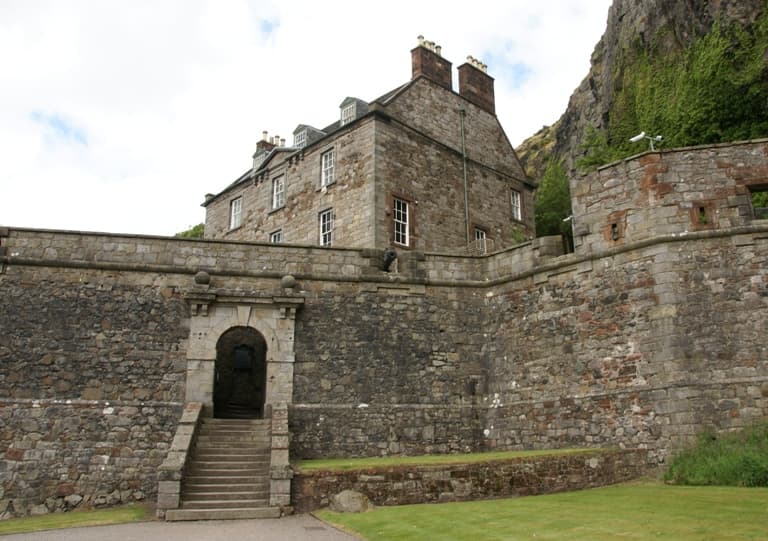
Dumbarton Castle
Dumbarton Castle stands as one of the most historically significant fortresses in Scotland, boasting the longest recorded history of any stronghold in the country. Perched atop Dumbarton Rock, a volcanic plug rising 240 feet (73 meters) above the surrounding landscape, the castle commands a strategic position overlooking the confluence of the River Clyde and River Leven. This natural elevation has made the site a crucial defensive and political center for over 1,500 years.
The site was originally known as Alt Clut, meaning "Rock of the Clyde" in the Brythonic language, serving as the capital of the early medieval British kingdom of Strathclyde from the 5th century until 1018. The Gaelic name Dun Breatann, meaning "Fortress of the Britons," later evolved into the modern name Dumbarton. Throughout its history, Dumbarton Castle has witnessed numerous sieges, battles, and transformations, reflecting the shifting political and military landscape of Scotland and the British Isles.
Early medieval significance and sieges
The fortress's origins date back to at least the Iron Age, with archaeological evidence indicating early settlement and trade connections, including contact with the Romans. Its first recorded mention appears in a late 5th-century letter from Saint Patrick to King Ceretic of Alt Clut. During the early medieval period, Dumbarton Castle was the political and military heart of the Brythonic kingdom of Strathclyde.
In 756, the castle endured an attack by a combined force of Picts and Northumbrians. The most devastating siege occurred in 870 when Viking leaders Amlaíb Conung and Ímar besieged the fortress for four months. The Vikings cut off the castle's water supply, forcing its surrender. The raid resulted in the capture of many inhabitants and the looting of treasure, marking a significant turning point in the site's history.
Medieval royal fortress and strategic importance
After the Viking siege, the site declined in prominence until the 13th century when it was redeveloped as a royal fortress by Alexander II of Scotland around 1220. This reconstruction aimed to defend against threats from the Norwegian kings who controlled the Hebrides and nearby islands. At the time, the Norwegian frontier was only 16 kilometers downriver, making Dumbarton a vital border stronghold.
The castle played a role in the Wars of Scottish Independence. It is believed that William Wallace was briefly imprisoned here in 1305 before his transfer to London. The Wallace Tower within the castle is thought to commemorate his legacy. The fortress also served as a refuge for Scottish royalty, including David II in 1333–34 and Mary Queen of Scots in 1548, who both sought safety here before fleeing to France.
Naval base and royal residence
Under the reign of James IV (1488–1513), Dumbarton Castle became a significant naval base on Scotland's west coast. James IV used the castle as a staging ground for campaigns in the Western Isles and commissioned the construction of ships nearby, highlighting the site's maritime importance. The castle also housed a parish church and a college where royal religious services such as Evensong were held, blending military and ecclesiastical functions.
In 1503, the castle was granted to Margaret Tudor, wife of James IV, further cementing its status as a royal residence. The castle safeguarded important artifacts, including the sword of William Wallace, which was repaired there in 1505, underscoring its symbolic significance in Scottish history.
Architectural features and fortifications
Dumbarton Castle's location atop a volcanic plug provided formidable natural defenses. The steep basalt cliffs made direct assault difficult, while the castle's fortifications evolved over centuries to withstand various military threats. Although little remains of the original Dark Age fortress, the medieval and later artillery fortifications are prominent today.
The castle's layout adapted to the rock's contours, resulting in a compact fortress with multiple defensive layers. The surviving structures include thick curtain walls, bastions, and artillery platforms built primarily during the 17th and early 18th centuries. These adaptations reflect the transition from medieval to early modern military architecture, emphasizing cannon defense.
Religious and cultural elements
Within the castle grounds stood a parish kirk and a college, indicating the site's dual role as both a military stronghold and a center for religious observance. Royal services such as Evensong linked the fortress to the spiritual life of the kingdom. The presence of these buildings highlights the castle's importance beyond purely military functions.
Later history and modern significance
In later centuries, Dumbarton Castle continued as a key garrison fortress. It was involved in various military actions, including its last known military use during the Second World War. The castle's strategic location remained relevant well into the modern era.
Today, Dumbarton Castle is a popular historic site open to the public. Visitors can explore the extensive fortifications, enjoy panoramic views of the town of Dumbarton and the Clyde estuary, and learn about the castle's rich history spanning from the Iron Age through medieval and modern times.
The castle's enduring legacy as a symbol of Scottish resilience and heritage makes it a significant cultural landmark. Its combination of natural defenses, historic architecture, and storied past continues to attract historians, tourists, and castle enthusiasts alike.
Frequently asked questions (FAQ)
- How do I get to Dumbarton Castle?
- Dumbarton Castle is easily accessible by public transport, with regular train services from Glasgow Central to Dumbarton East station. If you're driving, the castle is located just off the A82 road, and there is parking available nearby.
- What is the historical significance of Dumbarton Castle?
- Dumbarton Castle has a rich history dating back to at least the 6th century, serving as a royal residence and fortification. It played a crucial role in the defense against Viking invasions and was a seat of power for the Scottish kings.
- When was Dumbarton Castle built?
- The origins of Dumbarton Castle date back to the 1200s, with significant developments occurring throughout the medieval period. The castle's strategic location on the volcanic rock has made it a site of military importance for centuries.
- Can I visit Dumbarton Castle year-round?
- Yes, Dumbarton Castle is open to visitors throughout the year, although opening hours may vary by season. It's recommended to check the official website for the most current visiting hours before planning your trip.
- Why is the architecture of Dumbarton Castle unique?
- The architecture of Dumbarton Castle features a blend of medieval and later military construction, showcasing its evolution over centuries. Its impressive rock formations and fortified walls provide stunning views and a glimpse into its historical defenses.
- Is it possible to access all areas of Dumbarton Castle?
- While many areas of Dumbarton Castle are open to the public, some sections may be restricted for safety reasons. Visitors are encouraged to follow the designated paths and guidelines to ensure a safe and enjoyable experience.
- What is the best time to visit Dumbarton Castle?
- The best time to visit Dumbarton Castle is during the spring and summer months when the weather is milder and the gardens are in full bloom. These seasons also tend to attract fewer tourists, allowing for a more relaxed exploration of the castle.
- Are there any nearby attractions to visit?
- Yes, nearby attractions include the River Clyde Walkway, the Dumbarton Distillery, and the scenic Loch Lomond, which offers beautiful landscapes and outdoor activities. These sites enhance your visit to Dumbarton Castle and provide a comprehensive experience of the area.
- What are the ticket prices for Dumbarton Castle?
- Ticket prices for Dumbarton Castle are generally affordable, with discounts available for children, seniors, and families. It’s advisable to check the official website for the latest pricing details and any special offers that may be available.
- What are the opening hours for Dumbarton Castle?
- Dumbarton Castle typically opens at 10 AM and closes at 5 PM, but these hours can vary depending on the season. Always check the official site for the most accurate and current information before your visit.

Information
Website
Visit websiteSources & official resources
Verify the information above using these authoritative references.
Loading map...
Visitor reviews
No reviews yet. Been here? Write the first review and help other travelers!
Write the first reviewVisited this castle? Share your experience
Your review helps other travelers and adds first-hand knowledge to our encyclopedia.



