Dublino Castle
Dublin Castle stands prominently in the heart of Dublin city center, located on Dame Street just behind the City Hall and a short walk from Trinity College towards Christ Church. This historic fortress is one of the most important symbols of Dublin and holds a rich legacy as the seat of government and power in Ireland for centuries.
Situated south of the River Liffey, Dublin Castle was originally constructed as a Norman stronghold following the Norman invasion of Ireland in 1171. It served as the residence and administrative center of the Lordship of Ireland from its foundation until 1541. Subsequently, it became the seat of the Kingdom of Ireland until 1800, after which it housed the Irish Parliament until the establishment of the Irish Free State in 1922. Throughout these periods, the castle was the focal point of English and later British rule in Ireland.
Architectural evolution and surviving structures
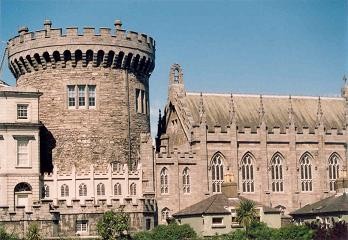
The castle's architecture reflects its long and varied history, with significant modifications and expansions over the centuries. The most notable surviving element of the original Norman castle is the Record Tower, a circular defensive tower dating back to the 13th century. This tower is the only remaining part of the medieval fortress and stands as a testament to the castle's military origins.
Inside the Record Tower visitors can find the Chester Beatty Library, a remarkable collection of rare manuscripts, prints, and artworks donated by the Canadian entrepreneur Chester Beatty, who made Dublin his home in 1953. This collection adds cultural significance to the castle, blending its medieval heritage with modern scholarly importance.
Damage and restoration
In 1941, a significant fire caused extensive damage to Dublin Castle's interiors, destroying many of its historic rooms and features. The restoration efforts that followed aimed to preserve the castle's historical integrity while adapting it for contemporary use. Today, much of the castle has been restored to reflect its historical grandeur, with careful attention to maintaining its architectural heritage.
Current function and visiting information
Dublin Castle remains a vital part of Ireland's political and cultural life. It serves as the official seat of the Presidency of Ireland and hosts important state functions and ceremonies. Due to its official status, public access is restricted; visitors can only tour the castle when accompanied by an official guide. This controlled access ensures the preservation of the castle's dignity and security while allowing the public to appreciate its historical and architectural significance.
Location and accessibility
Located centrally in Dublin, the castle is easily accessible to tourists exploring the city's historic core. Its proximity to landmarks such as Trinity College and Christ Church Cathedral makes it a convenient and essential stop for those interested in Ireland's medieval and political history.
Architectural highlights
- Record Tower: The oldest surviving structure, showcasing Norman military architecture.
- State Apartments: Lavishly restored rooms used for official ceremonies.
- Medieval walls and courtyards: Reflect the castle's defensive origins and later adaptations.
- Chester Beatty Library: Houses a world-renowned collection of manuscripts and art.
Historical significance
Dublin Castle's history encapsulates the complex political narrative of Ireland from the medieval period through to the 20th century. As the seat of English and British administration, it was central to the governance and control of Ireland for over seven centuries. The castle witnessed numerous historical events, including the Tudor reconquest, the establishment of the Kingdom of Ireland, and the eventual transition to Irish independence.
Its architecture and surviving features offer valuable insights into medieval fortification techniques, Renaissance and Georgian-era modifications, and 20th-century restoration practices. Dublin Castle remains a symbol of Ireland's layered history and resilience.
Frequently asked questions (FAQ)
- How do I visit Dublin Castle?
- Visitors can tour Dublin Castle only when accompanied by an official guide due to its status as the seat of the Presidency of Ireland. Guided tours are available at scheduled times and must be booked in advance.
- What is the historical significance of Dublin Castle?
- Dublin Castle was the seat of English and British administration in Ireland from 1171 until 1922. It played a central role in Irish governance and witnessed key historical events over seven centuries.
- What architectural styles are present in Dublin Castle?
- Dublin Castle features a mix of architectural styles, including Norman military architecture seen in the Record Tower, as well as Renaissance and Georgian modifications from later centuries.
- Is the Record Tower open to the public?
- Yes, the Record Tower is accessible to visitors as part of the guided tours. It houses the Chester Beatty Library, which contains a renowned collection of manuscripts and artworks.
- When is the best time to visit Dublin Castle?
- The castle is open for guided tours year-round, but spring and summer offer the most pleasant weather for exploring Dublin's historic sites. Booking tours in advance is recommended due to limited availability.
Information
Opening hours
Guided tours only, times vary
Ticket prices
Varies by tour
Current owner
State
Address
Dame Street, Dublin, Ireland
Loading map...
Visitor reviews
No reviews yet. Been here? Write the first review and help other travelers!
Write the first reviewVisited this castle? Share your experience
Your review helps other travelers and adds first-hand knowledge to our encyclopedia.