Dublin Castle
Dublin Castle (Irish: Caisleán Bhaile Átha Cliath) stands as a prominent historic government complex and tourist attraction in central Dublin, Ireland. Situated off Dame Street, the castle occupies a strategic location at the heart of the city and has played a pivotal role in Irish history since its foundation in the 13th century.
The site of Dublin Castle was originally selected for its natural defensive advantages, positioned on a motte-and-bailey structure atop the highest point in central Dublin. This elevated position allowed for surveillance over the surrounding area and control of the nearby waterways. The castle was constructed near the Dubh Linn or "dark pool," a body of water from which Dublin derives its name. This pool was part of the lower course of the River Poddle, which flowed into the wider River Liffey. At the time of construction, the Liffey was significantly broader, and the castle's defenses were naturally reinforced by the rivers, with the Poddle now running underground beneath the complex.
Medieval origins and strategic importance
The original Dublin Castle was established in the early 13th century during the reign of King John, the first Lord of Ireland. It was built as a motte-and-bailey fortress, a common type of fortification in the High Medieval period, designed to assert control over the newly established English lordship in Ireland. The castle served as the administrative center and military stronghold for the English crown, overseeing the city and its surroundings.
Throughout the medieval period, Dublin Castle was the seat of the English, and later British, government in Ireland. It was the center of political and military power under the Lordship of Ireland (1171–1541), the Kingdom of Ireland (1541–1800), and the United Kingdom of Great Britain and Ireland (1801–1922). The castle's role extended beyond military functions to include judicial and administrative duties, making it a focal point of governance for centuries.
Architectural evolution and georgian transformation
While the original medieval structure was primarily a defensive fortress, Dublin Castle underwent significant architectural changes from the late 17th century onward. The medieval fortifications were largely replaced or incorporated into a Georgian palace complex reflecting the architectural tastes and administrative needs of the period. Many of the surviving buildings within the castle complex date from the 18th century, showcasing Georgian architectural style characterized by symmetry, classical proportions, and elegant detailing.
The transformation involved the construction of grand state apartments, ceremonial halls, and administrative offices. These changes reflected Dublin Castle's evolving function from a military bastion to the seat of British administration in Ireland, emphasizing its role as a symbol of governmental authority and prestige.
Historical significance in modern ireland
Dublin Castle remained the center of British rule in Ireland until the early 20th century. Following the signing of the Anglo-Irish Treaty in December 1921, the castle was ceremonially handed over to the newly formed Provisional Government led by Michael Collins in 1922. This event marked the end of centuries of British administration and the beginning of Irish self-governance.
Today, Dublin Castle functions as a key venue for state functions, including the inauguration of the President of Ireland and other official receptions. It stands as a symbol of Irish sovereignty and heritage, blending its medieval origins with its Georgian architectural heritage.
Castle layout and defensive features
The original defensive design of Dublin Castle centered on its motte-and-bailey layout, with a raised earthwork (motte) topped by a fortified keep and an enclosed courtyard (bailey) surrounded by protective walls and ditches. The castle's location between the River Poddle and the River Liffey provided natural barriers that enhanced its defensibility.
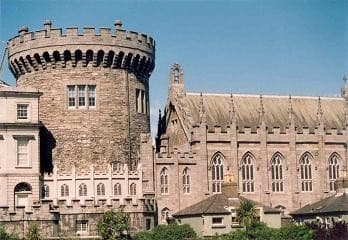
Over time, the medieval curtain walls and towers were modified or replaced with more refined Georgian structures, but some elements of the original fortifications remain visible. The castle complex includes gatehouses, battlements, and courtyards that reflect its layered history of military and administrative use.
Cultural and tourist importance
As a major tourist attraction in Dublin, the castle offers visitors a chance to explore Ireland's complex history through its architecture and exhibitions. The blend of medieval and Georgian elements provides insight into the changing political and cultural landscape of Ireland over several centuries.
Visitors can tour the state apartments, the medieval undercroft, and various exhibition spaces that highlight the castle's role in Irish history. The castle also hosts cultural events and conferences, maintaining its status as a vibrant part of Dublin's civic life.
Frequently asked questions (FAQ)
- What is the best time to visit Dublin Castle?
- The best time to visit Dublin Castle is during the spring and summer months when the weather is mild and the castle hosts various cultural events. Weekdays tend to be less crowded, providing a more relaxed experience.
- Can I tour the state apartments inside Dublin Castle?
- Yes, visitors can tour the beautifully restored state apartments, which showcase Georgian architecture and historical artifacts. Guided tours are available to provide detailed historical context.
- Is Dublin Castle accessible for visitors with mobility issues?
- Dublin Castle has made efforts to improve accessibility, including ramps and elevators in key areas. However, some older sections may have limited access due to their historic nature.
- What is the historical significance of Dublin Castle?
- Dublin Castle was the seat of English and later British administration in Ireland for centuries. It played a central role in Irish governance until 1922, when it was handed over to the Irish Provisional Government.
- Are there any nearby attractions to visit after Dublin Castle?
- Nearby attractions include Trinity College Dublin, the Chester Beatty Library, and St. Patrick's Cathedral, all within walking distance and rich in Irish history and culture.
- What are the opening hours and ticket prices for Dublin Castle?
- Dublin Castle is generally open daily from 9:45 AM to 5:45 PM. Ticket prices vary, with discounts available for students, seniors, and groups. It is recommended to check the official website for current rates before visiting.
Photo gallery

Public domain
Information
Address
Dame Street, Dublin, Ireland
Loading map...
Visitor reviews
No reviews yet. Been here? Write the first review and help other travelers!
Write the first reviewVisited this castle? Share your experience
Your review helps other travelers and adds first-hand knowledge to our encyclopedia.