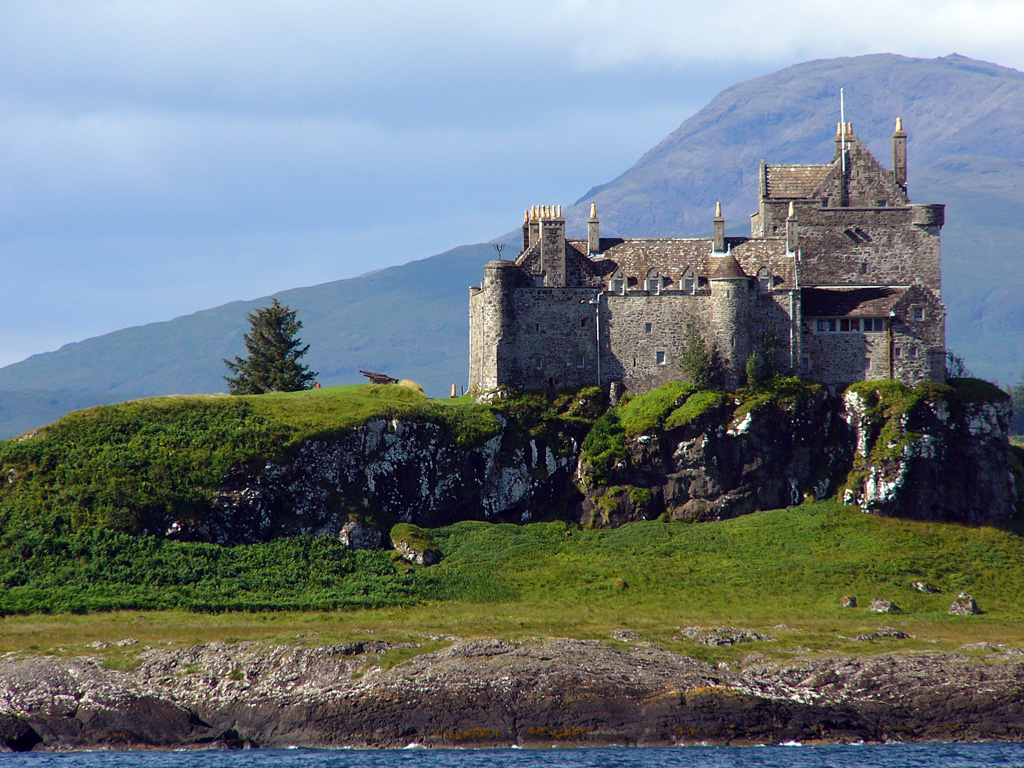
Ardtornish Castle Ruins
Ardtornish Castle is a historically significant hill castle located on a rocky promontory extending into the Sound of Mull in Morvern, Scotland. This castle was a principal stronghold of the Clan Donald from the early 14th century through the late 15th century, playing a pivotal role in the political and military history of the western Highlands. Its strategic location provided commanding views over the seaways, making it an ideal site for controlling maritime routes and regional power.
The origins of the fortress date back to the mid-12th century, linked to the Norse-Gaelic ruler Somerled, a key figure in the formation of the Lordship of the Isles. However, the castle's main period of prominence began in the 14th century when it became a principal seat for the high chiefs of Clan Donald. It was here that John of Islay, the 6th chief and Lord of the Isles, died in the 1380s. His funeral procession famously sailed from Ardtornish across the Sound of Mull to the sacred burial grounds on the Isle of Iona, underscoring the castle's ceremonial importance.
Clan Donald's power center and political significance
Donald of Islay, John’s son and successor, used Ardtornish Castle as a base for governance and military expeditions. From this site, he issued charters in both Latin and Gaelic, demonstrating the administrative sophistication and cultural duality of the lordship. The castle was the launching point for his fleet that sailed to Ross-shire in 1411, aiming to assert his claim to the Earldom of Ross. This campaign culminated in the Battle of Harlaw, a significant and indecisive conflict that marked the struggle for control in northern Scotland.
Negotiations and the Treaty of Ardtornish-Westminster
In 1461, Ardtornish Castle was the venue for a remarkable political event: the negotiation of the Treaty of Ardtornish-Westminster. The last Lord of the Isles, John of Islay’s great-grandson, met with envoys from King Edward IV of England to discuss a pact that would divide Scotland into three parts. Under this treaty, John, along with his ally Donald Balloch of Dunnyvaig and the Glens, and the exiled Earl of Douglas, were to become loyal subjects of England in exchange for control over large territories and financial rewards. The treaty's revelation in 1474 had profound consequences, including the loss of the Earldom of Ross in 1475 and the forfeiture of the Lordship of the Isles in 1493.
Later ownership and decline
After the forfeiture, the lands surrounding Ardtornish passed into royal hands before being granted to the Clan MacLean, whose chief resided at Duart Castle. The MacLeans had already established significant holdings in Morvern. Eventually, the powerful Campbell Earls of Argyll absorbed these estates by the late 17th century. By this time, Ardtornish Castle was likely abandoned and fell into ruin.
Architectural features and ruins
The castle ruins occupy the southern tip of the promontory, offering natural defensive advantages with steep cliffs and commanding views of the surrounding waters. Although detailed architectural records are scarce, the remains suggest a typical medieval fortress layout designed to control both land and sea approaches.
The surviving structures are fragmentary but include portions of curtain walls and foundations that mark the footprint of the original castle. Constructed primarily from local stone, the castle would have featured defensive towers, a gatehouse, and internal chambers typical of the period.
As a scheduled monument, the site is legally protected, preserving its historical and cultural significance. Visitors today can explore the ruins and appreciate the castle's role as a center of clan authority, maritime activity, and political intrigue in medieval Scotland.
Historical and cultural significance
Ardtornish Castle is a symbol of the power and influence of the Lords of the Isles, who wielded considerable autonomy in the western Highlands and islands during the medieval period. The castle's history reflects the complex interplay of Norse, Gaelic, and Scottish cultures, as well as the shifting allegiances and conflicts that shaped Scotland's history.
The castle's association with significant events like the Battle of Harlaw and the Treaty of Ardtornish-Westminster highlights its importance as a political and military hub. Its decline and eventual abandonment mirror the broader decline of the Lordship of the Isles and the consolidation of royal authority in Scotland.
Visiting Ardtornish Castle
Today, Ardtornish Castle ruins are accessible to visitors interested in Scottish history and medieval architecture. The site offers spectacular views of the Sound of Mull and the surrounding landscape. While the ruins are extensive, visitors should be prepared for uneven terrain and limited facilities.
As an important heritage site, Ardtornish Castle provides insight into the medieval clan system, maritime power, and the turbulent history of the Scottish Highlands.
Frequently asked questions (FAQ)
- How do I get to Ardtornish Castle?
- Ardtornish Castle is located on a promontory in Morvern, Highland, accessible by road from the village of Lochaline. Visitors should use local maps or GPS for precise directions, as the site is in a remote area.
- What is the historical significance of Ardtornish Castle?
- Ardtornish Castle was a principal seat of Clan Donald and the site of the 1461 Treaty of Ardtornish-Westminster. It played a key role in medieval Scottish politics and clan history.
- Can I visit the ruins of Ardtornish Castle?
- Yes, the ruins of Ardtornish Castle are open to the public. Visitors can explore the site, though facilities are limited and the terrain can be uneven, so appropriate footwear is recommended.
- When was Ardtornish Castle built?
- The main construction of Ardtornish Castle dates to the 14th century, although the site had earlier fortifications dating back to the mid-12th century.
- Why is Ardtornish Castle important in Scottish history?
- Ardtornish Castle was central to the power of the Lords of the Isles, hosting significant events such as the Battle of Harlaw campaign and the Treaty of Ardtornish-Westminster negotiations, which influenced Scotland's political landscape.
Information
Website
Visit websiteSources & official resources
Verify the information above using these authoritative references.
Loading map...
Visitor reviews
No reviews yet. Been here? Write the first review and help other travelers!
Write the first reviewVisited this castle? Share your experience
Your review helps other travelers and adds first-hand knowledge to our encyclopedia.