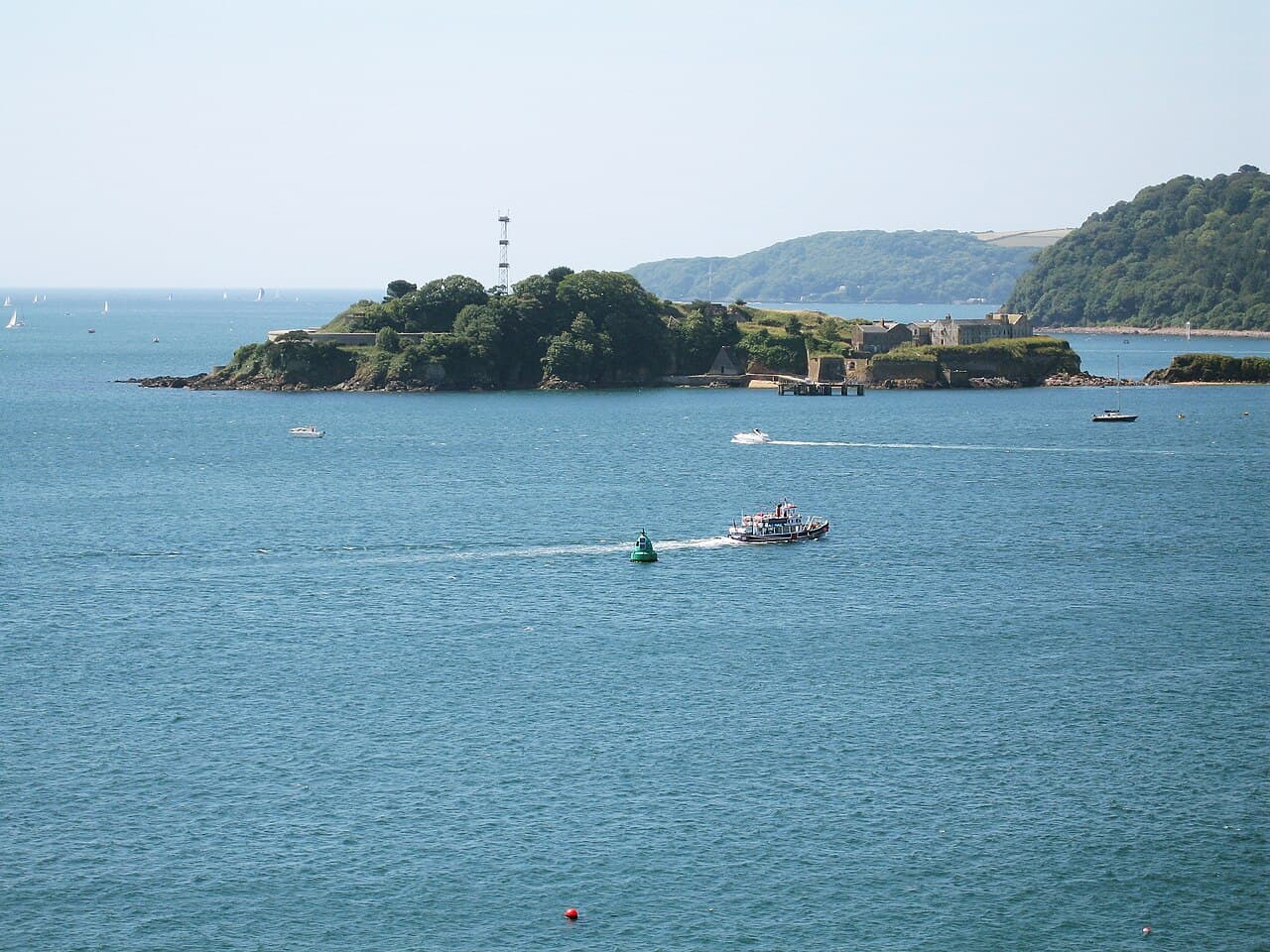
Drake's Island is a small but historically significant island located approximately 500 metres off the coast of Plymouth in Devon, United Kingdom. Covering an area of about 6.5 acres (2.6 hectares), the island lies in Plymouth Sound, a natural harbor that has played a crucial role in maritime defense for centuries. The island's geological composition includes volcanic tuff and lava, alongside marine limestone from the Devonian period, which has influenced its rugged terrain and strategic suitability for fortification.
For over four centuries, Drake's Island has been fortified to protect the naval approaches to Plymouth, one of Britain's most important naval ports. Its fortifications reflect a layered history of military architecture, evolving through the 16th century to the 20th century, adapting to changing defensive needs and advances in artillery technology.
Early history and strategic importance
The island's name is traditionally linked to Sir Francis Drake, the famed Elizabethan sea captain and privateer, who is believed to have used the island as a base or lookout point during the late 16th century. While direct documentary evidence of Drake's occupation is limited, the island's military use dates back at least to the 16th century, when England faced threats from European powers such as Spain.
Drake's Island's location at the entrance to Plymouth Sound made it a key defensive position controlling access to the harbor and the naval dockyards. Its proximity to the mainland allowed for easy communication and supply, while its isolation provided a natural defensive advantage.
Fortifications and architectural evolution
16th and 17th centuries
The earliest fortifications on Drake's Island were constructed in the 16th century, likely as part of the coastal defense improvements initiated under the reign of Henry VIII and later expanded during the Elizabethan era. These initial defenses included simple stone walls and gun platforms designed to mount cannon to deter enemy ships.
18th and 19th centuries
In the 18th century, the island's defenses were upgraded with the construction of more substantial stone batteries and barracks to accommodate a garrison. The fortifications were adapted to withstand the increasing power of naval artillery and to serve as a deterrent against French and Spanish naval threats during periods of conflict such as the Napoleonic Wars.
The 19th century saw further enhancements, including the installation of rifled muzzle-loading guns and the modernization of defensive walls. The island was integrated into the wider network of coastal defenses known as the Palmerston Forts, a series of fortifications built in response to perceived threats from France under Napoleon III. These upgrades included thickened walls, improved gun emplacements, and underground magazines for ammunition storage.
20th century and later use
During both World Wars, Drake's Island continued to serve as a military installation, with updated armaments and communications equipment. The island's role shifted somewhat as air power and modern naval tactics evolved, but it remained a key part of Plymouth's coastal defense system.
After World War II, the island's military significance declined, and it was eventually decommissioned. In recent decades, Drake's Island has been the subject of conservation efforts and proposals for redevelopment, reflecting its cultural and historic value.
Architectural features and layout
The fortifications on Drake's Island include a variety of military architectural elements typical of coastal defense installations. These include stone curtain walls, bastions, gun batteries, magazines, and barracks. The island's topography has been shaped to maximize defensive capabilities, with elevated positions for artillery and clear lines of sight over Plymouth Sound.
The surviving structures exhibit a range of construction techniques and materials, from early masonry work to later use of concrete and iron for gun mounts. The layout reflects the evolution of military engineering principles over several centuries, adapting to new threats and technologies.
Cultural significance and preservation
Drake's Island is recognized for its historical importance as part of Britain's coastal defense heritage. It has attracted interest from historians, archaeologists, and conservationists aiming to preserve its remains and interpret its story for the public.
The island is currently in a partially preserved condition, with many fortifications intact but requiring ongoing maintenance. Access to the island is limited, and there have been various proposals to open it to visitors as a heritage site, balancing preservation with public engagement.
Frequently asked questions (FAQ)
- How do I get to Drake's Island?
- Drake's Island is accessible by ferry from the mainland. Regular services operate from Plymouth, providing a scenic journey to this historic site.
- What is the historical significance of Drake's Island?
- Drake's Island has a rich history, having served as a military base since the 16th century. It played a crucial role in the defense of Plymouth and was named after the famous explorer Sir Francis Drake.
- When was Drake's Island originally constructed?
- Drake's Island was originally constructed in the late 16th century, with various fortifications added over the centuries. Its strategic location has made it an important military site throughout British history.
- Can I explore the island on my own?
- While some areas of the island are accessible for exploration, guided tours are recommended to fully appreciate its history and architecture. This ensures visitors receive informative insights about the site's significance.
- Is it possible to visit Drake's Island year-round?
- Drake's Island is open to visitors from April to October, with varying hours depending on the season. It is advisable to check the official website for the most current visiting hours and ferry schedules.
- What are the ticket prices for visiting Drake's Island?
- Tickets for Drake's Island tours are reasonably priced, with discounts available for children and families. It's best to purchase tickets in advance, especially during peak tourist season to guarantee your spot.
- What is the best time to visit Drake's Island?
- The best time to visit Drake's Island is during the late spring and summer months when the weather is generally warm and pleasant. This allows for a more enjoyable experience while exploring the outdoor areas of the island.
- Are there any nearby attractions to visit while at Drake's Island?
- Yes, nearby attractions include the historic city of Plymouth, the iconic Mayflower Steps, and the National Marine Aquarium. These sites complement a visit to Drake's Island and provide a richer understanding of the area's maritime history.
- Is Drake's Island accessible for visitors with mobility challenges?
- Drake's Island has some accessibility options, but due to its historic nature, certain areas may be challenging to navigate for visitors with mobility issues. It's advisable to contact the visitor center for specific accessibility information before planning your trip.
Photo gallery

Photo by Janipewter•Public domain
Information
Loading map...
Visitor reviews
No reviews yet. Been here? Write the first review and help other travelers!
Write the first reviewVisited this castle? Share your experience
Your review helps other travelers and adds first-hand knowledge to our encyclopedia.