Trematon Castle
Trematon Castle stands as a significant example of a 12th-century motte-and-bailey castle in Cornwall, England. Situated near Saltash, it occupies a commanding position overlooking the Plymouth Sound and the Lynher River. This fortress was likely constructed by Robert, Count of Mortain, half-brother to William the Conqueror, on the site of an earlier Roman fort. The castle served as the caput of the feudal barony of Trematon and played a key role in the Norman consolidation of power in the region shortly after the Norman Conquest of 1066.
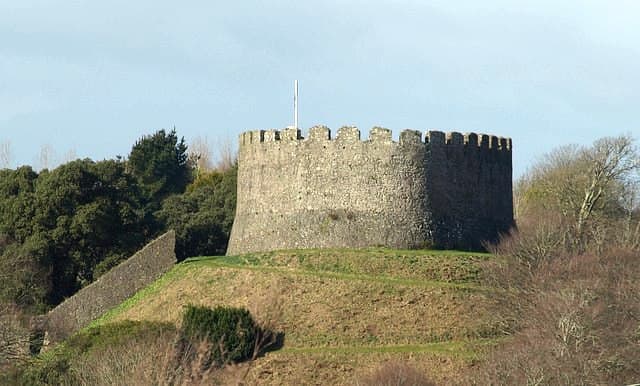
The castle’s design reflects the typical Norman military architecture of the High Medieval period, featuring a large motte topped by a distinctive stone shell keep. This oval-shaped keep, with walls approximately 10 feet thick and rising about 30 feet high, encloses an internal diameter of roughly 21 meters. The substantial stonework remains largely intact, allowing visitors to clearly discern the castle’s original form. Trematon shares architectural similarities with Restormel Castle, particularly in the use of a stone shell keep raised upon an earlier motte.
Historical background and ownership
Before the Norman period, the site had long-standing importance, believed to be linked with the rulers of Cornwall, such as Condor of Cornwall, a figure associated with pre-10th century regional leadership. After the Norman Conquest, the castle was granted to Robert, Count of Mortain, who established the motte-and-bailey fortress to secure Norman control.
By 1086, Reginald de Vautort was recorded as the lord of Trematon, initiating the Vautort family's long tenure throughout the 12th century. The Vautorts also controlled ferry rights over the nearby River Tamar until 1270. That year, the castle and manor were sold by Roger de Vautort to Richard, Earl of Cornwall, for £300. Subsequently, the castle remained under the ownership of the earls and later the dukes of Cornwall.
Before the establishment of the Duchy of Cornwall in 1337, Trematon was one of the four principal residences of the Cornish earls, alongside Launceston, Restormel, and Liskeard castles. The castle’s strategic location allowed it to oversee land and river approaches, particularly controlling access to Plymouth Sound.
Architectural features and defensive structures
Trematon Castle is centered on its motte, a raised earthwork mound surmounted by the stone shell keep. This keep is oval in shape, with thick walls designed to withstand siege weaponry of the medieval period. The keep’s interior space was used for defensive and residential purposes, typical of Norman military construction.
Adjacent to the motte stands a rectangular gatehouse constructed around 1270. This two-story gatehouse features a portcullis and served as the main entrance to the castle. The gatehouse’s preservation is notable, retaining much of its original medieval fabric and defensive function. Its design reflects the evolution of castle fortifications in the late 13th century, emphasizing controlled access and security.
The castle’s curtain walls, though partly ruined, still reveal the Norman masonry techniques and the layout of the bailey. The castle’s position on elevated ground provided natural defense advantages, with views extending over the Plymouth Sound and adjacent waterways.
Later history and adaptations
By the 16th century, Trematon Castle had begun to fall into partial ruin but continued to serve functional roles. In 1542, the antiquarian John Leland documented the castle’s use as a prison, noting the survival of a substantial dungeon. The castle also played a role in England’s maritime history; in 1580, treasures from Sir Francis Drake’s circumnavigation were temporarily stored here before being transferred to the Tower of London.
In the 18th and 19th centuries, the site saw further adaptation with the construction of a Georgian house within the castle courtyard around 1808. This residence included multiple reception rooms, bedrooms, and servants’ quarters. To afford scenic views, a section of the original castle wall was removed, illustrating the blend of medieval and Georgian architecture on the site.
During the 20th century, the castle was leased by the Duchy of Cornwall and served as the home of Hugh Foot, Lord Caradon, and his family. The site attracted royal attention when Queen Elizabeth II visited in 1962. More recently, the castle has been leased by landscape and interior design professionals who developed gardens and occasionally operated it as a temporary hotel, demonstrating adaptive reuse while preserving its historic character.
Current condition and visitor experience
Trematon Castle remains a partially preserved medieval fortress, with much of the Norman walls and the gatehouse in good condition. Visitors can explore the stone shell keep and the rectangular gatehouse, gaining insight into Norman military architecture and medieval defensive strategies.
The castle’s elevated location offers panoramic views of the surrounding countryside and the Plymouth Sound, enhancing its historical role as a sentinel site. The presence of the Georgian house adds a unique layer of historical interest, illustrating the site’s continuous occupation and adaptation over centuries.
Today, Trematon Castle is open to the public, providing access to its grounds and ruins. Its rich history, architectural features, and scenic setting make it a valuable heritage site in Cornwall, attracting visitors interested in medieval castles, Norman history, and English heritage.
Frequently asked questions (FAQ)
- How do I get to Trematon Castle?
- Trematon Castle is located near Saltash in Cornwall, England. It is accessible by car and public transport, with parking available nearby. The castle is about one and a half miles southeast of Trematon village.
- What are the opening hours of Trematon Castle?
- Trematon Castle is generally open to the public during daylight hours, though specific opening times can vary seasonally. Visitors are advised to check ahead for current visiting hours before planning their visit.
- Is there an entrance fee to visit Trematon Castle?
- Access to Trematon Castle grounds is often free or charged at a nominal fee, depending on the season and any special events. It is best to verify ticket prices locally or on the official site before visiting.
- What is the historical significance of Trematon Castle?
- Trematon Castle was a key Norman stronghold built soon after the Norman Conquest, serving as the caput of the feudal barony of Trematon. It played a strategic role in controlling Plymouth Sound and was one of the main residences of the Cornish earls.
- Can I explore the interior of Trematon Castle?
- Visitors can explore the remains of the stone shell keep and the well-preserved rectangular gatehouse. While much of the interior is in ruins, these structures provide insight into medieval defensive architecture.
- Why is Trematon Castle important in maritime history?
- In 1580, treasures from Sir Francis Drake’s circumnavigation voyage were temporarily stored at Trematon Castle before being sent to the Tower of London, linking the site to England’s maritime heritage.
Photo gallery

Information
Website
Visit websiteSources & official resources
Verify the information above using these authoritative references.
Loading map...
Visitor reviews
No reviews yet. Been here? Write the first review and help other travelers!
Write the first reviewVisited this castle? Share your experience
Your review helps other travelers and adds first-hand knowledge to our encyclopedia.